

25 km from Earth: India gains a rare feat in near-space tech
Business Standard
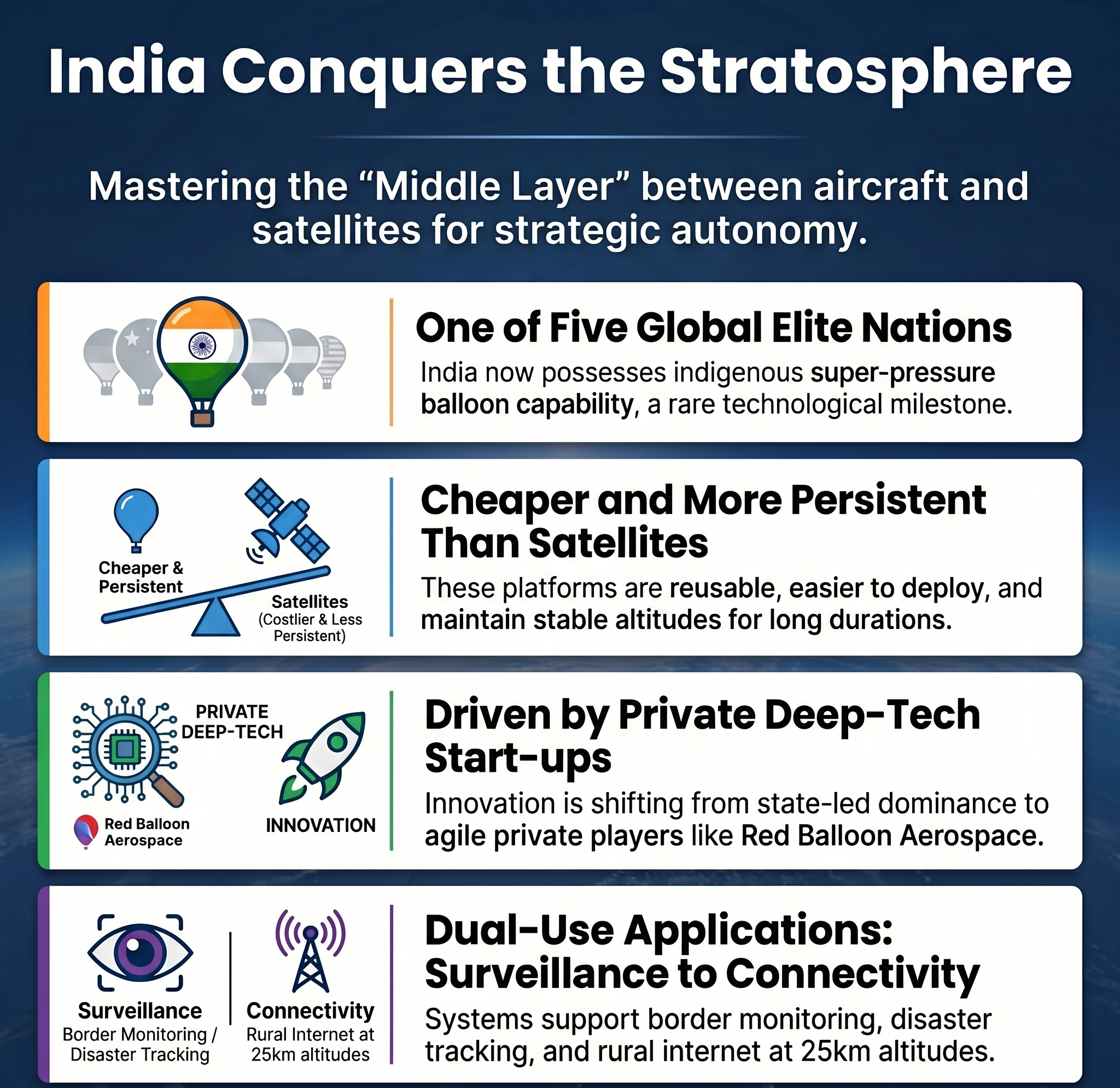
1. Core Arguments of the Article
India has achieved a rare technological capability
The article’s central claim is that:
- India has become one of only five countries with indigenous super-pressure stratospheric balloon capability.
This is portrayed as:
- A strategic technological milestone.
Near-space is an underutilised strategic domain
The article explains that:
- The stratosphere (20–50 km altitude) remains relatively underexploited despite major applications.
It positions near-space as:
- Cheaper than satellites,
- More persistent than aircraft,
- Operationally flexible.
Private Indian start-ups are driving innovation
A major emphasis is placed on:
- Red Balloon Aerospace,
- Indigenous innovation,
- Fast development timelines,
- Commercial scalability.
This reflects the emerging role of:
- India’s private aerospace ecosystem.
Near-space platforms have multiple civilian and military applications
The article highlights uses such as:
- Telecommunications,
- Earth observation,
- Disaster monitoring,
- Navigation,
- Persistent surveillance,
- Scientific experiments.
India can become a global player in emerging space technologies
The article presents the mission as:
- An indicator of India’s rising technological ambition and competitiveness.
2. Author’s Stance
Strongly optimistic and techno-nationalist
The article clearly celebrates:
- India’s technological advancement.
The tone is:
- Aspirational,
- Nationalistic,
- Innovation-centric.
Supportive of private-sector-led innovation
The author strongly endorses:
- Start-up-driven aerospace innovation,
- Commercial space ecosystems,
- Indigenous technological capability.
Strategic confidence
The article views near-space technology as:
- A force multiplier for India’s strategic autonomy.
3. Hidden Assumptions and Biases
A. Technological optimism bias
The article assumes:
- Technological innovation will naturally translate into strategic and economic gains.
However:
- Commercial viability,
- Regulatory clarity,
- Long-term sustainability,
remain uncertain.
B. Limited discussion of security concerns
The article underplays:
- Dual-use military implications,
- Surveillance ethics,
- Airspace governance challenges.
C. Start-up success narrative bias
The article adopts the increasingly common:
- “Indian start-up success” framework.
But it does not critically examine:
- Funding challenges,
- Technological dependency,
- Scalability risks,
- Global competition.
D. Strategic nationalism
The article subtly frames:
- Technological capability as a marker of national prestige.
This reflects a broader global trend where:
- Space and aerospace technologies are linked with geopolitical influence.
4. Understanding Near-Space Technology
What is near-space?
Near-space generally refers to:
- The atmospheric region between aircraft altitudes and outer space,
- Roughly 20–100 km above Earth.
The article specifically focuses on:
- Stratospheric platforms around 25 km altitude.
What are super-pressure balloons?
These are:
- High-altitude balloons designed to remain operational for long durations,
- Maintaining stable altitude despite temperature changes.
Unlike conventional weather balloons:
- They enable persistent observation and communication.
5. Strategic Importance of Near-Space
A. Cost-effective alternative to satellites
Near-space platforms are:
- Far cheaper than satellites,
- Easier to deploy,
- Recoverable and reusable.
This can democratise:
- Aerospace access,
especially for: - Developing countries.
B. Military and surveillance relevance
These platforms can support:
- Border surveillance,
- Maritime monitoring,
- Persistent ISR (Intelligence, Surveillance, Reconnaissance),
- Communication during conflict situations.
This becomes important amid:
- India-China tensions,
- Maritime competition in the Indo-Pacific.
C. Disaster management applications
Near-space systems can aid:
- Flood monitoring,
- Cyclone tracking,
- Communication restoration during disasters.
This aligns with India’s:
- Climate adaptation needs.
D. Bridging connectivity gaps
These platforms can support:
- Rural internet connectivity,
- Remote communications,
- Emergency response systems.
6. Science & Technology Dimensions
Emergence of indigenous aerospace capability
The article reflects India’s transition from:
- Import dependence,
toward: - Indigenous deep-tech innovation.
Commercialisation of space technology
India’s space ecosystem is moving from:
- Purely state-led ISRO dominance,
to: - Public-private collaboration.
Rapid innovation ecosystem
The article highlights:
- Speed of development,
- Agile engineering,
- Commercial deployment models.
This reflects:
- Start-up-led innovation culture.
7. Economic Implications
A. Growth of India’s space economy
India seeks to expand its:
- Global space-tech market share.
Near-space technologies may open opportunities in:
- Data services,
- Earth observation,
- Telecom infrastructure,
- Logistics.
B. Employment and high-skill ecosystem
The sector can create:
- High-skilled engineering jobs,
- Aerospace manufacturing ecosystems,
- R&D networks.
C. Export potential
If India scales such technologies:
- It can become a supplier to Global South nations seeking affordable aerospace systems.
8. Critical Concerns and Limitations
A. Regulatory vacuum
Near-space governance remains poorly defined globally.
Questions arise regarding:
- Airspace jurisdiction,
- Privacy,
- Surveillance legality,
- Security permissions.
India lacks a fully evolved:
- Near-space regulatory architecture.
B. Dual-use militarisation risks
Technologies developed for:
- Civilian communication,
can also serve: - Military surveillance.
This may intensify:
- Strategic competition.
C. Sustainability and operational challenges
Long-duration atmospheric platforms face:
- Weather instability,
- Material stress,
- Navigation challenges,
- Recovery difficulties.
D. Overhype risk
Many emerging technologies receive:
- Excessive media optimism before commercial maturity.
The article does not sufficiently examine:
- Economic feasibility,
- Long-term scalability,
- Market competition from satellites and drones.
9. India’s Broader Space Ecosystem
The article fits into India’s larger strategic transition:
From:
- State-controlled space programme,
Toward:
- Commercial space ecosystem.
This includes:
- IN-SPACe reforms,
- Start-up participation,
- Private launch systems,
- Space-tech investment.
10. National Security Perspective
Near-space systems may become critical for:
- Modern warfare,
- Border monitoring,
- Strategic communications.
This is especially important because:
- Satellites are expensive and vulnerable,
while: - Near-space platforms are flexible and replaceable.
11. Real-World Global Context
Countries investing heavily in near-space technologies include:
- United States,
- China,
- Japan,
- France.
China in particular has aggressively developed:
- High-altitude surveillance balloons,
- Near-space ISR capabilities.
Thus, India’s entry reflects:
- Geopolitical technological competition.
12. UPSC GS Paper Linkages
GS Paper III
Relevant themes:
- Science and technology
- Indigenous technology
- Space technology
- Internal security
- Disaster management
GS Paper II
Relevant themes:
- Governance of emerging technologies
- Public-private partnerships
- Strategic policy frameworks
Essay Topics
Potential themes:
- “Technology and strategic sovereignty”
- “Innovation as a driver of national power”
- “India’s rise in the space economy”
13. Pros Highlighted by the Article
Technological self-reliance
Promotes:
- Indigenous aerospace innovation.
Cost-effective infrastructure
Near-space systems can:
- Reduce dependence on expensive satellites.
Strategic flexibility
Supports:
- Surveillance,
- Communications,
- Disaster response.
Boost to start-up ecosystem
Encourages:
- Deep-tech entrepreneurship.
14. Weaknesses of the Article
Insufficient critical scrutiny
The article is highly celebratory and does not deeply examine:
- Risks,
- Governance gaps,
- Commercial viability.
Limited ethical discussion
No substantial focus on:
- Surveillance ethics,
- Privacy concerns,
- Militarisation risks.
Overemphasis on symbolic achievement
Joining “five nations” is important symbolically, but:
- Long-term operational capability matters more than headline achievement.
15. Policy Implications
India may now need:
A Near-Space Policy Framework
Covering:
- Airspace governance,
- Commercial licensing,
- Security protocols.
Public-private coordination
Between:
- ISRO,
- Defence agencies,
- Start-ups,
- Academia.
Investment in deep-tech R&D
Including:
- Materials science,
- Atmospheric engineering,
- Communication systems.
International cooperation
On:
- Near-space governance norms,
- Strategic transparency,
- Civilian applications.
16. Broader Strategic Interpretation
The article reflects a larger transformation in global geopolitics:
Earlier:
- Power depended on land, sea, and conventional air dominance.
Today:
- Control over:
- Space,
- Cyber,
- AI,
- Near-space,
has become equally important.
Near-space platforms may become:
- The “middle layer” between drones and satellites.
This has implications for:
- Warfare,
- Communications,
- Commercial intelligence,
- Strategic autonomy.
17. Balanced Conclusion
The article effectively highlights India’s important breakthrough in near-space technology and successfully positions it within the broader context of:
- Strategic autonomy,
- Aerospace innovation,
- Emerging commercial opportunities.
Its strongest contribution lies in explaining that:
- Near-space technology could become a cost-effective and flexible alternative to traditional satellite systems.
The article also rightly celebrates:
- Indigenous innovation,
- Private-sector participation,
- India’s expanding technological capabilities.
However, the piece adopts a strongly optimistic tone and insufficiently examines:
- Regulatory gaps,
- Militarisation risks,
- Commercial uncertainties,
- Ethical concerns related to surveillance technologies.
Technological capability alone does not guarantee:
- Strategic success,
- Commercial leadership,
- Sustainable ecosystems.
The real challenge lies in:
- Building scalable infrastructure,
- Ensuring governance frameworks,
- Maintaining technological competitiveness,
- Creating long-term industrial capacity.
18. Future Perspective
Near-space technology may emerge as one of the most strategically important technological frontiers of the coming decade.
For India, success will depend not merely on:
- Symbolic achievements,
but on: - Sustained R&D,
- Industrial scaling,
- Regulatory maturity,
- International competitiveness.
If properly developed, near-space systems could strengthen:
- National security,
- Disaster resilience,
- Digital connectivity,
- Scientific research,
- India’s role in the global space economy.
India’s challenge now is to convert:
- Technological demonstration,
into: - Sustainable strategic capability.
