

35 Years of Economic Liberalisation: Lessons from the 1991 Crisis

Source: The Hindu
Why in News?
India is marking 35 years of the 1991 economic reforms. Shyam Saran, who was associated with the PMO during the 1991 Balance of Payments (BoP) crisis, recalled the circumstances that pushed India towards major economic reforms.
1991: The Balance of Payments Crisis
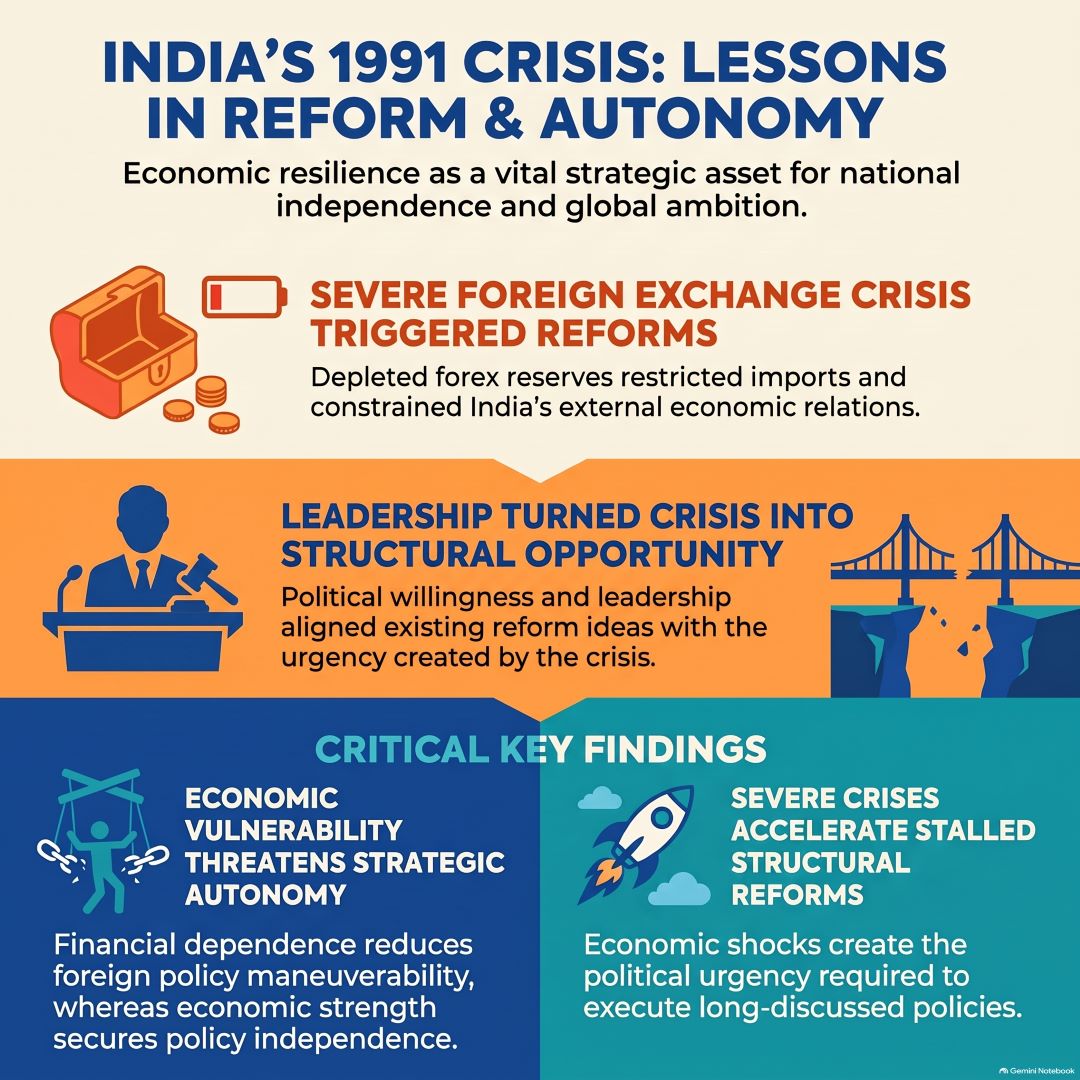
India entered 1991 with a severe foreign-exchange crisis and growing difficulties in meeting external payment obligations.
- Foreign-exchange reserves had fallen sharply, creating difficulty in financing essential imports and external liabilities.
- The crisis emerged during the Chandra Shekhar government and continued after the P.V. Narasimha Rao government assumed office.
- Efforts to secure external financial assistance had already begun before the Rao government came to power.
- Taiwan and Japan were among the possible sources explored for additional foreign-currency support.
The crisis was therefore not merely a domestic economic problem; it also constrained India's ability to manage its external economic relations and strategic choices.
From Crisis to Structural Reform
The 1991 reforms were not entirely conceived after the crisis. Several reform ideas and discussions were already underway.
However, the deepening BoP crisis created the urgency and political space required to implement reforms on a much wider scale.
- P.V. Narasimha Rao provided the political leadership.
- Manmohan Singh, as Finance Minister, played a central role in implementing the reform programme.
- A.N. Verma, Principal Secretary to the Prime Minister, was identified as an important figure in advancing the reform blueprint.
Thus, the 1991 transformation resulted from the convergence of:
Earlier reform thinking + Economic crisis + Political willingness + Institutional leadership
Key Lessons from 1991
|
1. Economic strength and strategic autonomy The crisis demonstrated that economic vulnerability can limit strategic autonomy. Dependence on external financial assistance can reduce a country's room for manoeuvre in foreign policy. A stronger and more resilient economy, therefore, provides greater capacity to pursue an independent external policy. 2. Crisis can accelerate structural reform The 1991 experience shows that a major economic crisis can create the conditions for implementing reforms that may have been discussed for years but lacked sufficient political urgency. 3. Domestic economic resilience matters for foreign policy Economic capability is closely linked with India's ability to manage external pressures, maintain policy autonomy and pursue wider strategic objectives. 4. Regional strength supports global ambitions The experience also underlines the importance of a stable and economically integrated neighbourhood. India's broader global role is closely connected with:
|
Way Forward
The central lesson from 1991 is that economic resilience is not only a development objective but also a strategic asset. Sustained economic strength can expand India's policy space, strengthen its external engagement and support its wider global ambitions.
