

35 Years of Economic Liberalisation: Lessons from the 1991 Crisis

Why in News?
- Shyam Saran, who served as Joint Secretary in the Prime Minister’s Office (PMO) from 1991 to 1992, recalled the economic situation surrounding India’s 1991 Balance of Payments (BoP) crisis.
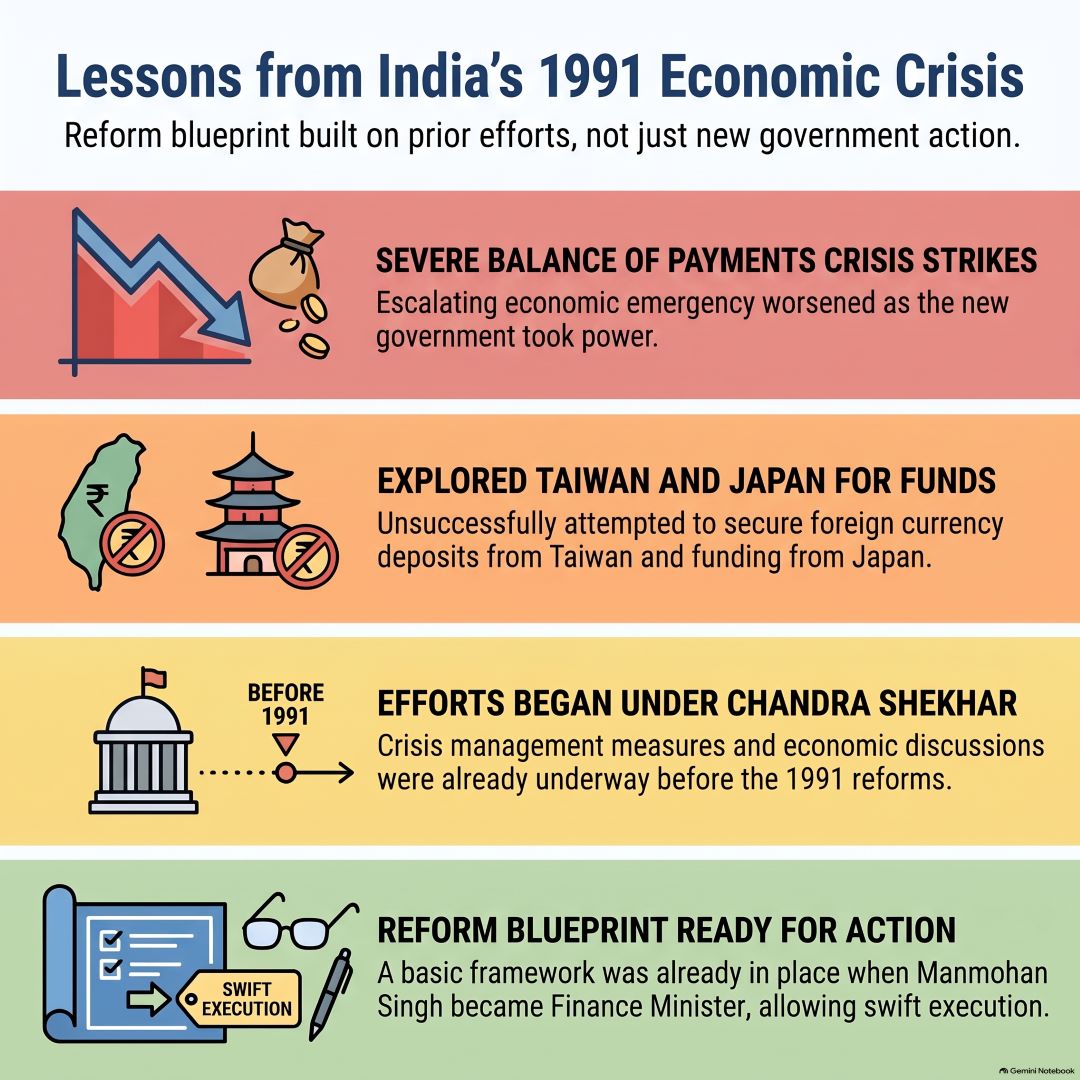
- He noted that India faced a severe economic crisis and that efforts to address the situation had already begun before the P.V. Narasimha Rao government came to power.
- The crisis continued into the new government and became even more severe.

About the 1991 Crisis
- Before joining the PMO, Saran was Joint Secretary in the Ministry of External Affairs and was responsible for East Asia.
- The government explored several sources of foreign currency to manage the crisis.
- Taiwan was considered as a possible source of foreign currency deposits, but the effort did not work.
- Japan was also explored as a possible source of funds.

- The Chandra Shekhar government had already been attempting to find ways to manage the crisis before the new government took office.
- Discussions on several economic measures were already underway before the 1991 reforms, but they were not pursued in as focused and coordinated a manner as they were after the new government came in.
- According to Saran, when Manmohan Singh became Finance Minister, the basic blueprint for the reforms was already in place, and the new government was able to take it forward.
