

A 23-year-old drank water from a well and broke a social order
The Hindu
1. Key Arguments
A. Symbolism of Everyday Resistance
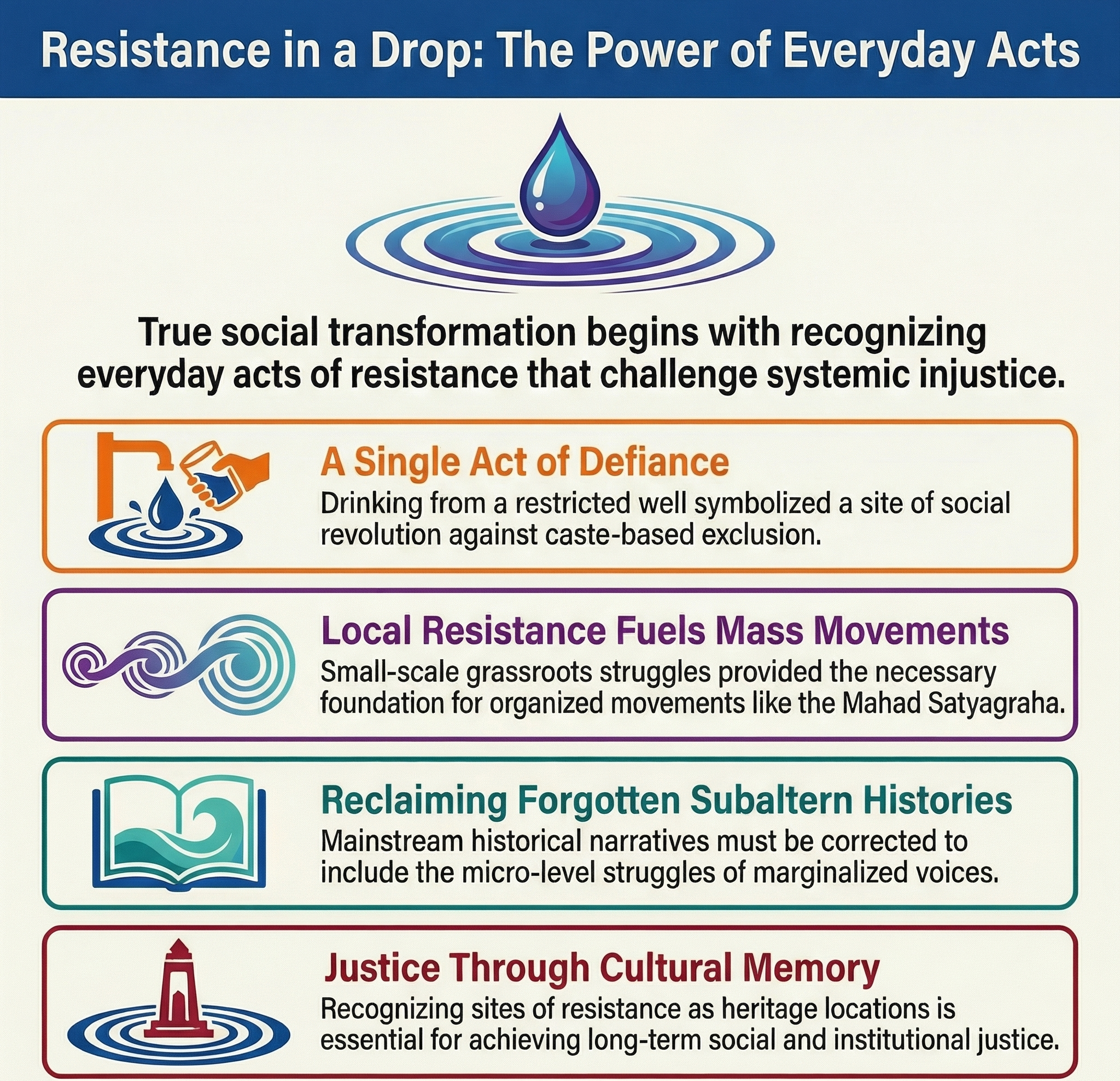
Access to water became a site of social revolution.
The act of a Dalit youth drinking from a well symbolised defiance against caste-based exclusion.
B. Precursor to Larger Movements
Local struggles preceded organised mass movements.
Events like Mahad Satyagraha were built on such grassroots resistance.
C. Erasure of Subaltern Histories
Local contributions are absent from mainstream historical narratives.
Dominant historiography overlooks micro-level struggles.
D. Persistence of Caste Discrimination
Caste-based exclusion continues in various forms.
The article connects historical discrimination with contemporary realities.
E. Need for Recognition and Preservation
Sites and stories of resistance require institutional acknowledgement.
Memory, heritage, and justice are interconnected.
2. Author’s Stance
Empathetic and corrective
Focus on marginalised voices
Highlights overlooked narratives of Dalit resistance.
Critique of historical neglect
Questions why such events remain forgotten.
3. Biases and Limitations
Subaltern emphasis bias
Strong focus on marginalised narratives may underplay broader historical context.
Limited counter-perspective
Does not explore reasons for historiographical gaps.
Emotive tone
Relies on moral appeal more than analytical depth.
4. Strengths (Pros)
Humanises historical struggle
Focus on individual act makes issue relatable.
Highlights neglected history
Adds depth to understanding of social movements.
Strong social justice perspective
Aligns with constitutional values of equality.
5. Weaknesses (Cons)
Limited analytical depth
More narrative than critical examination.
Lack of broader historical linkage
Could better connect with national-level movements.
Policy discussion is implicit, not explicit
Needs clearer recommendations.
6. Policy Implications
A. Inclusive Historiography
Recognising subaltern contributions in history writing
Curriculum reforms and documentation.
B. Preservation of Historical Sites
Declaring important sites as heritage locations
Promoting awareness and tourism.
C. Strengthening Social Justice Frameworks
Ensuring access to public resources without discrimination
Effective implementation of laws.
D. Awareness and Education
Promoting anti-caste values through education
Building inclusive society.
E. Community Participation
Involving local communities in preserving history
Decentralised cultural governance.
7. Real-World Impact
Social Impact
Reclaiming dignity and identity of marginalised groups
Strengthening social justice discourse.
Cultural Impact
Broadening historical narratives
Inclusive representation of past.
Political Impact
Influencing debates on reservation and caste policies
Shaping public discourse.
Challenges
Resistance to rewriting dominant narratives
Political and ideological contestation.
8. UPSC GS Paper Linkages
GS Paper I (Society & History)
- Caste system
- Social reform movements
GS Paper II (Governance)
- Social justice
- Inclusion policies
GS Paper IV (Ethics)
- Equality and dignity
- Justice
9. Balanced Conclusion
The article successfully foregrounds a forgotten episode of resistance, but requires deeper analytical engagement to connect it with broader socio-political processes.
Recognition of such histories is essential for an inclusive understanding of India’s past.
10. Future Perspective
Rewriting inclusive histories
Integrating marginalised voices into mainstream narratives.
Strengthening anti-discrimination mechanisms
Ensuring equality in practice.
Promoting cultural memory
Institutional recognition of historical sites.
Bridging past and present
Using history to inform contemporary social justice policies.
Final Insight
True social transformation begins with recognising everyday acts of resistance that challenge injustice—history must remember not just movements, but moments.
