

A blueprint for all-round growth
The Tribune
I. Core Theme
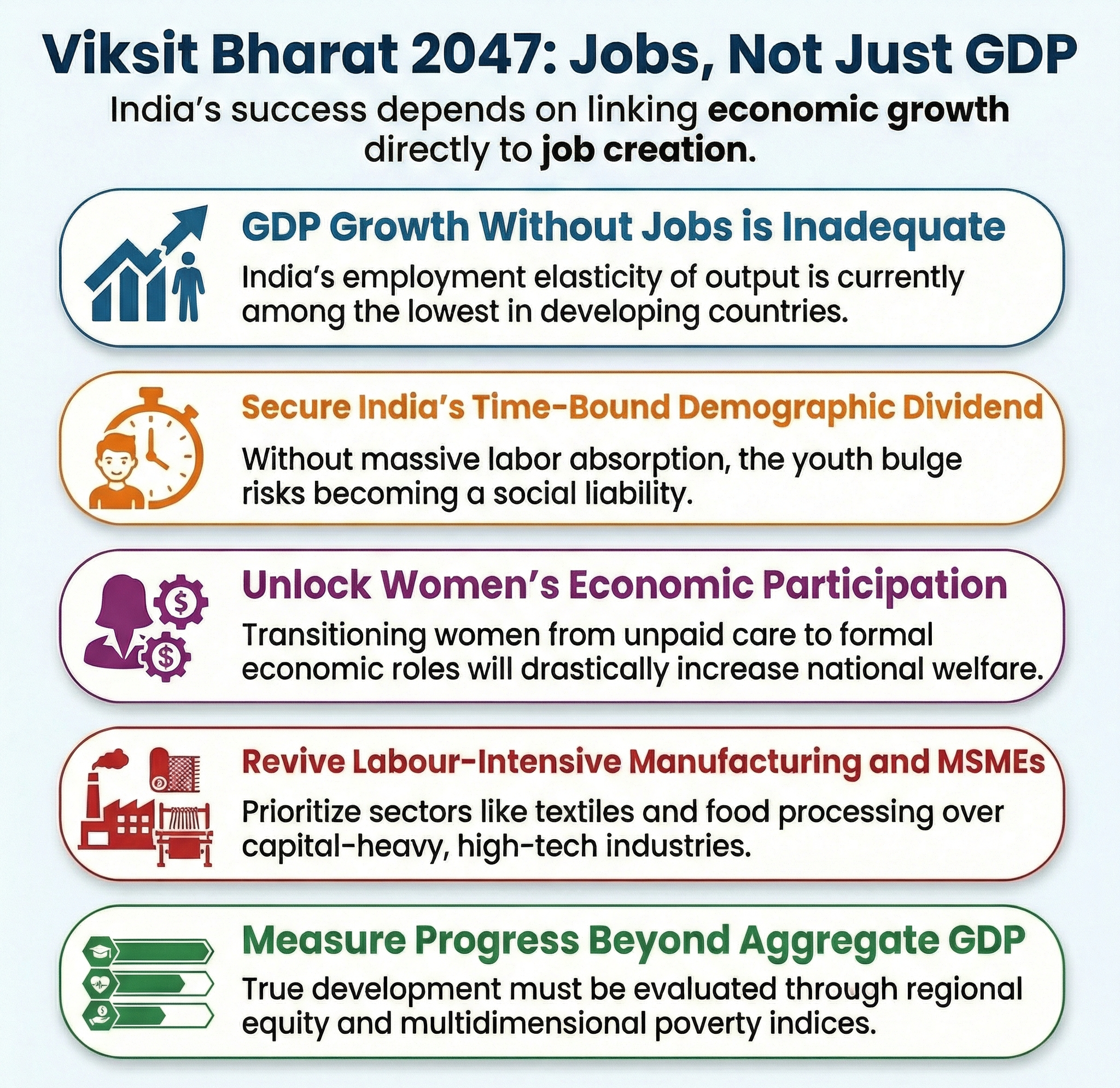
The article argues that India’s Viksit Bharat 2047 vision must shift from a narrow GDP-centric growth model to an inclusive, employment-intensive, and socially equitable development framework. It critiques capital-heavy growth patterns and calls for broader participation in economic gains.
II. Key Arguments Presented
1. GDP Growth Without Employment Is Inadequate
The article highlights:
- India’s employment elasticity of output is among the lowest in developing countries.
- Growth has been driven by capital-intensive sectors rather than labour-intensive manufacturing.
- Rising GDP has not proportionately reduced inequality or informalisation.
The core concern is the disconnect between growth and job creation.
2. Demographic Dividend at Risk
India’s youth bulge is described as:
- A potential dividend if productive employment is generated.
- A demographic liability if unemployment persists.
The author warns that without labour absorption, social instability may increase.
3. Women’s Labour Force Participation
A central point is:
- Women’s unpaid care work and informal sector presence remain high.
- Pulling women into formal economic enterprises could significantly raise GDP and social welfare.
The article stresses structural barriers, including caregiving burdens and informality.
4. Manufacturing and MSMEs as Engines
The author argues for:
- Reviving labour-intensive manufacturing.
- Strengthening MSMEs.
- Reducing overdependence on capital-intensive sectors like high-end technology.
It suggests that inclusive growth must be employment-rich.
5. Measuring Progress Beyond GDP
The article implies:
- Growth must be evaluated regionally and socially.
- Distributional outcomes matter as much as aggregate output.
This aligns with broader global debates on multidimensional development.
III. Author’s Stance
The tone is reformist and developmentalist.
The author clearly:
- Supports inclusive, labour-driven growth.
- Critiques inequality and capital concentration.
- Favors structural economic rebalancing.
The argument is normative, urging policy recalibration rather than defending status quo growth strategies.
IV. Possible Biases
1. Limited Acknowledgment of Structural Constraints
The article underplays:
- Global competitiveness pressures.
- Automation trends reducing labour demand.
- Fiscal constraints on large-scale employment schemes.
2. Implicit Critique of Current Policy Model
The tone suggests dissatisfaction with:
- Capital-led growth.
- Rising wealth concentration.
However, it does not deeply analyse the gains from capital accumulation in technology, infrastructure, or global integration.
V. Pros and Strengths
• Strong focus on employment elasticity
• Highlights gender dimension of growth
• Recognises demographic urgency
• Moves debate beyond GDP fetishism
• Advocates regionally balanced development
VI. Weaknesses and Gaps
• Limited discussion on productivity enhancement
• No detailed roadmap for labour-intensive revival
• Underestimates global automation pressures
• Does not address labour law rigidities
VII. Policy Implications
1. Labour-Intensive Industrial Policy
Policy must prioritise:
- Textiles, food processing, footwear, furniture, and MSME clusters
- Export-linked employment strategies
- Localised industrial ecosystems
2. Gender-Sensitive Economic Reform
Measures may include:
- Affordable childcare infrastructure
- Flexible work policies
- Skilling women in non-traditional sectors
- Formalisation incentives
3. Human Capital Investment
Investment in:
- Vocational training
- Apprenticeship models
- Skill–industry alignment
is essential for employment-led growth.
4. Balanced Technology Adoption
Technology must:
- Complement labour
- Enhance productivity
- Avoid premature automation in labour-surplus sectors
5. Development Metrics Reform
Adoption of:
- Multidimensional poverty indices
- Employment quality indicators
- Regional disparity measures
to guide policy.
VIII. Real-World Impact
If implemented:
Short-term:
- Increased formalisation of women workers
- Boost to MSMEs
Medium-term:
- Higher employment elasticity
- Reduced regional inequality
Long-term:
- Social stability
- Stronger domestic consumption
- Sustainable demographic dividend
If ignored:
- Rising inequality
- Youth unrest
- Underutilised human capital
IX. UPSC Alignment
GS Paper I
• Population and demographic dividend
• Women and development
GS Paper II
• Inclusive growth policies
• Welfare schemes and governance
GS Paper III
• Employment generation
• Industrial policy
• MSME sector
• Economic growth vs development debate
GS Paper IV
• Equity and justice in policy design
Essay Themes
• Growth vs Development
• Demographic dividend
• Women-led development
• Beyond GDP metrics
X. Balanced Conclusion and Future Perspective
The article makes a persuasive case that India’s aspiration to become a developed nation by 2047 must be anchored in inclusive, employment-rich growth rather than output expansion alone.
However, structural realities—automation, global competition, fiscal prudence—must also inform policy design. A calibrated model combining:
- High-productivity sectors
- Labour-intensive industries
- Gender inclusion
- Regional equity
will be critical.
India’s demographic window is time-bound. The success of Viksit Bharat will ultimately be judged not merely by GDP size but by the breadth of opportunity it creates for its citizens.
