

A broad-based development model
The Hindu
I. Core Thesis and Central Argument
The article argues that Tamil Nadu’s economic performance represents a diversified, resilient, and inclusive development model, driven by a balanced mix of manufacturing, services, infrastructure, social sector investment, and state-led industrial policy. It presents Tamil Nadu as a counter-example to growth models overly dependent on a single sector, positioning it as a template for sustainable sub-national growth within India’s federal structure.
The author’s central claim is that broad-based growth—not headline GDP spikes—is the real indicator of economic strength, and Tamil Nadu’s ability to combine industrial depth, human development, and fiscal discipline explains its consistent economic outperformance.
II. Key Arguments Presented
1. Diversified Growth Structure
The article highlights Tamil Nadu’s balanced sectoral composition, where manufacturing, services, MSMEs, exports, and infrastructure growth reinforce each other, reducing vulnerability to sector-specific shocks.
2. Manufacturing as a Growth Anchor
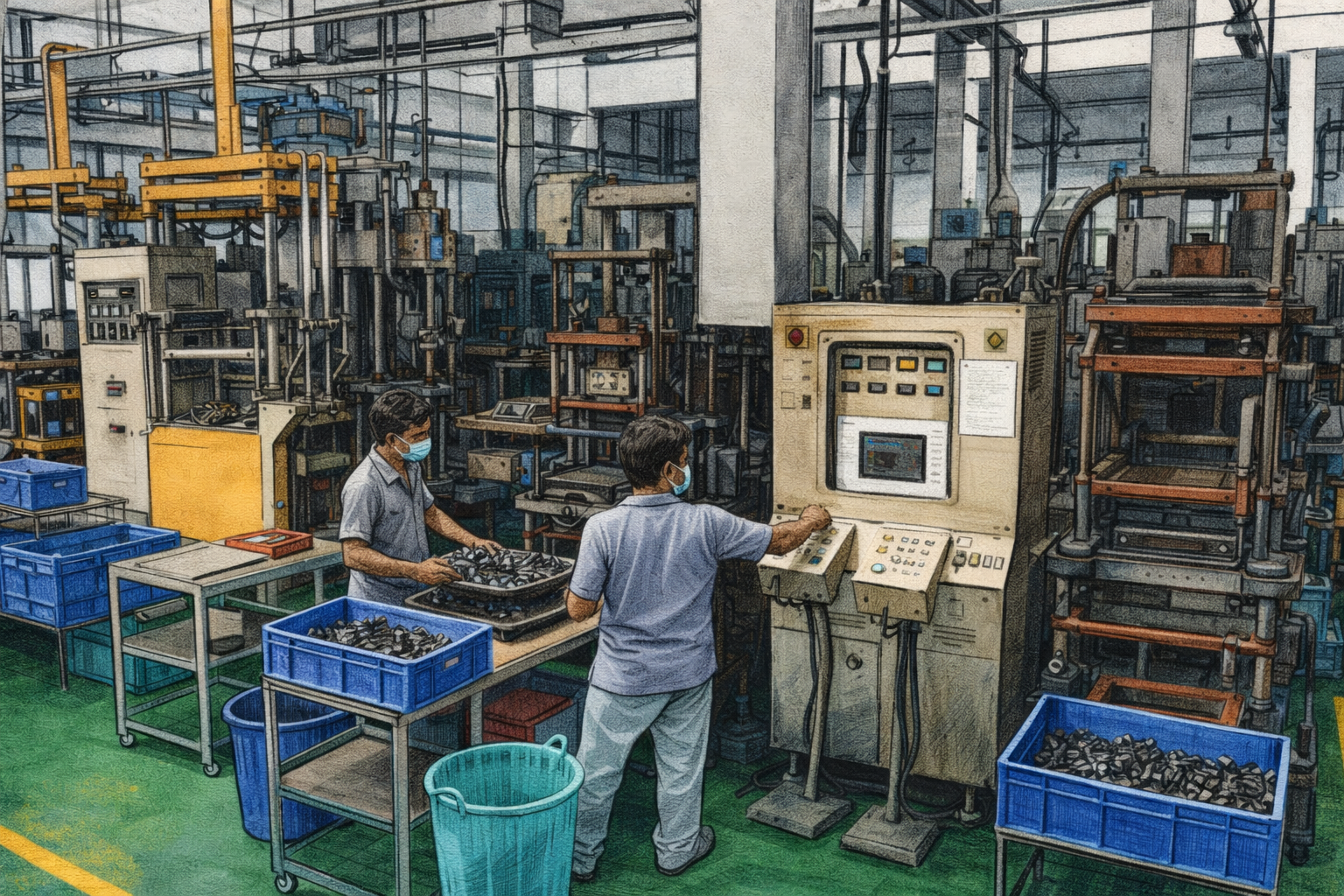
Strong performance in automobiles, electronics, textiles, and capital goods is presented as the backbone of the state economy, supported by industrial corridors, logistics, and power availability.
3. MSME-Driven Industrial Depth
The author stresses the role of small and medium enterprises in employment generation and regional dispersal of growth, preventing excessive urban concentration.
4. Infrastructure and Power Capacity
Investments in ports, roads, renewable energy, and power generation are framed as enablers rather than outcomes of growth.
5. Human Capital and Social Indicators
Higher health, education, and social welfare outcomes are linked to productivity, labour participation, and industrial stability.
6. Fiscal Management and Investment Climate
Tamil Nadu’s ability to attract FDI and maintain investor confidence while sustaining welfare expenditure is portrayed as evidence of institutional maturity.
III. Author’s Stance
The author adopts a strongly affirmative and illustrative stance, portraying Tamil Nadu as a model state whose development trajectory reflects policy continuity, administrative capacity, and inclusive governance.
While the tone is analytical, it is also normative, implicitly suggesting that other states—and even national policy—should draw lessons from this approach.
IV. Implicit Biases and Editorial Slant
1. Positive Regional Bias
The article foregrounds Tamil Nadu’s successes while giving limited attention to structural challenges such as regional disparities within the state, urban congestion, or environmental stress.
2. Selective Comparative Framing
Other states are referenced mainly to highlight contrast, not to explore alternative but equally valid development pathways.
3. Underplayed Social Stress Points
Issues such as informal labour precarity, industrial pollution, and agrarian distress receive minimal scrutiny.
4. Governance Continuity Assumption
The article assumes policy stability and institutional strength will persist, without engaging deeply with political economy risks.
V. Strengths of the Article
1. Holistic Economic Lens
Moves beyond GDP numbers to examine structure, composition, and sustainability of growth.
2. Strong Empirical Anchoring
Uses sectoral data, growth rates, and investment figures effectively to support arguments.
3. High UPSC Relevance
Directly connects to themes of cooperative federalism, state capacity, industrial policy, and inclusive growth.
4. Counters Growth Simplification
Challenges the narrative that high growth must be services-led or consumption-heavy.
5. Policy Continuity Emphasis
Highlights the importance of long-term planning over episodic reforms.
VI. Limitations and Gaps
1. Environmental Sustainability Underexplored
Industrial expansion’s ecological footprint is not critically assessed.
2. Labour Market Quality Issues Missing
Job quality, wage growth, and informality are not examined in depth.
3. Intra-State Inequalities Glossed Over
District-level disparities and rural-urban divides receive limited attention.
4. Replicability Question Not Fully Addressed
The article does not adequately explore whether Tamil Nadu’s model is replicable in states with weaker institutions or fiscal capacity.
VII. Policy Implications
For GS Paper II (Governance & Federalism)
• Demonstrates the role of states as primary engines of economic transformation
• Highlights importance of administrative capacity and policy continuity
• Reinforces cooperative federalism through competitive best practices
For GS Paper III (Economy & Development)
• Supports diversified industrial policy over mono-sectoral growth
• Emphasises infrastructure as growth-enabling capital
• Validates human capital investment as an economic strategy
For Essay & Ethics Papers
• Illustrates ethical governance through inclusive growth
• Raises questions of equity, sustainability, and long-term planning
VIII. Real-World Impact Assessment
Positive Impacts
• Employment generation across skill levels
• Resilience against economic shocks
• Strong export competitiveness
• Stable investment environment
Potential Risks
• Environmental degradation
• Urban infrastructure stress
• Industrial labour informalisation
• Rising inter-regional inequality if growth clusters intensify
IX. Balanced Conclusion
The article successfully presents Tamil Nadu’s development trajectory as structurally sound, diversified, and institutionally grounded. It convincingly argues that sustainable growth emerges not from singular policy bets, but from the cumulative effect of manufacturing depth, human capital, infrastructure, and governance capacity.
However, the largely affirmative tone leaves critical questions insufficiently interrogated—particularly around environmental sustainability, labour quality, and replicability across diverse Indian states. As an editorial intervention, it functions more as a model exposition than a stress-test of the development paradigm.
X. Future Perspectives
• Integrating environmental sustainability into industrial expansion
• Upgrading labour conditions alongside manufacturing growth
• Addressing regional imbalances within high-growth states
• Designing adaptive versions of the model for lower-capacity states
• Strengthening data-driven district-level planning
In sum, the article contributes meaningfully to the UPSC-relevant debate on what constitutes “quality growth” in India, positioning state-led, broad-based development as a credible alternative to narrow growth narratives.
