

A Decade of Placing Research and Innovation at the Centre

A Decade of Placing Research and Innovation at the Centre
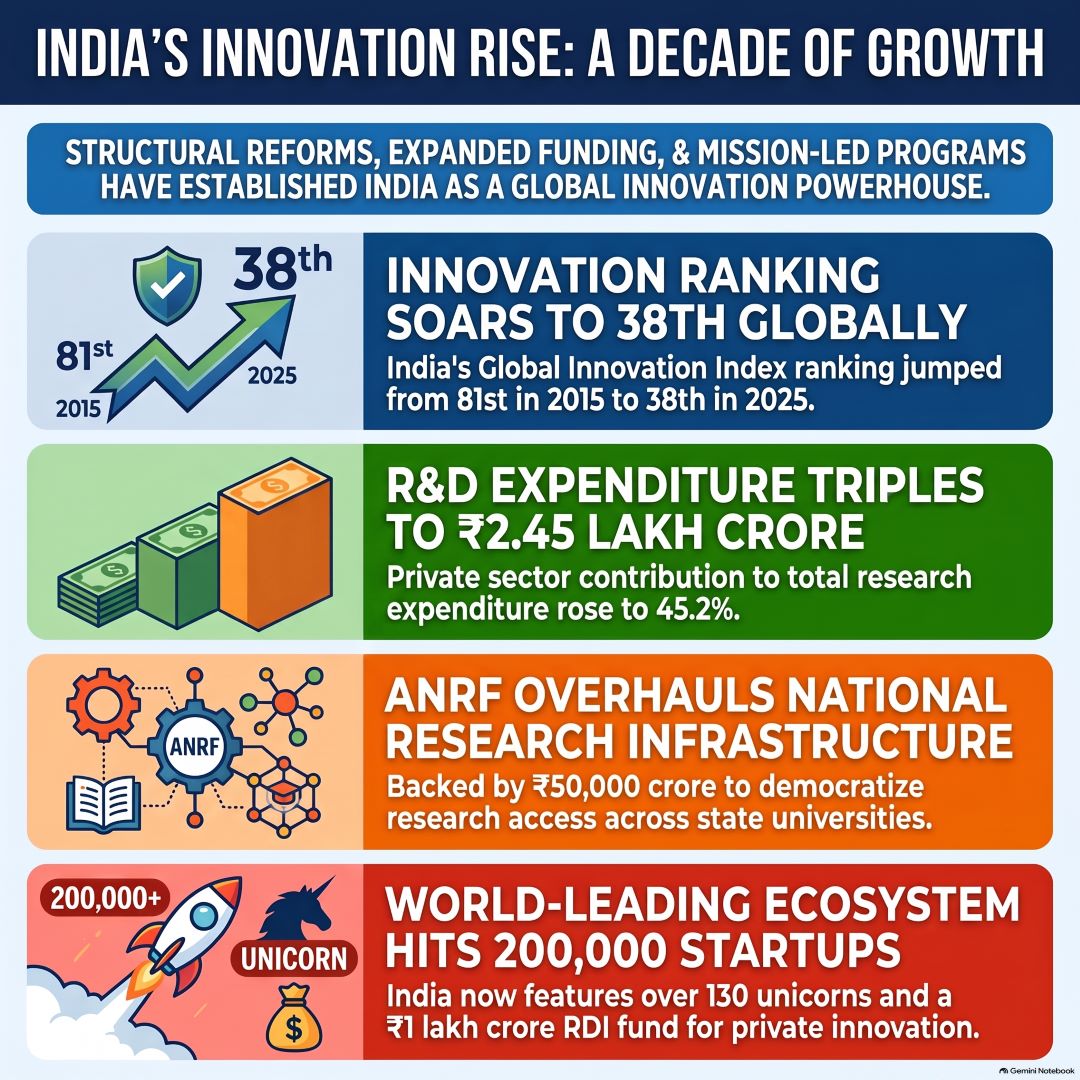
India’s Innovation Journey
- The slogan “Jai Jawan, Jai Kisan, Jai Vigyan, Jai Anusandhan” emphasises the role of research and innovation in national development.
- India’s Global Innovation Index (GII) ranking improved from 81st in 2015 to 38th in 2025, according to the supplied article.
- Gross Expenditure on Research and Development (GERD) increased from ₹79,355.89 crore in 2013–14 to ₹2,44,767.81 crore in 2023–24, reaching 0.84% of GDP.
- The private sector’s share of GERD rose from 32.2% to 45.2% over the decade.
- India ranks third globally in the volume of scientific and engineering publications and has developed one of the world’s largest startup ecosystems, with over 2 lakh registered startups and more than 130 unicorns.
- India’s bioeconomy expanded from $10 billion in 2014 to $195.3 billion in 2025, with a projected value of $300 billion by 2030.
Anusandhan National Research Foundation (ANRF)
- Established under the Anusandhan National Research Foundation Act, 2023, ANRF replaced the Science and Engineering Research Board (SERB) and broadened the scope of publicly supported research.
- It promotes collaboration among universities, research institutions, industry and government, with the objective of strengthening India’s research ecosystem.
- Its mandate extends beyond natural sciences to include humanities, social sciences, arts, health and agriculture.
- Funding framework: The announced outlay is ₹50,000 crore for 2023–2028, comprising ₹14,000 crore from the government and an expected ₹36,000 crore from non-government sources.
- Democratise research: ANRF aims to expand research opportunities in State universities and colleges, reducing the concentration of funding in a limited number of leading institutions.
- Mission-oriented research: Initiatives include MAHA (Mission for Advancement in High-impact Areas), with programmes such as MAHA Water and MAHA MedTech.
- Research facilitation: Tools such as SARAL (Simplified and Automated Research Amplification and Learning) and grants such as the Advanced Research Grant (ARG) aim to simplify research administration and improve access to funding.
- The Prime Minister serves as the ex-officio President of the ANRF Governing Board.
|
The Anusandhan National Research Foundation (ANRF) is a landmark initiative designed to overhaul India's research ecosystem and turn the country into a global knowledge superpower. It represents a shift from a purely government-funded model to a more collaborative, industry-led, and inclusive research culture. Key Features of ANRF The ANRF was established by the Anusandhan National Research Foundation Act, 2023, and became operational in late 2023. It serves as an apex body to provide high-level strategic direction for scientific research in the country, as recommended by the National Education Policy (NEP) 2020.
Major Objectives & Missions The foundation is not just about funding; it is about "seeding and growing" research in institutions that have historically lacked support.
|
Major Initiatives Driving Research and Innovation
- Research, Development and Innovation (RDI) Fund: The ₹1 lakh crore fund is intended to provide patient, risk-tolerant capital for private-sector R&D, pilot-scale demonstration and commercialisation, addressing the “valley of death” between laboratory research and market-ready products.
- National Quantum Mission: Develops capabilities in quantum computing, communication, sensing and related technologies.
- IndiaAI Mission: Supports AI infrastructure, innovation, skills and applications across sectors.
- Indian Semiconductor Mission: Promotes domestic semiconductor manufacturing and the development of the electronics ecosystem.
- BioE3 Policy: Encourages biotechnology for the economy, environment and employment.
- Deep Ocean Mission and Mission Mausam: Strengthen ocean exploration, marine-resource assessment and weather and climate capabilities.
- Indian Space Policy, 2023 and IN-SPACe: Enable greater private-sector participation in space activities; India has developed more than 400 space startups, according to the supplied material.
- SHAKTI Act: The reported legislation is intended to provide a framework for private participation in nuclear energy, subject to applicable regulatory requirements.
Inclusive Innovation and Technology for Public Services
- Women in Science and Engineering (WISE-KIRAN), Gender Advancement for Transforming Institutions (GATI) and Vigyan Jyoti seek to expand women’s participation and opportunities in STEM.
- Startup India, launched in 2016, supports entrepreneurship through the Seed Fund Scheme, Fund of Funds for Startups, Credit Guarantee Scheme and Atal Innovation Mission.
- India’s digital public infrastructure includes the JAM trinity (Jan Dhan, Aadhaar and Mobile), UPI, DigiLocker, Account Aggregator and the Ayushman Bharat Digital Health Mission.
- In agriculture, satellites, drones, remote sensing, GIS and AI support precision farming, crop monitoring and farmer advisories.
Challenges and Way Forward
- India’s GERD remains relatively low as a proportion of GDP, indicating scope to expand sustained investment in research.
- Greater private-sector participation is necessary to translate scientific research into commercially viable technologies.
- Funding should reach State universities, emerging researchers and interdisciplinary projects, alongside established research institutions.
- Stronger industry–academia partnerships, technology-transfer mechanisms, intellectual-property support and access to testing facilities can accelerate commercialisation.
- Research policy should prioritise long-term funding, scientific autonomy, transparent evaluation and measurable outcomes.
India’s transition towards an innovation-driven economy depends not only on increasing research expenditure but also on converting scientific knowledge into indigenous technologies, productive enterprises and solutions to public problems. ANRF, the RDI Fund and mission-oriented programmes are intended to strengthen this research-to-commercialisation pathway.