

A Delicate Balance Between Life and Dignity
The Tribune
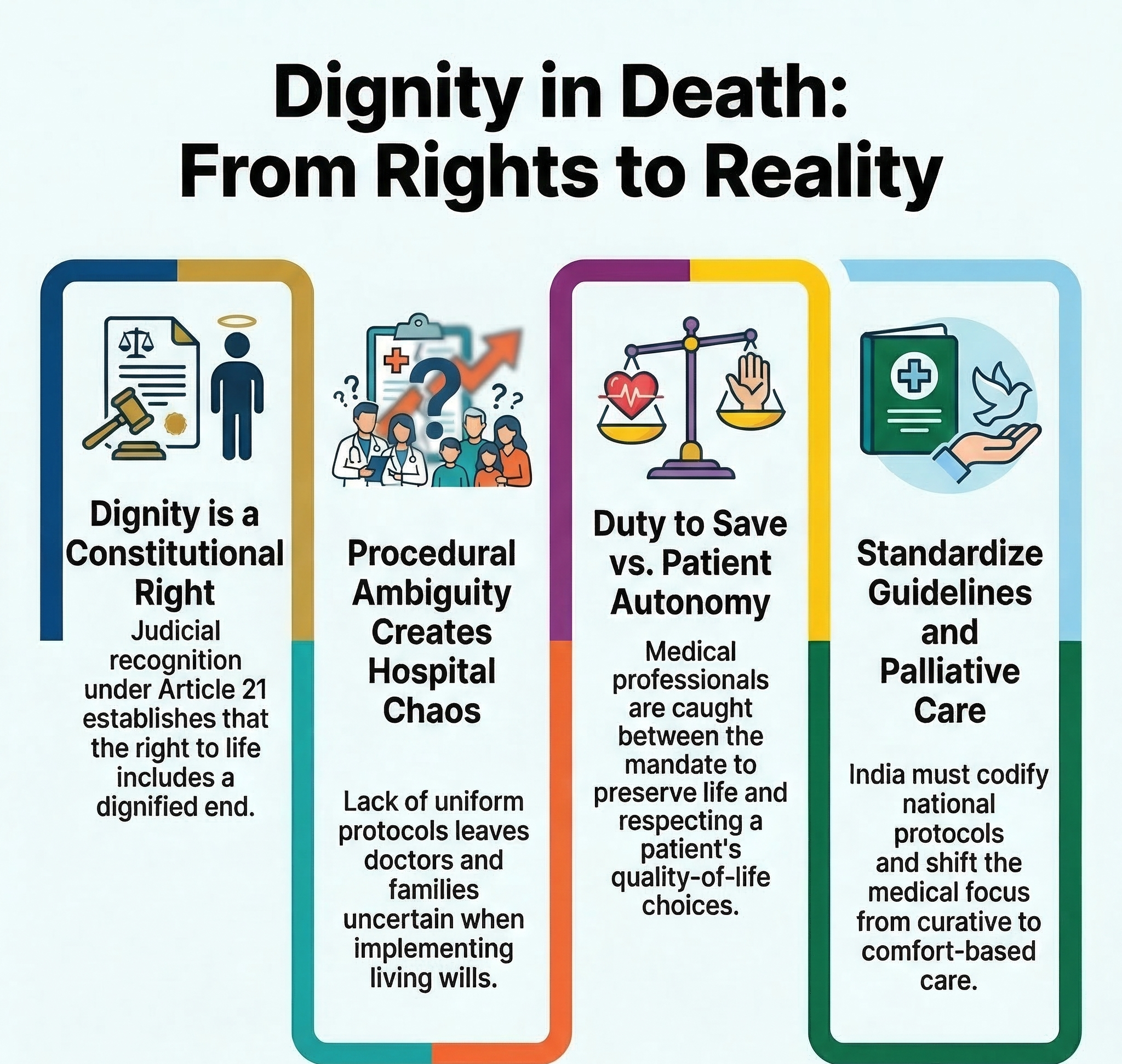
1. Key Arguments
A. Right to Die with Dignity is Constitutionally Grounded
Judicial recognition under Article 21 extends to dignified death.
The discussion draws from Supreme Court jurisprudence (passive euthanasia, living wills), establishing that dignity is integral to life and death.
B. Absence of Clear Operational Guidelines
Legal recognition exists, but procedural clarity is weak.
Hospitals, doctors, and families face ambiguity in implementing living wills and withdrawing treatment due to lack of uniform protocols.
C. Ethical Conflict in Medical Practice
Doctors are caught between professional duty and patient autonomy.
The principle of “saving life at all costs” often clashes with respecting patient consent and quality of life.
D. Risk of Misuse and Safeguard Concerns
Fear of coercion, misuse, and premature withdrawal of care.
Socio-economic inequalities and weak regulatory systems increase the risk of exploitation.
E. Need for Institutional and Legal Framework
Standardised national guidelines are essential.
Clear protocols can protect patients, families, and medical professionals while ensuring ethical compliance.
2. Author’s Stance
Balanced but reform-oriented approach
Support for dignity with caution
Both pieces support the right to die with dignity but emphasise safeguards to prevent misuse.
Advocacy for clarity and institutionalisation
The tone strongly favours codified guidelines, institutional accountability, and procedural uniformity.
3. Biases and Limitations
Judicial-centric perspective
Heavy reliance on Supreme Court rulings; limited engagement with grassroots healthcare realities.
Urban healthcare bias
Focus appears tilted towards advanced hospital settings; rural and informal healthcare contexts are underexplored.
Underestimation of socio-cultural resistance
India’s familial, religious, and cultural values around death receive limited attention.
4. Strengths (Pros)
Ethical depth and constitutional grounding
Effectively links dignity, autonomy, and rights-based discourse.
Timely relevance
Increasing life expectancy and chronic illness make end-of-life care a pressing issue.
Focus on systemic gaps
Highlights procedural ambiguity, a key governance challenge.
5. Weaknesses (Cons)
Limited policy detailing
Does not sufficiently outline what concrete guidelines should include.
Insufficient stakeholder analysis
Role of palliative care workers, nurses, and local health systems is not adequately addressed.
Lack of comparative perspective
Global best practices (e.g., advanced directives in other countries) are missing.
6. Policy Implications
A. Legal Framework
Codification of living wills and passive euthanasia protocols
Uniform national legislation or detailed rules under existing laws.
B. Medical Governance
Clear hospital-level SOPs
Ethics committees, documentation processes, and consent verification mechanisms.
C. Palliative Care Expansion
Shift from curative to comfort-based care
Integration of palliative services into primary healthcare.
D. Safeguards Against Misuse
Multi-layered approval systems
Judicial or quasi-judicial oversight in sensitive cases.
E. Public Awareness
Promoting informed decision-making
Awareness about living wills and patient rights.
7. Real-World Impact
Healthcare System
Reduced burden of futile medical interventions
Efficient allocation of scarce medical resources.
Patients and Families
Enhanced autonomy and dignity
Reduced emotional and financial distress.
Medical Professionals
Legal clarity and reduced liability fears
Better alignment between ethics and practice.
Society
Gradual shift in perception of death and dignity
From life preservation at all costs to quality-of-life considerations.
8. UPSC GS Paper Linkages
GS Paper II (Polity & Governance)
- Fundamental Rights (Article 21)
- Role of Judiciary in policy evolution
- Health governance and regulatory frameworks
GS Paper IV (Ethics)
- Dignity, autonomy, compassion
- Medical ethics: beneficence vs autonomy
- End-of-life ethical dilemmas
GS Paper I (Society)
- Changing social attitudes towards death and healthcare
- Family structures and decision-making
9. Balanced Conclusion
End-of-life care in India represents a complex intersection of law, ethics, and medicine.
While judicial recognition of the right to die with dignity is a progressive step, the absence of clear, implementable guidelines creates uncertainty and risk.
10. Future Perspective
From legal recognition to practical implementation
Focus must shift towards operational clarity and institutional readiness.
Holistic approach to healthcare
Integration of palliative care, ethics training, and patient rights.
Culturally sensitive policymaking
Policies must align with India’s socio-cultural realities.
Strengthening accountability mechanisms
Ensuring safeguards without diluting patient autonomy.
Final Insight
The real challenge is not choosing between life and death, but ensuring dignity in both.
