

A gift that addresses global challenges
The Statesman
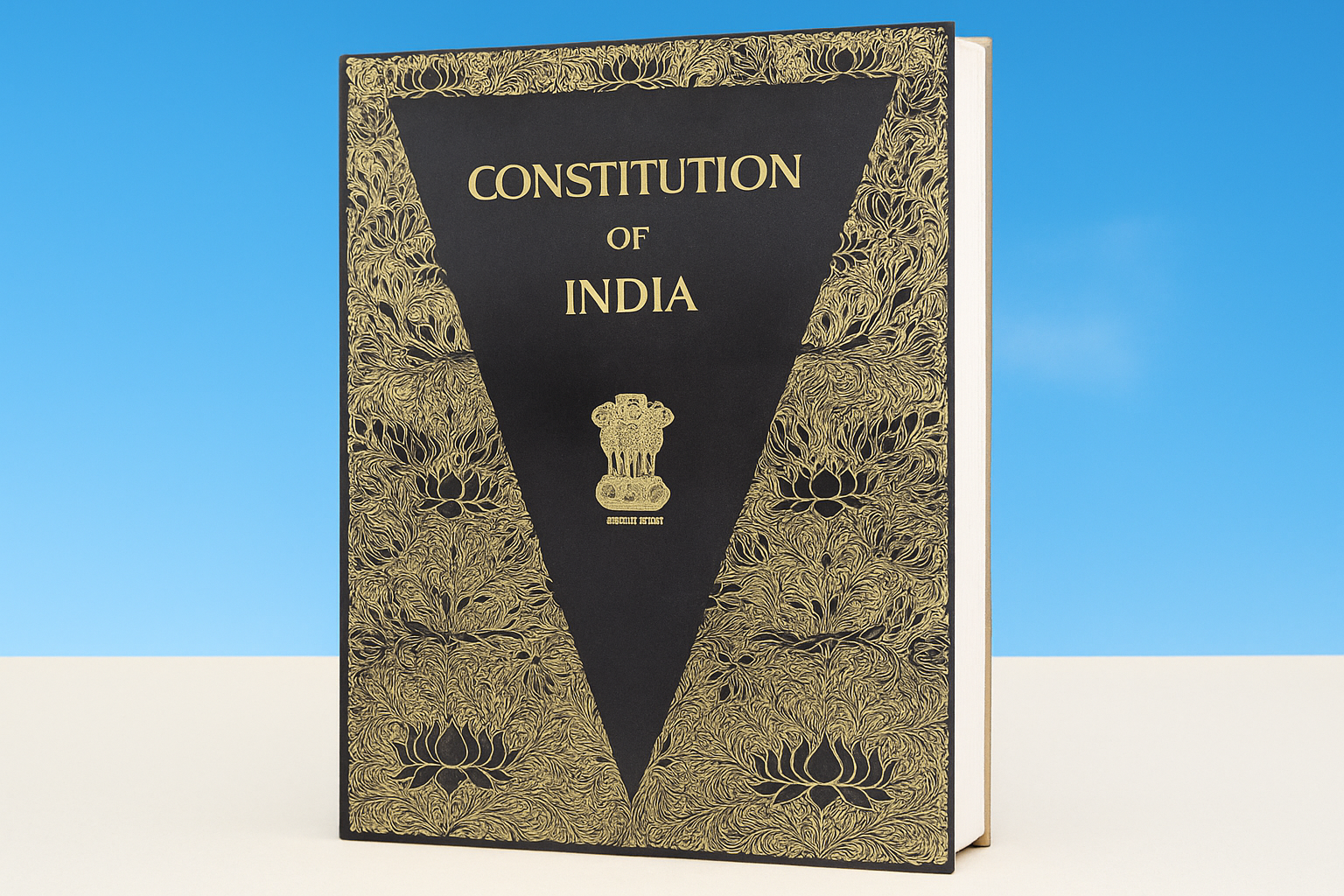
1. Key Arguments in the Article
a. India’s Constitution as a “living document” with global relevance
The author argues that the Constitution of India—adopted on 26 November 1949—blends:
- Indigenous wisdom,
- Ethical philosophy of Gandhi,
- Civilizational ideals such as Vasudhaiva Kutumbakam and Sarvodaya, and
- *Modern constitutionalism.
This unique blend allows the Constitution to respond meaningfully to contemporary global challenges: conflict, inequality, pandemics, and environmental crises.
b. The Preamble as a guiding light for global values
The values of Justice, Liberty, Equality, and Fraternity are highlighted as the bedrock of:
- Social harmony
- Peaceful coexistence
- Conflict resolution
- Collective development
The author notes that these principles have universal relevance today.
c. Constitutional support for alternative dispute resolution (ADR)
Articles such as:
- Article 39A (equal justice)
- Article 142 (complete justice)
- Article 51 (promotion of peace and international cooperation)
are cited as enabling mechanisms that support mediation, community dialogue, and consensus—methods crucial in reducing adversarial conflict globally.
d. Democratic decentralisation as a global model
India’s Panchayati Raj and urban local bodies are presented as:
- Models of people-centric governance
- Mechanisms that enhance participation and accountability
- Frameworks that many nations can emulate to strengthen grassroots democracy
e. Constitutional morality as a solution to global issues
The article argues that adherence to constitutional morality fosters:
- Respect for rule of law
- Ethical conduct in public life
- Social justice
- A sense of responsibility and restraint
These values collectively form an ethical alternative to rising global polarization, xenophobia, economic disparities, and authoritarian tendencies.
2. Author’s Stance
The author clearly takes a laudatory, celebratory stance on the Indian Constitution, emphasizing:
- Its moral and ethical strength
- Its philosophical lineage
- Its potential role in addressing global disorder
The tone is nationalistic but aspirational, presenting India’s constitutional ethos as a model for the world.
3. Potential Biases Present
a. Overemphasis on idealism
The article tends to glorify:
- Constitutional principles
- Gandhi’s philosophy
- India’s civilizational ethos
Without adequately acknowledging:
- Practical constitutional challenges
- Institutional limitations
- Implementation gaps (judicial pendency, rights infringements, bureaucratic delays)
b. Lack of critique of contemporary governance practices
Many current issues contradict the Constitution’s ideals:
- Restrictions on dissent
- Communal polarization
- Weakening of institutions
- Unequal access to justice
The article avoids any mention of these contradictions.
c. Skew toward normative rather than empirical analysis
The piece assumes that:
- Constitutional values automatically translate into effective governance
- Global acceptance of Indian constitutional thought is imminent
Both are more aspirational than evidence-based.
4. Structured Critical Examination
Strengths
- Accurately highlights India’s constitutional philosophy as inclusive, humanistic, and globally relevant.
- Draws meaningful connections between ancient ethics and modern constitutionalism.
- Correctly acknowledges the importance of ADR, decentralisation, and fraternity.
- Provides a visionary and optimistic interpretation of India’s global role.
Weaknesses
- Fails to address implementation challenges such as:
- Judicial delays
- Federal tensions
- Rights violations
- Social inequalities
- Presents an idealized version that may not fully reflect ground realities.
- Overlooks the limitations of the Constitution in resolving complex geopolitical issues.
5. Policy Implications
Domestic Implications
- Stronger push for mediation and ADR to reduce court burden.
- Need to strengthen local governance institutions as per the constitutional spirit.
- Greater emphasis on constitutional morality in public institutions and civil services.
- Making fraternity and peaceful coexistence central to public policy.
Global Implications
- India could advocate for:
- Dialogue-based conflict resolution
- Multilateral cooperation rooted in equality and non-violence
- Ethical governance strategies inspired by its constitutional values
- India’s constitutional philosophy supports its role in climate negotiations, peacekeeping, and global diplomacy.
6. Real-World Impact
Positive
- Can inspire policy reforms to strengthen democratic accountability.
- Promotes India’s image as a responsible and ethical global actor.
- Encourages a culture of peaceful negotiation and inclusive governance.
Negative / Limitations
- Without institutional reforms, constitutional ideals may remain symbolic.
- Excessive idealism can mask structural weaknesses.
- Global influence requires demonstrable internal consistency, not just moral arguments.
7. UPSC GS Paper Alignment
GS2 – Polity & Constitution
- Constitutional values
- Role of Preamble
- Decentralization
- Constitutional morality
- ADR mechanisms (Article 39A, Article 51, Article 142)
GS4 – Ethics
- Gandhian philosophy
- Ethics of dialogue, peace, non-violence
- Values of justice, equality, liberty, fraternity
- Constitutional morality and public service ethics
GS1 (Society)
- Social harmony and unity
- Managing diversity
- Communal coexistence
Essay
Highly relevant for essays on:
- Constitutionalism
- Democracy
- Global peace
- Gandhian principles
- India’s role in the world
8. Balanced Conclusion
The article argues that India’s Constitution is not merely a legal document but a moral guide capable of addressing global crises. Its foundations in justice, liberty, equality, and fraternity—combined with Gandhian ethics and civilizational values—make it uniquely equipped to provide humane solutions for conflict-ridden and polarized societies.
However, while these ideals are powerful, their real-world impact depends on how faithfully institutions and governance systems embody them. The Constitution offers a profound vision, but fulfilling its global promise requires consistent domestic adherence, institutional strengthening, and a renewed commitment to constitutional morality.
9. Future Perspectives
- Strengthening judicial reforms and ADR to uphold equal access to justice
- Deepening decentralization to make democracy more participatory
- Promoting civic education on constitutional values
- Enhancing global diplomacy anchored in India’s constitutional ethos
- Ensuring internal governance aligns with the constitutional principles India seeks to showcase globally
