

A Shaman Who Shattered the Lens on Anthropocene
Morning Standard
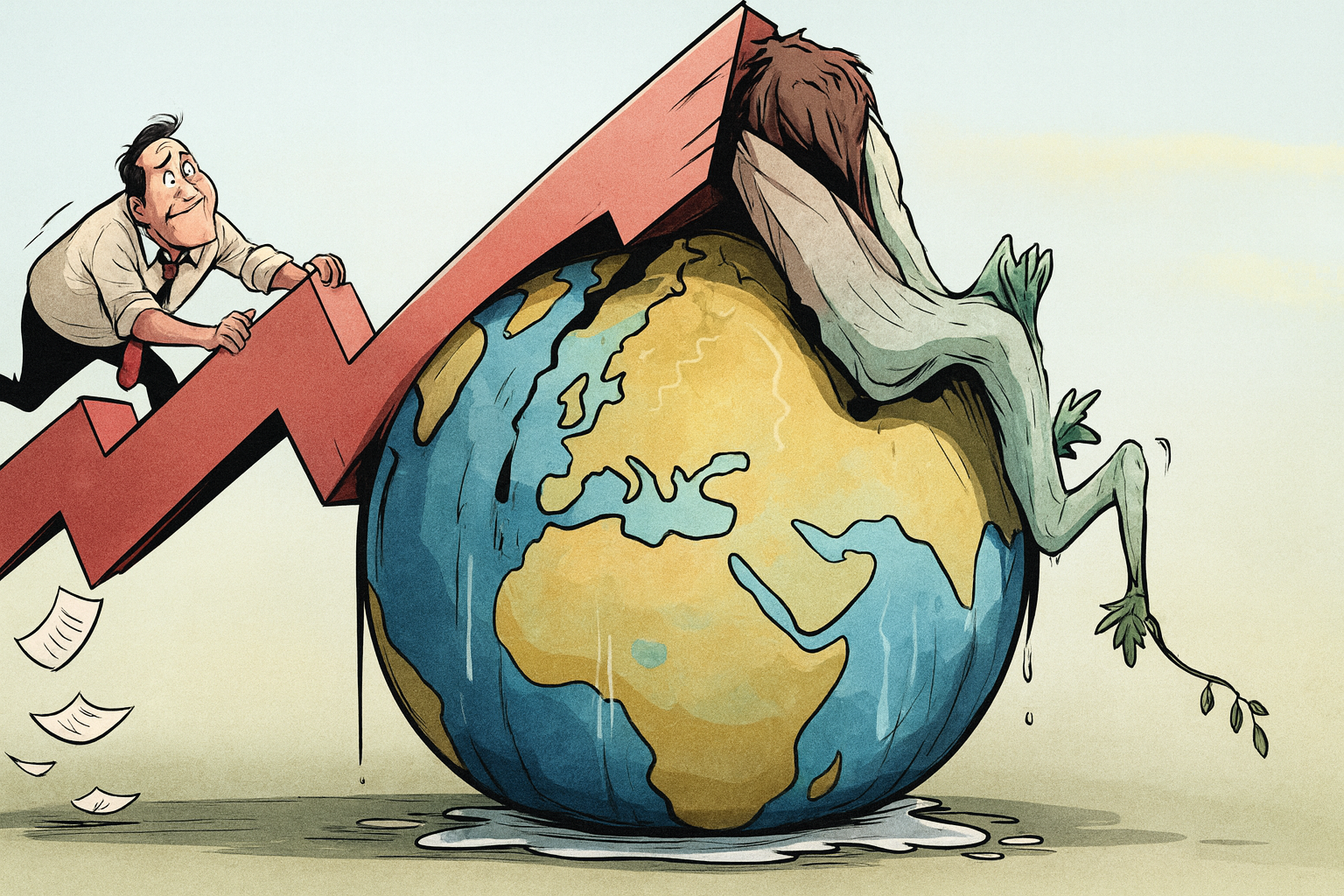
I. AUTHOR’S CENTRAL ARGUMENT
The author argues that the dominant Western understanding of the Anthropocene—as an era in which humans destroy Earth through industrial excess and economic cost–benefit calculations—is intellectually limited. He suggests that a paper presented by Zia (a shaman from Russia’s Sakha community) at the Anthropocene conference in Delhi challenges this dominant paradigm by offering a storytelling-based, spiritual, indigenous, and ecological worldview.
The core message is that the Anthropocene cannot be fully understood through scientific or economic language alone; it requires alternative epistemologies—such as myth, memory, ritual, and indigenous cosmologies—to re-imagine human–Earth relations.
II. KEY ARGUMENTS PRESENTED
- Western Anthropocene Framework Is Reductionist
It relies on metrics, cost–benefit analysis, ecological modelling, and technological fixes, which fail to capture relational, cultural, and moral dimensions of environmental crisis. - Zia’s Storytelling Approach Offers a Radical Alternative
– Uses myth, dream, folklore, and cosmology
– Centres nature as subject, not object
– Frames Earth as a moral and spiritual entity
– Argues that industrial civilisation has ruptured ancestral ties to land and spirit - Importance of Language and Narrative
Zia critiques modern science’s inability to create stories that resonate with people. He proposes that storytelling can bridge scientific knowledge and human experience. - Anthropocene as a Crisis of Imagination
The author suggests that modernity’s lens—rooted in Enlightenment rationality—fails to perceive ecological collapse because it lacks symbolic and spiritual depth. - Holistic Cosmologies Offer Ethical Pathways
Indigenous frameworks emphasise:
– restraint rather than extraction
– reciprocity rather than domination
– memory rather than data
– continuity rather than disruption - Science Must Learn to Dialogue With Other Knowledge Systems
True understanding requires plural epistemologies and abandonment of scientific arrogance.
III. AUTHOR’S STANCE AND POSSIBLE BIASES
- Strongly Favourable to Indigenous and Storytelling Approaches
The author frames the shamanic perspective as morally superior to Western scientific discourse. - Implicit Critique of Western Science and Modernity
The narrative suggests that science is technocratic, soulless, and unable to grasp ecological meaning. - Romanticisation of Indigenous Knowledge
While valuable, indigenous cosmologies are presented without acknowledging their own limits or modern adaptation challenges. - Limited Engagement With Practical Environmental Policy
The article emphasises epistemology over actionable solutions.
IV. PROS OF THE ARTICLE (Strengths)
1. Provides an Innovative Lens on the Anthropocene
Most environmental articles focus on emissions, climate treaties, and technology. This one shifts the debate to culture, ethics, and imagination.
2. Highlights the Importance of Indigenous Knowledge
Reinstates long-overlooked epistemologies that emphasise harmony with nature.
3. Critiques Scientific Reductionism
Reminds readers that over-quantification and technocratic solutions often ignore human behaviour and cultural meaning.
4. Encourages Interdisciplinary Thinking
Blends anthropology, philosophy, and ecology in a refreshing academic style.
5. Strong Narrative Appeal
The storytelling emphasis is itself engaging and reinforces the article’s message.
V. CONS OF THE ARTICLE (Critical Gaps & Limitations)
1. Underestimates Scientific Contributions
Climate science, ecology, and earth-system modelling remain essential to understanding the Anthropocene. Their importance is overshadowed.
2. Over-idealisation of Indigenous Cosmologies
Indigenous worldviews are context-specific and may not scale to modern urban or industrial societies.
3. Lacks Concrete Policy Examples
No actionable strategies are provided for integrating storytelling into environmental governance.
4. Oversimplifies “Western vs Indigenous” Divide
Many Western thinkers—deep ecologists, phenomenologists, ecofeminists—have already challenged reductionist science.
5. Minimal Engagement With Structural Drivers
Large-scale issues—capitalism, inequality, climate politics, global supply chains—are not addressed directly.
6. Language of Critique Can Alienate Policy Discourse
The poetic, metaphorical tone may resonate academically, but policymakers require clearer frameworks.
VI. POLICY IMPLICATIONS (UPSC GS-III & GS-I Relevance)
- Environmental Ethics and Sustainable Development (GS-III)
Development must move beyond economic metrics to incorporate cultural and ethical considerations. - Preservation of Indigenous Knowledge (GS-I: Indian Society)
Integrating tribal and indigenous ecological knowledge can improve conservation and climate adaptation. - Climate Governance
Policies should reflect ecological stewardship, not merely carbon accounting. - Holistic Education
Environmental curricula can include mythologies, oral traditions, and indigenous epistemologies. - Decentralised Ecological Governance
Panchayati Raj and tribal governance frameworks can integrate place-based ecological wisdom.
VII. REAL-WORLD IMPACT ASSESSMENT
- Cultural Shift in Environmental Awareness
Storytelling may help create emotional engagement in climate action. - Reclaiming Indigenous Voices
Supports the inclusion of tribal knowledge systems in policy processes. - Challenges in Practical Implementation
Translating philosophical narratives into policy remains difficult. - Potential for Bridging Science and Society
Narratives can make climate science more relatable, improving public participation. - Risk of Misinterpretation
Romanticising indigenous worldviews can lead to oversimplification or tokenism.
VIII. BALANCED CONCLUSION
The article is a compelling exploration of how the Anthropocene narrative—dominated by Western scientific discourse—can be enriched by indigenous cosmologies and storytelling traditions. It challenges readers to rethink ecological crisis not merely as a technical problem, but as a cultural and moral rupture.
However, its critique sometimes overcorrects, downplaying the indispensable role of science, policy, and structural reforms. While the storytelling approach brings emotional depth and ethical resonance, it must complement—not replace—rigorous scientific understanding.
A balanced Anthropocene discourse should integrate science, ethics, indigenous knowledge, history, and imagination to build a sustainable ecological future.
IX. FUTURE PERSPECTIVES (UPSC Mains-Ready Insights)
- Develop frameworks that combine scientific modelling with cultural narratives to support community-based conservation.
- Incorporate indigenous ecological knowledge into climate adaptation plans.
- Promote interdisciplinary research connecting anthropology, ecology, and environmental ethics.
- Ensure environmental impact assessments include cultural and spiritual dimensions.
- Encourage participatory storytelling in local climate resilience programmes.
- Create platforms for tribal leaders, shamans, and knowledge-keepers to contribute to national climate dialogues.
The Anthropocene is not just a geological epoch—it is a civilisational reflection. Addressing it demands both scientific clarity and cultural imagination.
