

A shift in the climate narrative as Paris pact comes under scrutiny
Indian Express
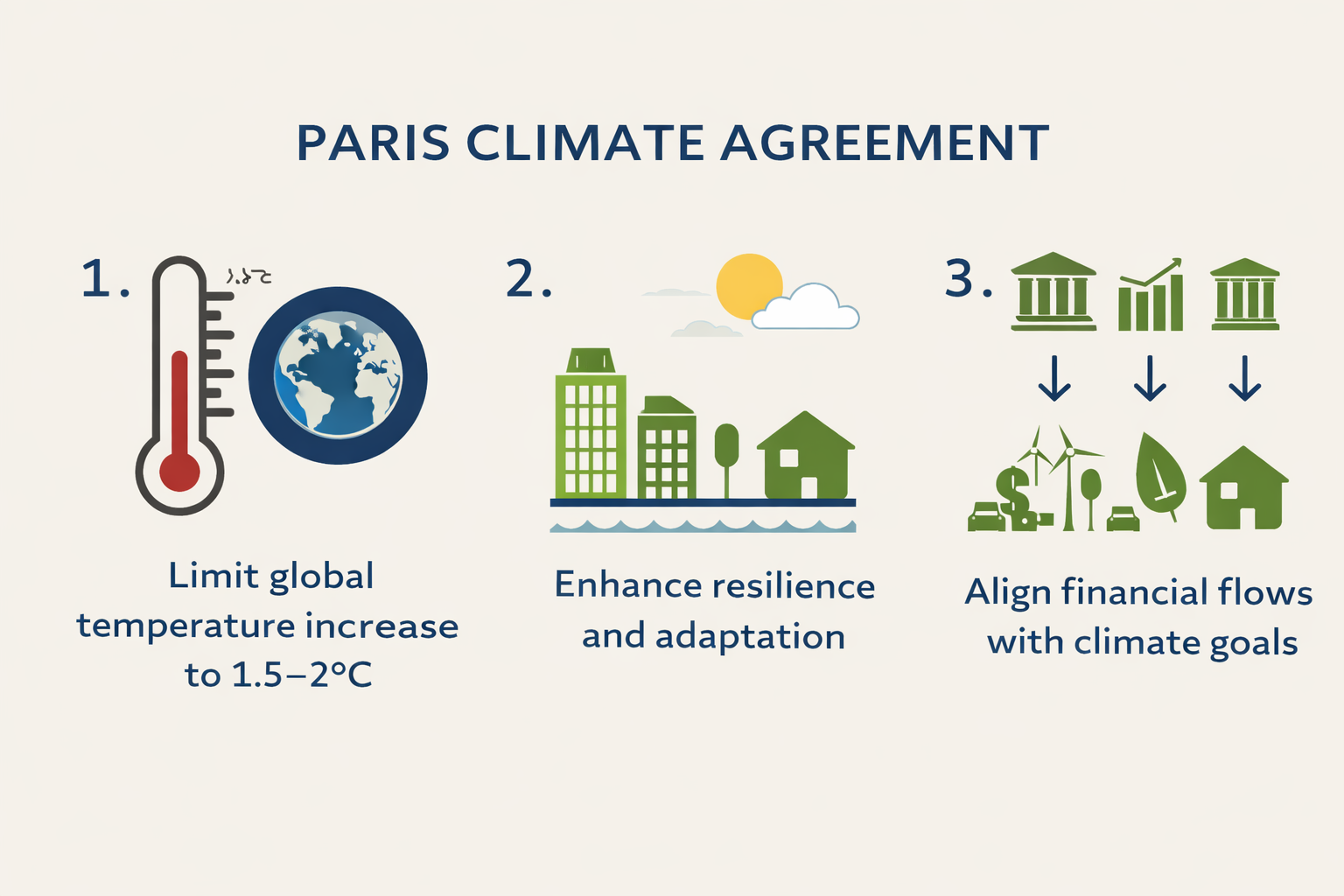
Core Theme and Context
The article examines the changing global discourse on climate action as the Paris Agreement approaches a decade of existence. It argues that while the Agreement remains symbolically central to global climate governance, its political authority, normative coherence, and implementation credibility are under strain. The piece situates this shift within a fragmented global order marked by geopolitical rivalry, uneven development trajectories, and divergent national priorities.
Rather than questioning climate change itself, the article interrogates the architecture of climate cooperation and the evolving narratives around responsibility, equity, and feasibility.
Key Arguments Presented
1. Paris Agreement as a Normative Framework Under Stress
The article argues that the Paris Agreement was designed as a flexible, bottom-up framework, relying on voluntary nationally determined contributions. While this flexibility enabled broad participation, it has also diluted enforceability and collective ambition.
The central concern is that aggregation of national pledges remains insufficient to meet global temperature targets, exposing a credibility gap between aspiration and outcome.
2. Fragmentation of the Global Climate Narrative
The author highlights a growing divergence in how countries frame climate action:
- Developed countries increasingly focus on emissions reduction commitments and timelines
- Developing countries emphasise adaptation, climate finance, and historical responsibility
This divergence has weakened the idea of a single, universal climate pathway.
3. The US Exit and the Politics of Uncertainty
The article treats the US withdrawal from the Paris framework (and subsequent re-engagement debates) as emblematic of climate action’s vulnerability to domestic political cycles. This volatility undermines trust, especially among developing countries that depend on long-term predictability in finance and technology transfer.
4. Rise of National and Regional Climate Pathways
A key argument is that countries are increasingly pursuing self-defined climate strategies, shaped by domestic political economy rather than multilateral consensus. Climate action is being integrated into industrial policy, energy security, and competitiveness narratives.
This represents a shift from global moral obligation to national interest-based climate policy.
5. Equity and Climate Finance as the Fault Line
The article underscores climate finance as the most contentious issue. Promised financial flows have not materialised at the scale or predictability required, weakening trust in multilateral commitments and reinforcing North–South divides.
Author’s Stance
The author adopts a realist but reform-oriented stance:
- Accepts the Paris Agreement’s historical importance
- Recognises its structural limitations
- Argues for adaptation of climate governance to geopolitical realities rather than idealistic universalism
The tone is analytical and reflective, avoiding alarmism while questioning complacency.
Implicit Biases and Editorial Leanings
1. Realist Bias in International Cooperation
The article leans toward the view that nation-states ultimately prioritise domestic interests, which may underplay the normative power of international agreements in shaping long-term behaviour.
2. Limited Grassroots Perspective
The focus remains on state actors and global negotiations, with limited engagement with:
- Sub-national climate action
- Civil society pressure
- Private-sector transitions
3. Emphasis on Political Over Scientific Urgency
While acknowledging climate risks, the article foregrounds political feasibility over scientific timelines, which could be read as normalising delayed action.
Pros and Cons of the Argument
Pros
- Provides a nuanced understanding of climate governance fatigue
- Avoids simplistic blame narratives
- Integrates geopolitics, development, and climate policy
- Helps readers understand why consensus is weakening
Cons
- Offers limited concrete alternatives to the Paris framework
- Understates the role of climate science in shaping urgency
- Risks legitimising minimalism in climate ambition
- Limited attention to climate justice at community levels
Policy Implications
1. Rethinking Global Climate Architecture
The article implies that future climate governance may need:
- Smaller, issue-based coalitions
- Sectoral agreements
- Greater emphasis on adaptation and resilience
2. Climate Action as Development Strategy
For developing countries, climate policy must align with:
- Energy access
- Industrialisation
- Poverty reduction
This reinforces the legitimacy of differentiated pathways.
3. Finance and Trust as Central Pillars
Without predictable climate finance and technology transfer, global cooperation risks erosion, regardless of normative commitments.
Real-World Impact
- Slower collective emissions reduction
- Increased reliance on national climate strategies
- Heightened North–South tensions in climate negotiations
- Potential marginalisation of vulnerable countries
For citizens, this translates into uneven climate resilience and unequal capacity to adapt.
UPSC GS Paper Alignment
GS Paper II – International Relations
- Multilateral institutions
- Climate diplomacy
- North–South relations
GS Paper III – Environment and Economy
- Climate change mitigation and adaptation
- Sustainable development
- Energy transition
GS Paper I – Society and Geography
- Impact of climate change
- Global environmental challenges
Balanced Conclusion and Future Perspective
The article persuasively argues that the Paris Agreement, while still symbolically central, can no longer be treated as a sufficient mechanism for global climate action. Its voluntary architecture, uneven implementation, and geopolitical stress have reshaped climate narratives from collective moral duty to national strategic choice.
Going forward, the challenge lies in reconciling realism with responsibility:
- Preserving the spirit of multilateralism
- Accommodating differentiated development paths
- Ensuring climate justice through finance and technology
The future of climate governance will depend not on abandoning Paris, but on adapting its principles to a fractured world while retaining scientific urgency and ethical commitment.
