

A Signal Buried Between the Lines of a Resignation: Bangladesh's Political Turbulence

A Signal Buried Between the Lines of a Resignation: Bangladesh's Political Turbulence
Relevance: GS Paper II (International Relations, India's Neighbourhood, Bangladesh) | GS Paper III (Internal Security, Extremism)
Why in the News?
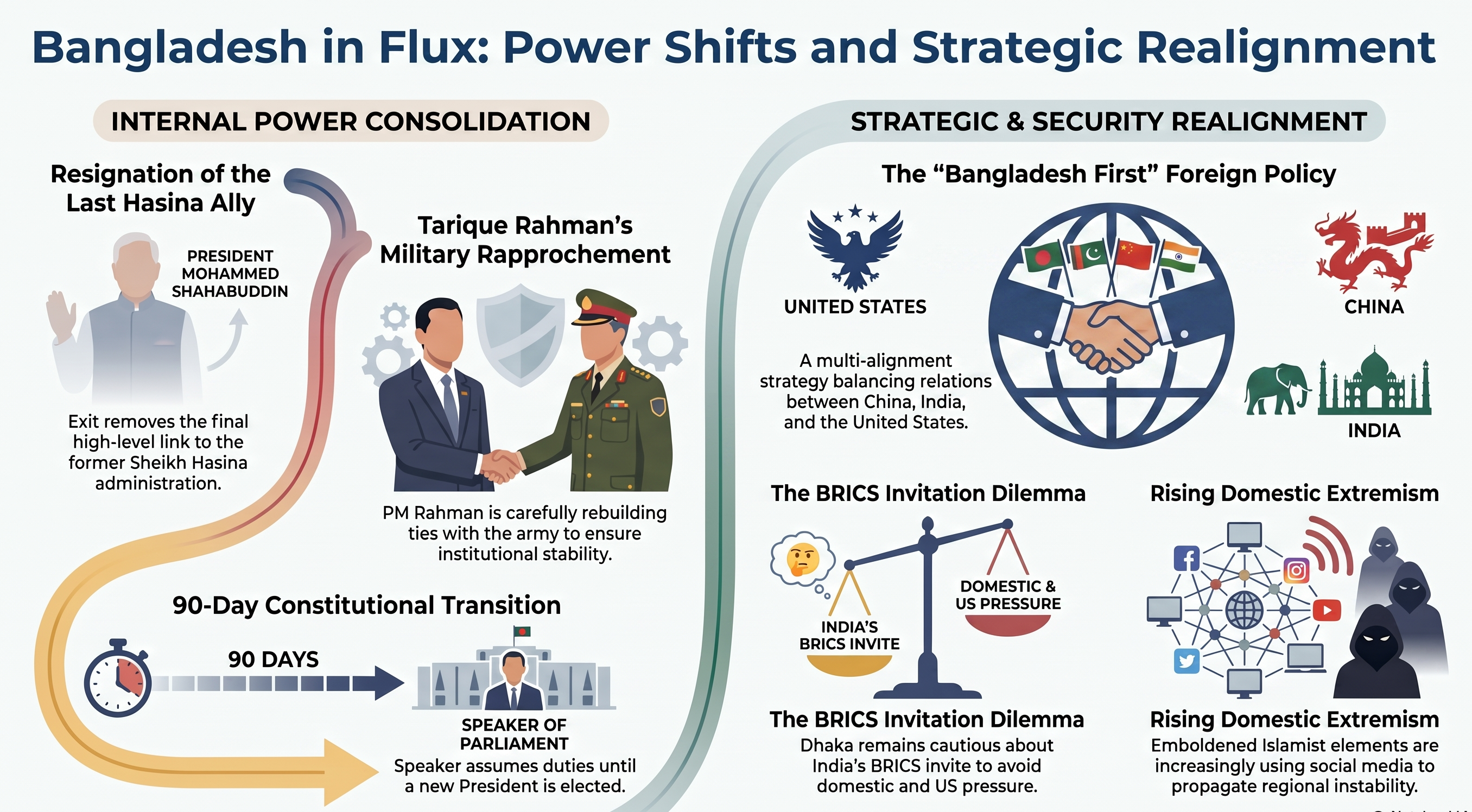
- Mohammed Shahabuddin, the 76-year-old former President of Bangladesh, resigned two years before the end of his five-year term, triggering speculation despite the President's largely ceremonial role.
- Shahabuddin cited health reasons — a diagnosis of autonomic neuropathy, causing occasional momentary loss of consciousness.
- Per Bangladesh's Constitution, the Speaker of the Jatiya Sangsad (Parliament) will perform presidential duties until a new President is elected within 90 days.
Background: Shahabuddin's Position
- He was appointed in April 2023 by former PM Sheikh Hasina, who regarded him as a steadfast ally, and was in office when Hasina was forced into exile in India.
- He is a veteran of Bangladesh's 1971 Liberation War and a former lower-judiciary judge.
- Student leaders of the "people's revolution" had earlier gheraoed Bangabhaban (the President's residence) in the months after Hasina's exile, hoping to force his resignation — but the army stepped forward to protect him at the time.
- Shahabuddin had earlier expressed frustration with the unelected interim government under Mohammad Yunus, saying he felt "humiliated" after his portraits were suddenly removed from Bangladesh's consulates and embassies worldwide. He did not resign then, as the military backed him and the interim government backed off.
Why the Timing Matters?
- The author argues Shahabuddin's exit was carefully choreographed by the current government under PM Tarique Rahman.
- It followed an emotional announcement by Hasina that she and other senior leaders would return to Bangladesh despite a death sentence and possible imprisonment awaiting her.
- The resignation was timed while the army chief was on an official visit to Turkey — suggesting Shahabuddin was likely in the loop and had negotiated concessions regarding his future security.
- Another speculated (government-denied) trigger: a reported telephonic conversation between Shahabuddin and Hasina while she was travelling abroad, which may have renewed pressure for his resignation.
Political Implications
- With Shahabuddin's exit, Hasina has effectively lost her last remaining ally within Bangladesh's top government structure.
- The Awami League remains banned, with many of its leaders jailed or having fled abroad, primarily to India.
- Given the ruling BNP's overwhelming parliamentary majority, any BNP nominee for the presidency would be virtually guaranteed election — with speculation already circulating around potential candidates.
Tarique Rahman's Cautious Approach with the Military
- The author notes Tarique has conducted himself with notable maturity, aware of his prior reputation as an arrogant figure overseeing significant corruption during his mother Khaleda Zia's PM tenure (2001-2006).
- Tarique had previously fallen out with the military during 2002-06; when the army-backed caretaker government took over in 2007, he was arrested for corruption and jailed, later alleging torture during interrogation that caused spinal injury.
- This earlier souring of relations stemmed from Tarique's haughty attitude toward senior generals, including the then army chief.
- Given the Bangladesh Army's close-knit institutional character and long memory, Tarique has reportedly been careful this time to avoid provoking the military's displeasure — and likely ensured army backing before facilitating Shahabuddin's resignation.
Bangladesh's Foreign Policy Posture: "Bangladesh First"
- The Tarique government has been advocating a "Bangladesh First" foreign policy, reaching out to China for assistance despite US discomfort — one of the speculated reasons behind American displeasure with the earlier Hasina government.
- Bangladesh appears to be pursuing a multi-alignment approach, keeping options open across China, India, and the US.
The BRICS Invitation Dilemma
- This cautious posture has led Dhaka to sit on India's invitation to the upcoming BRICS Outreach Session in New Delhi this September, with Bangladesh's official position being that the invite remains "under consideration."
- Notably, Bangladesh had earlier shown interest in joining BRICS; a multilateral event of this kind could offer Dhaka a valuable opportunity to work out a modus vivendi with India.
- Bilateral ties, which nosedived during the Yunus regime, need stabilising — the author argues no Dhaka government can afford to ignore Delhi.
- However, accepting the invitation risks exposing the government to pressure from anti-India domestic forces and the US, given the Trump administration's hostility toward BRICS (which it reportedly views, mistakenly, as anti-American in orientation).
Rising Concern: Islamic Extremism in Bangladesh
- Reports suggest emboldened Islamist elements are using social media to openly call for violence against Hindus.
- The author describes a "malevolent ecosystem" using online platforms to provide guidance and operational advice for violent activities, spreading extremist narratives including "Ghazwa-e-Hind" — a fringe extremist concept advocating the forcible Islamification of India.
- This post-Hasina rise of Islamic extremism in Bangladesh is described as a matter of concern for India and other South Asian countries (barring Pakistan).
- The author references a former Pakistani minister's televised claim that Pakistan had nurtured jihadi organisations to "bleed" India, warning that the Tarique government would invite disaster if Bangladesh moves in a similar direction against India, given the likely severe blowback.
Author's Overall Assessment
The resignation, while framed around health reasons, is read by the author as a carefully managed political move reflecting deeper power dynamics involving the military, the Tarique government, Hasina's anticipated return, and Bangladesh's broader recalibration of its foreign policy between India, China, and the US.
