

A Tale of Two Indias: Rural Gains, Urban Strains

A Tale of Two Indias: Rural Gains, Urban Strains
GS Paper: GS-III (Indian Economy: Growth, Employment, Inclusive Growth) |
Source: The Tribune
Why in News?
Economic data shows a divergence: the urban middle class is under financial stress (falling savings, rising borrowing), while rural India is seeing rising incomes and wages.
Signs of Urban Middle-Class Stress
• Credit card: cash withdrawals rising steadily; spending up 5.9% against urban retail inflation of 4.3%, so real growth is only 1.6%. Transactions are up 28%, so the average ticket size is falling.
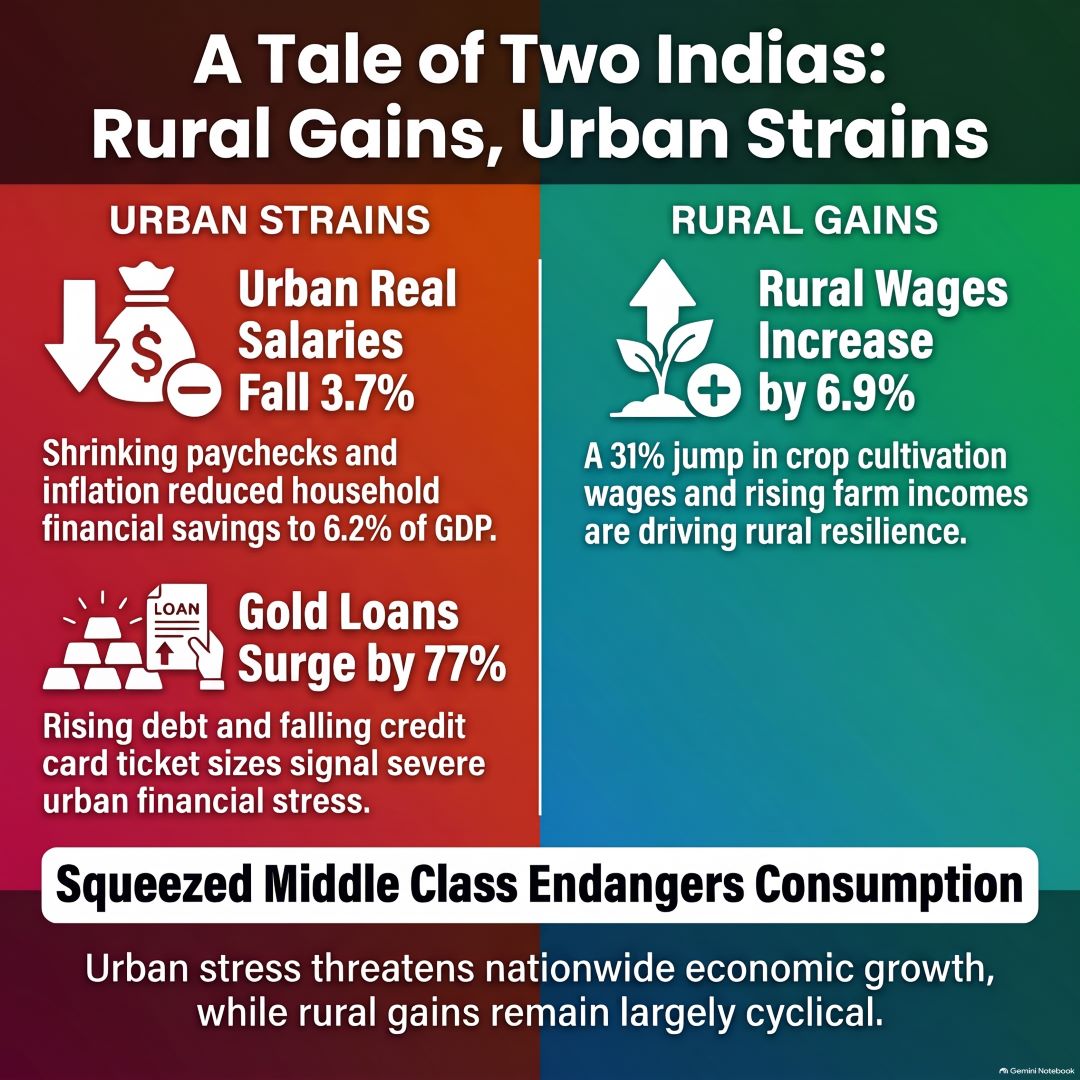
• Gold loans: up 77% (August 2025 y-o-y); 20% of gold-loan borrowers are delinquent on other personal loans, and GenZ borrowers are visible.
• Falling savings: household financial savings fell to 6.2% of GDP in 2025-26 after deducting debt. Mutual fund inflows fell 36% in the first five months of the financial year.
• Income squeeze: 2025 was the worst year for corporate pay raises in 15 years; the CMIE finds average urban salaries fell 3.7% (May to August) while retail inflation rose about 2.3%. Illustration: a salary of Rs 1,00,000 falls to Rs 96,300 and savings drop from Rs 10,000 to Rs 4,250.
• Jobs: AI is replacing workers, and hiring is concentrated at lower pay.
Rural Resilience
• Farm income from the kharif crop is set to rise 6.4% (against 2.8% in 2025).
• Rural wages rose 6.9% (inflation-adjusted) in August, driven by a 31% rise in crop cultivation wages.
• Occupational shift: the number of small traders, hawkers and casual labourers fell 10% while those working as farmers rose 10.1%. (This is also a sign of distress in non-farm jobs.)
• Political economy: upcoming Assembly elections in Uttar Pradesh and Punjab mean more transfers and subsidies, DBT and release of pending dues.
Analysis
• Rural gains may be cyclical (monsoon, MSP, election transfers), not structural.
• Risk: the middle class drives consumption demand; its stress can slow growth and fuel anger and protests (the article refers to GenZ protests and social media campaigns).