

ADOPT POLICIES FOR REUSE OF TREATED WATER

ADOPT POLICIES FOR REUSE OF TREATED WATER
Context
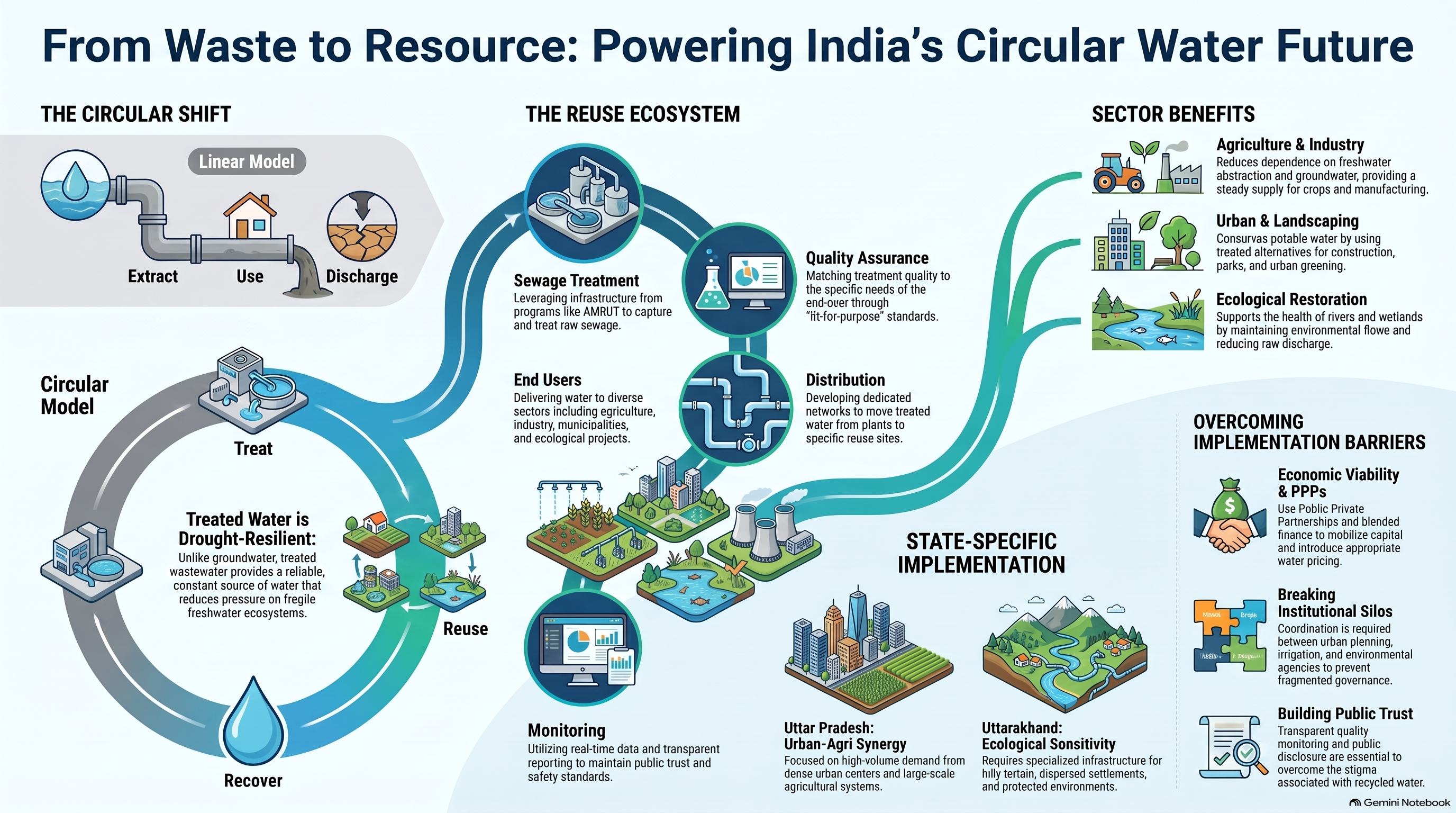
India faces growing water stress due to urbanisation, population growth, industrialisation, agricultural demand and climate change. The recently notified treated wastewater reuse policies of Uttar Pradesh and Uttarakhand highlight the need for context-specific and circular water management.
Why Treated Wastewater Matters?
Treated wastewater can provide a relatively reliable, drought-resilient source of water while reducing pressure on freshwater ecosystems and groundwater.
|
Potential Use |
Benefit |
|
Agriculture |
Reduces dependence on freshwater and groundwater |
|
Industry |
Provides an alternative to freshwater abstraction |
|
Landscaping & construction |
Conserves potable water |
|
Ecological restoration |
Supports rivers, wetlands and urban ecosystems |
|
Urban water supply systems |
Strengthens drought resilience |
From Treatment to Reuse
India has invested significantly in sewage-treatment infrastructure through programmes such as AMRUT. However, treatment capacity alone is insufficient.
The key challenge is creating a reuse ecosystem linking:
Sewage treatment → Quality assurance → Distribution → End users → Monitoring
Treated water should reach farmers, industries, municipalities and ecological projects instead of merely being discharged into drains or water bodies.
Need for Contextualised Policies
Uttar Pradesh and Uttarakhand demonstrate why wastewater policies cannot follow a uniform national template.
- Uttar Pradesh: Dense urban and agricultural systems create substantial demand for recycled water.
- Uttarakhand: Hilly terrain, dispersed settlements and ecological sensitivity require different infrastructure and reuse strategies.
Both approaches emphasise fit-for-purpose reuse, where water quality is matched to its intended use.
National Framework
The National Framework on Safe Reuse of Treated Water (SRTW), 2022 provides the broader policy foundation.
Its approach recognises that:
National vision + State-specific implementation = sustainable water security
States need measurable reuse targets, quality standards, monitoring systems and city-level implementation plans.
Major Challenges
|
Challenge |
Required Response |
|
Fragmented governance |
Integrated coordination among water, urban, irrigation and environment agencies |
|
Limited economic incentives |
Appropriate pricing, incentives and blended finance |
|
Poor linkage between STPs and users |
Develop dedicated reuse networks |
|
Public distrust |
Transparent quality monitoring and awareness |
|
Uneven State capacity |
Technical assistance and localised planning |
|
Infrastructure-focused approach |
Shift towards actual utilisation and outcomes |
Way Forward
1. Make reuse economically viable: Introduce appropriate pricing, incentives and innovative financing.
2. Break institutional silos: Integrate urban planning, water supply, sanitation, irrigation and environmental management.
3. Promote PPPs and blended finance: Mobilise private capital for treatment, distribution and reuse infrastructure.
4. Build public trust: Ensure stringent quality standards, real-time monitoring and public disclosure of water-quality data.
5. Adopt fit-for-purpose standards: Match treatment quality with specific applications rather than imposing a uniform standard for every use.
6. Scale successful State models: Use the experiences of Uttar Pradesh and Uttarakhand to develop adaptable models for other States.
Conclusion
India's water challenge cannot be addressed merely by creating new freshwater sources or expanding treatment infrastructure. Treated wastewater must be recognised as a valuable economic and environmental resource.
A transition from a linear model — use, discharge and extract again — to a circular model — treat, reuse and recover — can reduce groundwater stress, strengthen climate resilience and improve long-term water security. The priority now is to move from isolated policy initiatives to locally adapted, economically viable and effectively monitored wastewater reuse systems.
