

AFSPA: Balancing National Security and Civil Liberties

AFSPA: Balancing National Security and Civil Liberties
1. Latest Status and Background
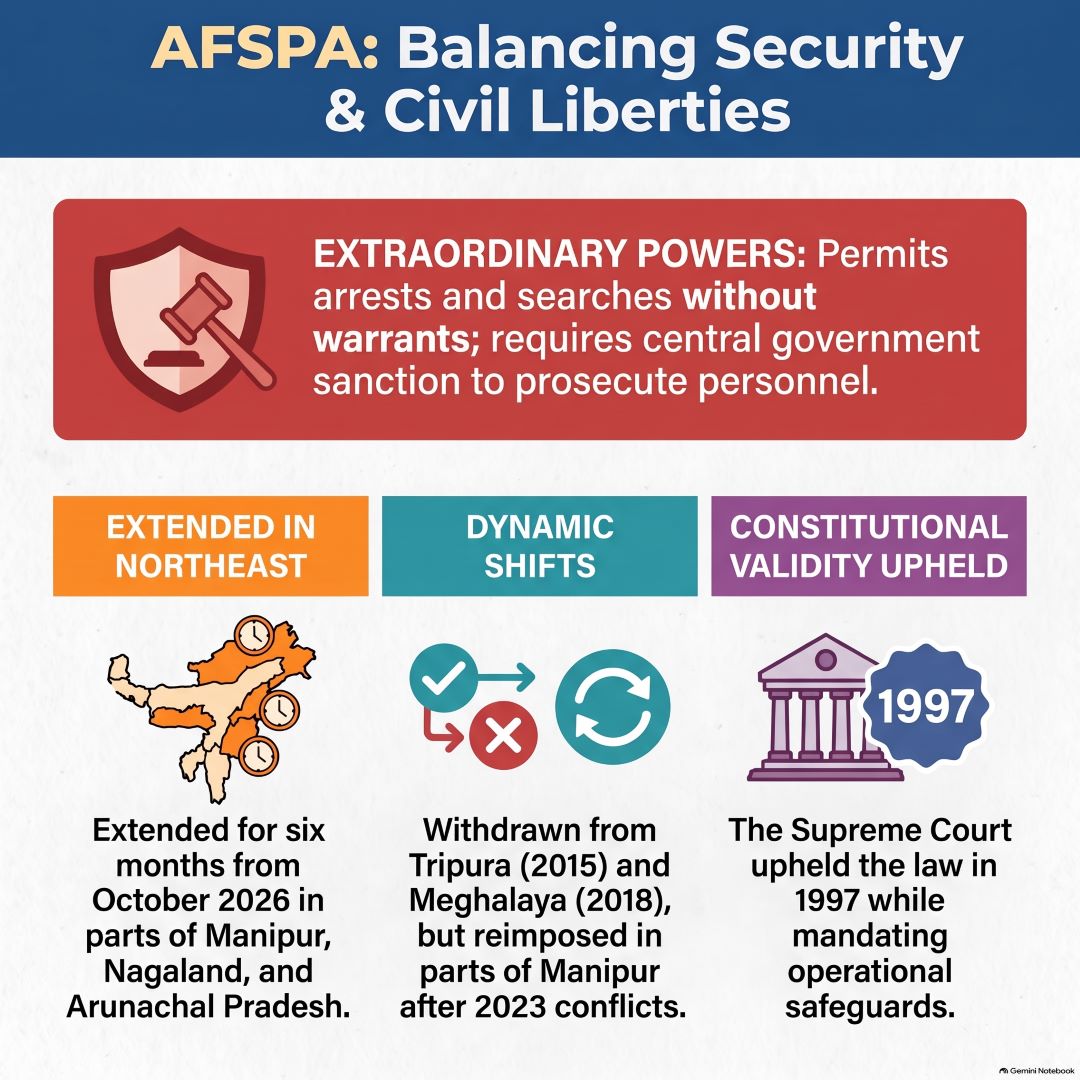
- The Union Ministry of Home Affairs has extended AFSPA, 1958 for another six months from 1 October 2026 in parts of Manipur, Nagaland and Arunachal Pradesh.
- In Manipur, the entire state is declared a “disturbed area” except the jurisdictions of 13 police stations in five Valley districts.
- In Nagaland, AFSPA continues in 9 districts and areas under 21 police stations in 5 other districts.
- In Arunachal Pradesh, it continues in Tirap, Changlang and Longding and specified areas of Namsai district.
- The present extension occurs in the context of the ethnic conflict in Manipur since May 2023.
2. Powers under AFSPA
- Under Section 3, an area can be declared a “disturbed area” when the situation is considered sufficiently disturbed due to insurgency or serious internal security challenges.
- Once AFSPA applies, armed forces receive powers beyond ordinary policing, including:
- Use of force, including lethal force, in specified circumstances.
- Arrest without warrant.
- Search and entry without warrant under specified conditions.
- Section 7 provides legal protection: prosecution or legal proceedings against personnel for acts done or purportedly done under the Act require prior sanction of the Central Government.
- These extraordinary powers and the sanction requirement have made AFSPA a subject of debate concerning security, accountability and civil liberties.
3. Evolution of AFSPA in Northeast India
- AFSPA was enacted in 1958, initially in the context of insurgency in the Naga Hills and Assam.
- Its application has not remained uniform:
- Tripura: AFSPA completely withdrawn in 2015.
- Meghalaya: Revoked from April 2018 after about 27 years.
- Assam: Disturbed-area notification is issued by the State Government.
- Jammu & Kashmir: Governed by a separate J&K Armed Forces (Special Powers) Act, 1990.
- This demonstrates that AFSPA's geographical scope has historically expanded or contracted according to security conditions.
4. Manipur: Contraction and Reimposition
- 2004: AFSPA was withdrawn from Imphal municipal area.
- April 2022–April 2023: It was withdrawn from all police-station areas in the Manipur Valley, reflecting an assessment of improved security.
- AFSPA continued in several hill areas.
- The May 2023 ethnic conflict reversed the earlier process of gradual withdrawal.
- November 2024: MHA reimposed AFSPA in areas covering six police stations across five districts.
- The Manipur government's disagreement with the Centre's decision illustrates the difficult balance between Union security responsibilities and State-level political preferences.
5. Constitutional and Governance Issues
· AFSPA represents a difficult balance between national security and fundamental civil liberties. Supporters emphasise the need to provide security forces with operational flexibility in areas affected by insurgency, while critics have raised concerns about accountability and the possibility of excessive use of force.
· The Supreme Court has also examined AFSPA-related issues. In Naga People's Movement of Human Rights v. Union of India (1997), the Court upheld the constitutional validity of AFSPA but laid down safeguards concerning the exercise of powers under the Act.
· The broader challenge is therefore not simply whether AFSPA should exist, but when, where and under what safeguards extraordinary security powers should be exercised. Periodic review, clearly defined disturbed areas, effective accountability mechanisms and restoration of normal civil administration when security conditions improve are important for maintaining the balance between security and civil liberties.
