

Agriculture: Left Behind in 35 Years of Liberalisation

Agriculture: Left Behind in 35 Years of Liberalisation
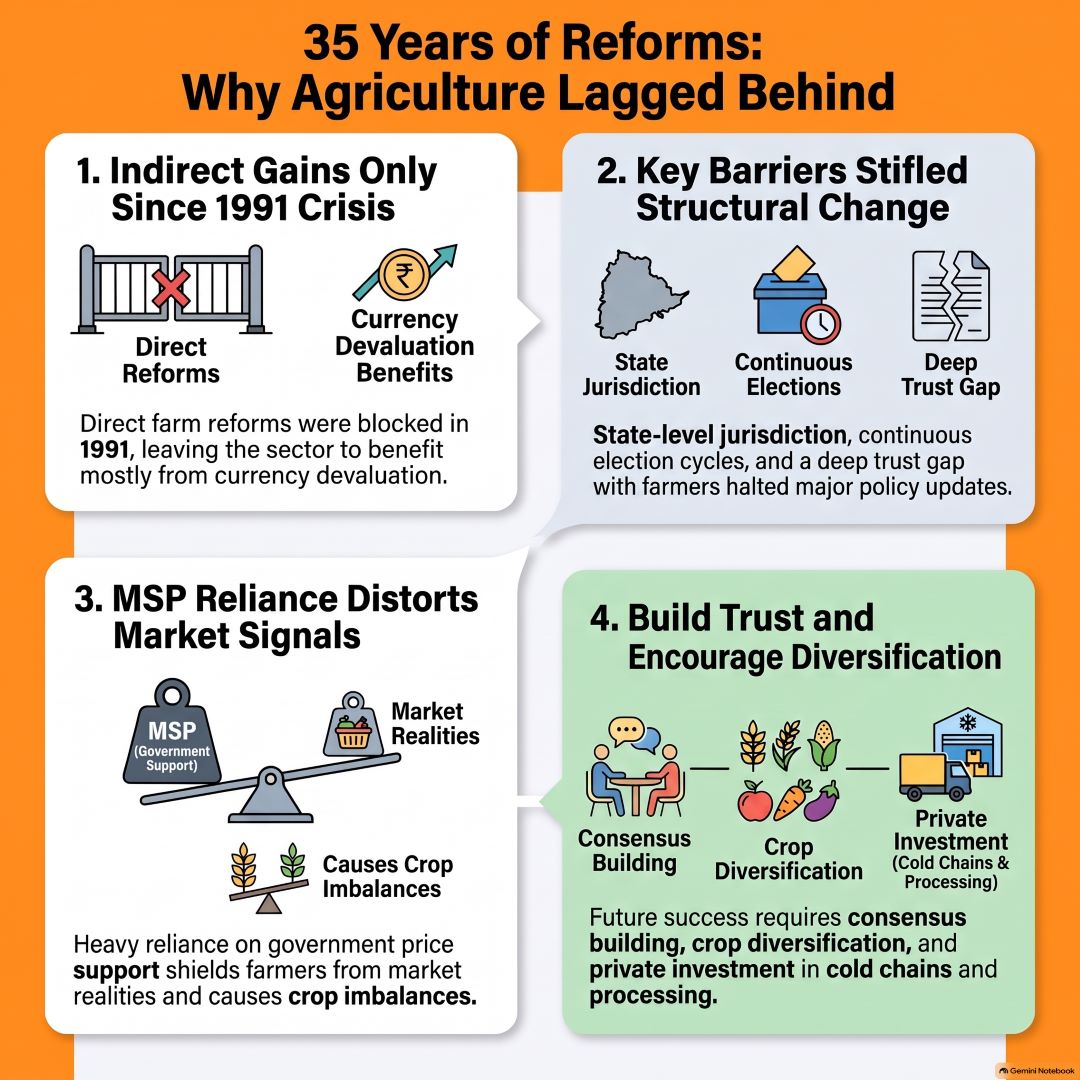
Why in News?
- Source: Business Standard, 1 October 2026, "Agriculture: Strong reform intentions, but little progress", part of its series on 35 years of the 1991 reforms.
- Experts such as Ashok Gulati, Ramesh Chand and Ajay Vir Jakhar say agriculture saw far fewer reforms than industry, trade or finance.
- A West Asia war has pushed up fertiliser prices and the subsidy bill, putting pressure on India's fiscal balance, much as the 1991 crisis did.
Background
- The 1991 balance-of-payments crisis led to a rupee devaluation of over 40% within three days, lower import tariffs and the end of industrial licensing.
- Agriculture gained only indirectly, through a depreciated rupee and lower industrial protection. Montek Singh Ahluwalia says this helped sectors like horticulture.
- Direct farm reforms were blocked at the time by the minority government's allies and the Opposition.
- Later attempts were limited:
- 2001-02: wheat, paddy, coarse grains, sugar, edible oilseeds and pulses were freed from the Essential Commodities Act, 1955.
- 2003: the ban on futures trading in agricultural commodities was lifted.
- GM cotton was permitted, and it remains India's only GM crop.
- 2020: three farm laws on agricultural marketing were passed and later repealed after farmers' protests.
Why Reforms Did Not Happen?
- Agriculture is less politically attractive than industry or finance, and specialised expertise is scarce at the top of policymaking.
- Agriculture and markets are State subjects, so the Centre has limited room to reform.
- China focused on agriculture for its first 10 years of reform. India preferred industrial and service reforms within the Centre's domain.
- Influential farming communities resist change, and there is a trust gap between farmers and political leaders.
- Governments are in a near-continuous election cycle, so they have little bandwidth for structural reforms.
Impact
- Agriculture's share in GDP has declined as industry and services grew faster, but labour has not moved out of agriculture at the required pace.
- Heavy dependence on MSP and assured procurement shields farmers from market signals. This leads to overproduction of some crops and shortages of others.
- Low private investment has hurt storage, trading, value addition and food processing.
- Sustainability is under threat from falling groundwater, nutrient-deficient soils and low soil organic carbon.
Way Forward
- Pursue "second-generation reforms" in marketing, with State consensus.
- Promote crop diversification and gradually reduce dependence on MSP-based procurement.
- Attract private investment in cold chains, warehousing and food processing.
- Use fertiliser and water efficiently to contain the subsidy burden.
- Build farmers' trust through consultation before introducing reforms.
