

AI anxiety can turn into an advantage for Atmanirbhar India
Indian Express
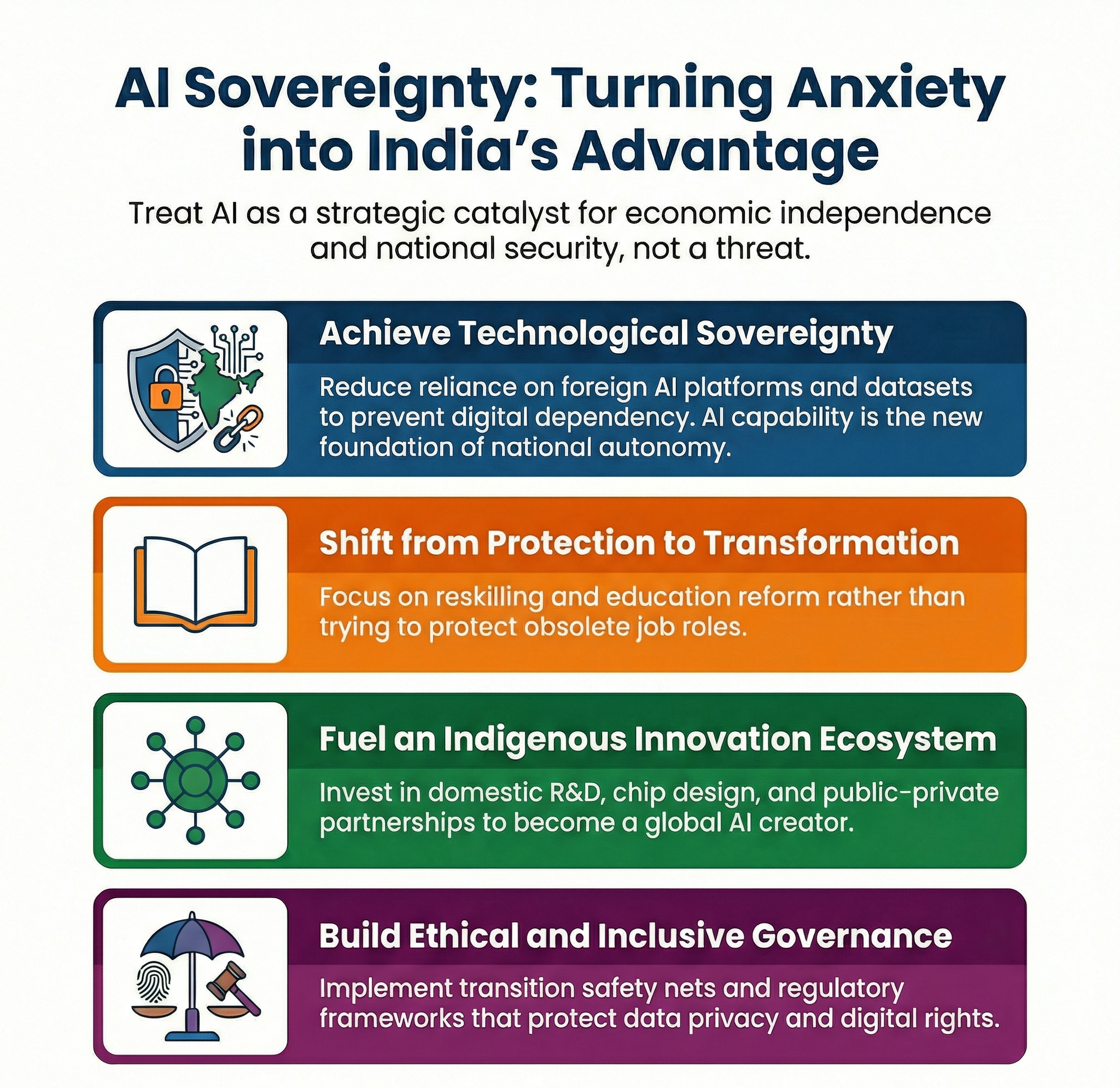
Core Arguments of the Article
1. AI as Disruption and Opportunity
The author acknowledges that AI generates legitimate anxiety—especially regarding job displacement and automation. However, the argument is that technological revolutions historically create new sectors, productivity gains, and fresh employment avenues.
The implicit thesis: India must not fear AI but strategically harness it.
2. Atmanirbharta through Technological Sovereignty
AI is framed not merely as an economic tool but as a strategic domain. If India depends excessively on foreign AI platforms, chips, and datasets, it risks digital dependency.
Thus, AI capability becomes central to economic independence and national security.
3. Skill Transformation over Job Protection
Instead of protecting obsolete jobs, the focus must be on reskilling, upskilling, and education reform. The author emphasizes human capital development as the bridge between anxiety and advantage.
4. Domestic Innovation Ecosystem
The article hints that AI adoption must be accompanied by indigenous research, startup ecosystems, and public-private collaboration. Without domestic innovation, India risks becoming merely a consumer of global AI systems.
Author’s Stance
The stance is techno-optimist but policy-sensitive.
The author does not dismiss fears as irrational. Rather, he reframes anxiety as a catalyst for reform. The tone supports proactive state intervention combined with market dynamism.
The ideological leaning is developmental-nationalist: technology is a tool for strengthening national autonomy.
Underlying Biases
1. Technological Determinism
The article assumes AI adoption is inevitable and largely beneficial. It underplays structural inequalities that technology can worsen.
2. Growth-Centric Lens
There is emphasis on productivity and competitiveness. Less attention is given to ethical AI, algorithmic bias, or digital rights.
3. Limited Labour-Side Analysis
While reskilling is mentioned, the deeper challenges of informal labour, gig vulnerability, and rural employment transitions are not sufficiently elaborated.
Pros of the Argument
1. Strategic Clarity
It correctly identifies AI as a strategic sector, similar to semiconductors or critical minerals. This aligns with India’s push for digital sovereignty.
2. Focus on Skill Capital
Emphasis on human capital aligns with India’s demographic advantage.
3. Policy Realism
The argument avoids protectionism and supports adaptation rather than resistance.
4. Alignment with National Missions
It complements initiatives like Digital India, Startup India, National AI Mission, and semiconductor push.
Cons and Gaps
1. Employment Shock Underestimation
Automation could disproportionately affect routine, mid-skill jobs in services—an area where India has comparative strength.
2. Regional Inequality
AI adoption may widen urban-rural divides.
3. Ethical Governance
The article does not sufficiently address AI regulation, data protection, and algorithmic accountability.
4. Fiscal Constraints
Scaling AI infrastructure, R&D, and skill programs requires sustained public investment.
Policy Implications
Education Reform
Curriculum redesign towards computational thinking, AI literacy, and interdisciplinary skills.
Labour Market Transition
Creation of transition safety nets, portable skilling vouchers, and lifelong learning frameworks.
Indigenous R&D
Increased funding for public research institutions, AI compute infrastructure, and domestic chip design.
Regulatory Framework
Balanced AI governance that protects innovation while ensuring data privacy and ethical safeguards.
MSME Integration
Support for small enterprises to adopt AI tools, preventing concentration of benefits in large firms.
Real-World Impact
If implemented effectively:
• Increased productivity in manufacturing and services
• Reduced import dependence in high-tech sectors
• Greater global competitiveness
• Emergence of AI-driven startups
If poorly managed:
• Job polarization
• Social unrest due to unemployment
• Digital dependency on foreign tech giants
• Widening inequality
UPSC GS Paper Alignment
GS Paper II
Governance reforms, education policy, data protection, digital sovereignty, public-private partnerships.
GS Paper III
Science and Technology developments, inclusive growth, employment, industrial policy, startups, economic self-reliance.
GS Paper IV
Ethics in technology, AI governance, accountability, and public interest in emerging technologies.
Balanced Assessment
The article rightly identifies AI anxiety as a productive tension. Fear signals structural transformation. If policymakers channel this anxiety into reforms—education overhaul, industrial strategy, and regulatory preparedness—AI can indeed strengthen Atmanirbhar Bharat.
However, optimism must be tempered by distributive justice concerns. Technological change is not automatically inclusive. It must be shaped by deliberate statecraft.
Future Perspective
India stands at a technological inflection point. The coming decade will determine whether AI becomes:
• A tool of digital colonisation
or
• A pillar of strategic autonomy
The transformation of anxiety into advantage depends on three pillars: skill depth, sovereign innovation capacity, and ethical governance.
For UPSC aspirants, the key takeaway is that AI is not merely a technology topic. It is a governance, economic, ethical, and geopolitical issue—central to India’s development trajectory in the 21st century.
