

AI-BASED PROTEIN DESIGN: REWRITING THE BUILDING BLOCKS OF LIFE

AI-BASED PROTEIN DESIGN: REWRITING THE BUILDING BLOCKS OF LIFE
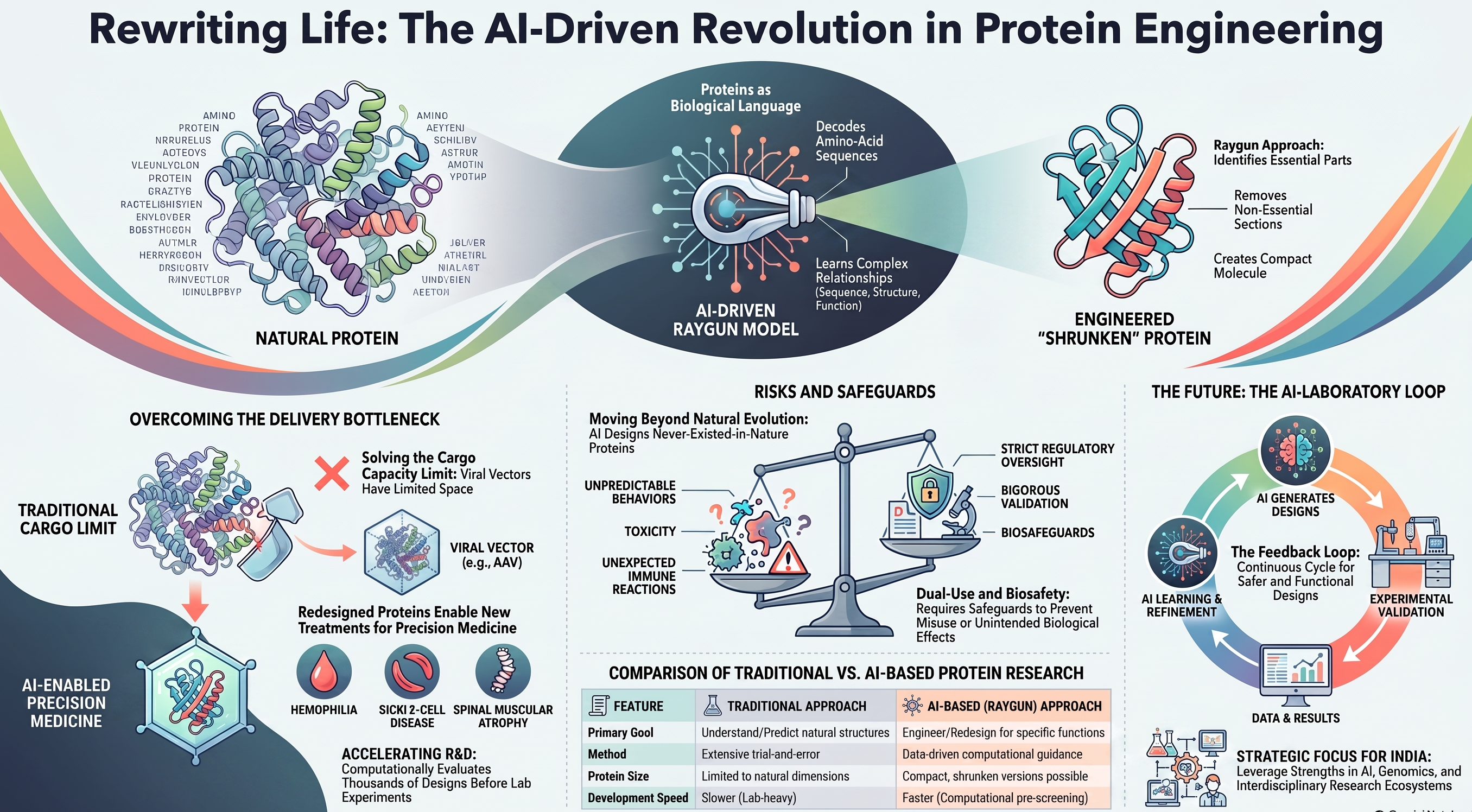
Context
- Scientists at Duke University, in research published in Nature, have developed an AI-based approach to shrink and redesign proteins while retaining their essential functions.
- The development uses protein language models, signalling a shift from merely understanding biological molecules towards engineering proteins with desired characteristics.
- The technology has particular relevance for gene therapy, where the size of therapeutic genes can be constrained by the limited cargo capacity of delivery vectors.
Protein Language Models and the Raygun Approach
- Proteins are chains of amino acids in which the sequence determines the eventual structure and biological function of the molecule.
- AI models can treat amino-acid sequences like a form of biological language, learning relationships between sequence, structure and function from millions of naturally occurring proteins.
- The Raygun model can analyse existing proteins and generate shorter versions while attempting to preserve their important functional characteristics.
- This approach uses patterns produced through evolutionary selection to identify which parts of a protein are essential and which may be modified or removed.
- Thus, AI can move protein engineering from extensive trial-and-error towards data-driven and computationally guided design.
- Smaller proteins could help overcome the packaging limitations of viral vectors such as AAVs, improving the feasibility of certain gene therapies.
- Potential applications include treatment of haemophilia, sickle-cell disease and spinal muscular atrophy, apart from broader applications in biotechnology.
- AI-assisted protein engineering can accelerate drug discovery, enzyme engineering, synthetic biology and development of novel biomaterials.
- The technology could allow researchers to evaluate numerous possible protein designs computationally before undertaking expensive laboratory experiments.
- It therefore represents a transition from protein prediction to protein design, with potential implications for the future of precision medicine.
Limitations and Biosafety Concerns
- AI models primarily learn from existing evolutionary patterns, while artificially designed proteins may exhibit properties that have not occurred naturally.
- A computationally promising protein may therefore behave differently when produced and tested in a biological system.
- Major concerns include unintended biological effects, toxicity, immune reactions and difficulty in predicting novel protein functions.
- The increasing ability to design biological molecules also creates dual-use concerns, requiring appropriate safeguards against misuse.
- Consequently, AI-generated protein designs must undergo rigorous laboratory validation, biosafety assessment and regulatory scrutiny.
Way Forward and Relevance for India
- India can leverage its strengths in Artificial Intelligence, biotechnology, genomics and pharmaceuticals to develop indigenous capabilities in AI-driven protein engineering.
- Greater investment is required in protein databases, computational biology, interdisciplinary research and AI-biology laboratories.
- Collaboration between ISRO/DRDO-type research ecosystems where relevant, universities, biotechnology start-ups and pharmaceutical companies can accelerate translational applications.
- India should develop clear ethical, biosafety and regulatory frameworks for AI-enabled biological design while encouraging responsible innovation.
- The future lies in an AI–laboratory feedback loop, where AI generates and prioritises protein designs and experimental research validates their structure, function and safety.
Conclusion
AI-based protein design can transform biotechnology from understanding naturally occurring proteins to deliberately engineering biological molecules. For India, the convergence of AI and biotechnology provides an opportunity to strengthen indigenous drug discovery, gene therapy and advanced life-science capabilities, provided innovation is accompanied by robust scientific validation and biosafety governance
