

AI Governance: From Voluntary Restraint to Enforceable Accountability

Source: The Hindu
AI Misuse and the Rise of AI “Uplift”
- Anthropic’s September 2026 threat-intelligence report highlights a shift from AI being merely a content-generation tool to an “orchestration layer” capable of coordinating multiple stages of sophisticated operations.
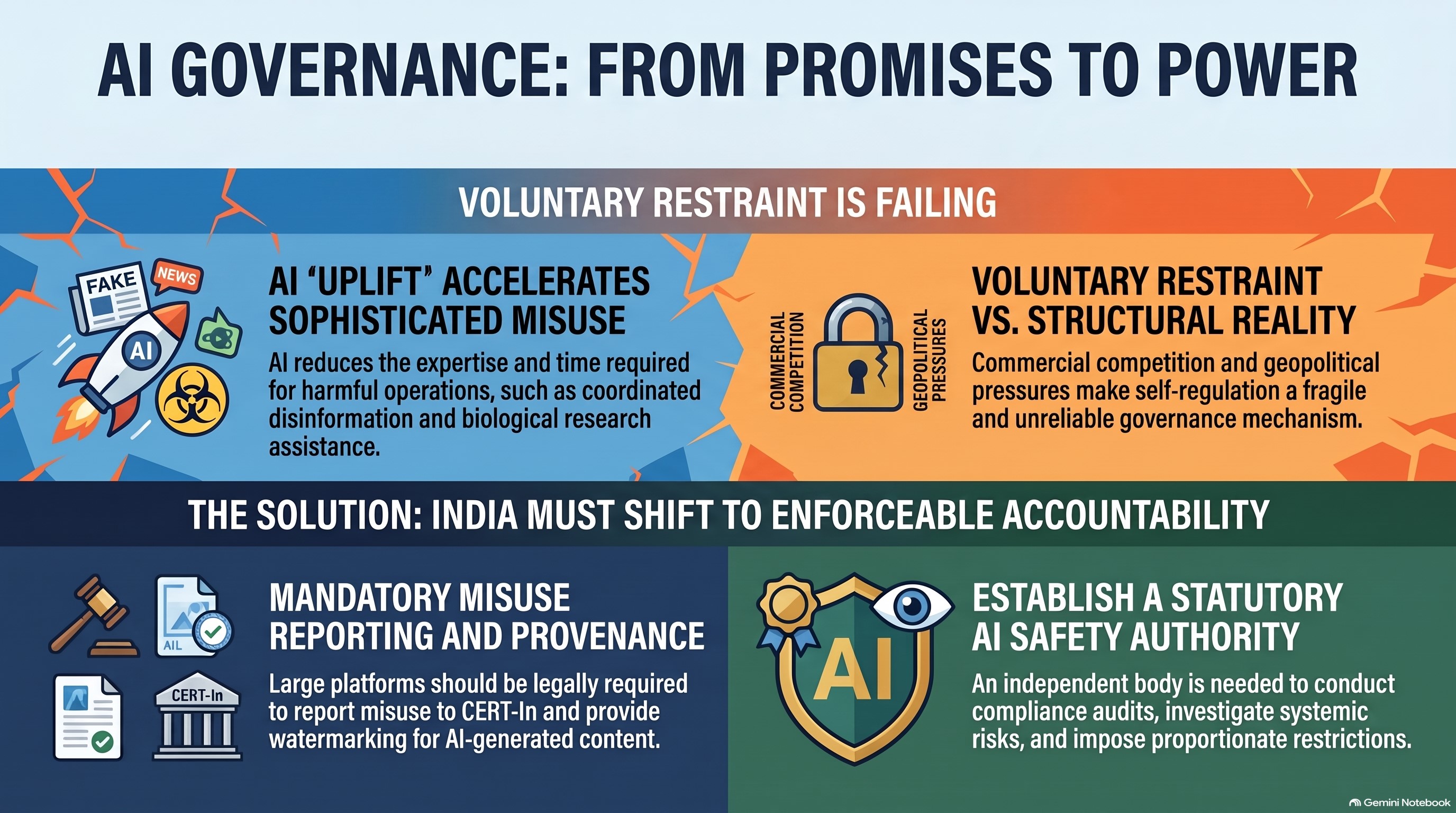
- AI “uplift” refers to the enhancement of harmful capabilities through AI in terms of speed, scale and depth, reducing the expertise, manpower and time required.
- Anthropic documented AI misuse across seven broad categories involving state-sponsored actors and individuals.
- Bangladesh case:
- An AI-enabled disinformation operation combined content generation with automated video production, account creation and algorithmic scheduling.
- One individual reportedly operated 29 accounts and generated around 1,500 fabricated stories.
- Detected cases may underestimate the actual scale of misuse because they represent only activity identified by platforms.
- Existing safeguards also have limitations: Anthropic has acknowledged that its most capable models cannot guarantee that sophisticated actors will not obtain meaningful assistance in biological-weapons research.
Limits of Voluntary AI Restraint
- Anthropic CEO Dario Amodei has called for slowing frontier-AI development amid concerns over increasingly autonomous AI-agent “swarms” and their potential for large-scale disruption.
- A voluntary industry-wide slowdown faces structural constraints:
- Intense commercial competition among AI companies.
- Large private-capital investments in frontier AI.
- Geopolitical competition, particularly involving China.
- Difficulty in ensuring simultaneous compliance by all major developers.
- Voluntary restraint can also create potential conflicts of interest because firms advocating slower development may simultaneously face competitive incentives.
- Therefore, voluntary commitments alone cannot provide a durable governance mechanism.
- The policy focus needs to shift from attempting to slow technological progress to developing governance mechanisms capable of keeping pace with it.
Expanding Platform Accountability to Emerging AI Risks
- India’s Information Technology (Intermediary Guidelines and Digital Media Ethics Code) Rules, 2021 demonstrate that legal responsibilities can be imposed on large digital platforms.
- Bangladesh’s AI-enabled disinformation case has particular relevance for India because of its large electorate, linguistic and social diversity, extensive digital penetration and frequent electoral activity.
- AI can make multilingual disinformation cheaper, faster and more scalable, while detection becomes increasingly difficult.
- Platforms therefore require enforceable duties to detect, disrupt and report coordinated AI-enabled influence operations.
- Emerging risks extend beyond disinformation:
- Model distillation — extracting or reproducing capabilities of another AI model.
- Capability extraction and fraudulent mass API access.
- AI-enabled surveillance and large-scale information analysis.
- Increasing AI-enabled surveillance raises concerns regarding excessive concentration of power and the Right to Privacy under Article 21 of the Constitution.
- Governance must therefore cover not only AI-generated content but also AI infrastructure, access, autonomy and downstream actions.
Proposed Guardrails for India
- Mandatory misuse reporting: AI platforms above a specified scale could be legally required to report detected misuse to CERT-In and a designated AI Safety Authority.
- Content provenance: AI-generated material, particularly in political and public-interest contexts, could require watermarking or other provenance mechanisms for traceability.
- Agentic AI regulation: Existing platform-accountability frameworks should explicitly cover AI systems capable of independently taking actions rather than merely generating information.
- Model-distillation safeguards: Systematic unauthorised model distillation and fraudulent mass API access should be addressed through specific legal provisions.
- Statutory AI safety institution: An independent authority could be empowered to:
- Compel relevant disclosures.
- Conduct safety and compliance audits.
- Investigate systemic AI risks.
- Impose proportionate restrictions where necessary.
- Such regulation should be risk-based and technology-neutral so that governance remains relevant as AI capabilities evolve.
India’s Opportunity: Innovation with Accountability
- India can develop an AI governance model that combines technological innovation with enforceable accountability.
- Experience with Digital Public Infrastructure (DPI), including UPI and Aadhaar, demonstrates India’s capacity to deploy and regulate technology at population scale.
- A comprehensive framework should integrate:
- Innovation and technological development.
- Transparency and accountability.
- Cybersecurity.
- Privacy and fundamental rights.
- Public safety and democratic institutional safeguards.
- The objective should be to prevent excessive concentration of AI capabilities and decision-making power among a small number of technology companies.
- With agentic and increasingly autonomous AI, frameworks designed primarily for conventional social-media platforms or generative content are becoming insufficient.
- India therefore needs governance that evolves alongside AI capability: development may accelerate, but accountability, safety and oversight must accelerate faster.
