

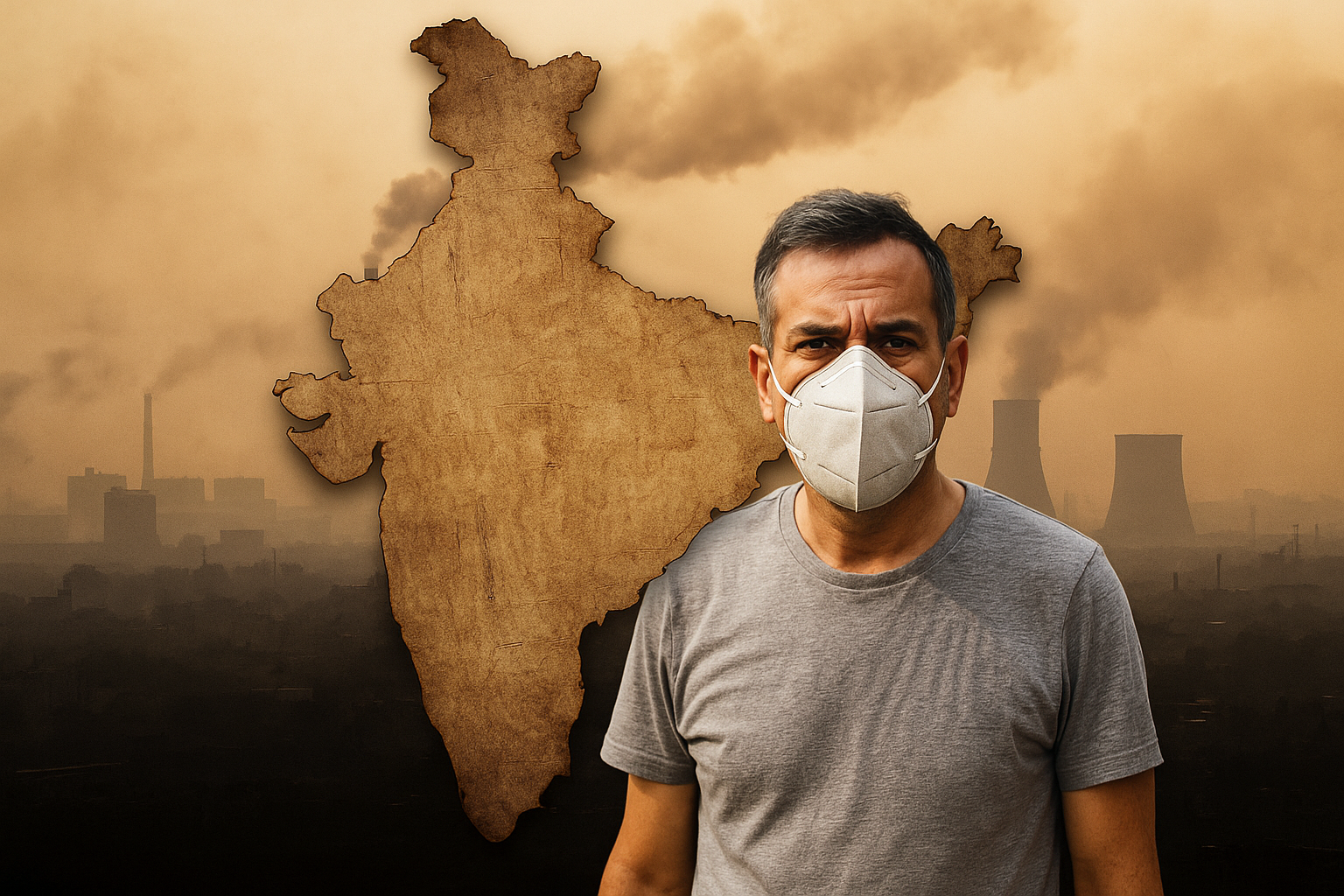
Air pollution, largest external threat to life expectancy, is reducing India’s GDP
Times Of India
Key Arguments Explained
a. Air pollution impacts life expectancy significantly
- India’s pollution levels — 2.5× safe limits worldwide — reduce life expectancy by nearly 5.3 years.
- Even newborns face severe long-term damage, including stunting, poor lung growth, cognitive impacts, and complications during pregnancy.
b. South Asia: the world’s worst air quality region
- Dense population, rapid urbanization, industrial emissions, biomass burning, and fossil fuel dependence make South Asia the most polluted region.
c. Economic impact — Pollution as a GDP drag
- Pollution affects workforce productivity through increased illness, low attendance, and reduced cognitive performance.
- The article links GDP loss to health deterioration, especially for the working poor.
d. Why China succeeded — and lessons for India
- China treated pollution as a national crisis after public pressure.
- It used real-time data, strict enforcement, and centralized political commitment to rapidly reduce PM2.5 levels by more than 40% in a decade.
- India, by contrast, has fragmented governance and slow bureaucratic processes.
e. Why India’s growth model worsens pollution
- Fossil-fuel-driven industrialization, expanding transport demand, and weak enforcement mechanisms worsen pollution levels.
- The “growth-first” approach ignores environmental consequences, leading to a trade-off between expansion and health.
3. Author’s Stance
The tone is urgent, evidence-driven, and critical.
The author and interviewee strongly argue that:
- India underestimates the economic and human cost of air pollution.
- Strong political prioritization is missing.
- Data transparency, governance reforms, and public engagement can trigger real change.
Bias tendency: Pro-regulation and pro-environment, though based on global benchmarks and credible scientific research.
4. Strengths of the Article
a. High-quality evidence
Uses credible EPIC data, Air Quality Life Index (AQLI), and comparative country data.
b. Connects environment with economy
Frames pollution not merely as a health problem but as a major economic threat.
c. Highlights systemic weaknesses
Discusses poor implementation, fragmented responsibilities, and low political focus.
d. Provides global comparisons
Compares India with China, Japan, and Singapore — beneficial for UPSC answers.
5. Weaknesses / Limitations
a. Over-reliance on China as a model
Ignores India’s democratic constraints vs China’s top-down enforcement.
b. Urban bias
Focuses heavily on Delhi and Indo-Gangetic plains; pollution in rural India is underexplored.
c. Limited discussion on structural political economy factors
Such as energy pricing, state-level politics, or municipal governance deficits.
d. Insufficient attention to regional disparities
NE India, coastal regions, and forested regions have distinct pollution patterns, not reflected here.
6. Policy Implications (UPSC GS Mapping)
GS1 — Population & Urbanization
- Life expectancy changes.
- Urban sprawl and unplanned construction as drivers of pollution.
GS2 — Governance
- Need for real-time monitoring.
- Strengthening central-state coordination.
- Transparent public data systems.
GS3 — Environment, Economy, Disaster Management
- PM2.5 as a national health emergency.
- Economic loss due to productivity decline.
- Importance of clean energy, transport reform, waste management.
GS4 — Ethics
- Environmental justice — the poor suffer the worst impacts.
- Intergenerational equity.
- Corporate responsibility.
7. Real-World Impact
Positive Outcomes if Addressed
- Improved life expectancy and public health.
- Higher productivity and GDP.
- Cleaner cities attract investment.
- Reduction in healthcare burden.
- Global credibility in climate action.
Consequences of Inaction
- Rising infant and elderly mortality.
- Severe healthcare expenditure.
- Loss of foreign investment due to “polluted nation perception”.
- Climate migration from the Indo-Gangetic belt.
- Political instability due to public frustration.
8. Balanced Summary
The article convincingly argues that air pollution is India’s biggest external threat to human health and a hidden tax on economic growth.
It calls for China-style urgency but with democratic adaptability.
The message is clear: unless India puts clean air at the centre of development policy, both life expectancy and GDP will continue to suffer.
9. Future Perspectives
To reverse the trend, India must:
- Adopt national-level emergency status for PM2.5 reduction.
- Strengthen NCAP with enforceable targets.
- Replace fragmented city-wise efforts with regional airshed management.
- Shift households from biomass to clean energy.
- Prioritise public transport and EV transition.
- Use technology (remote sensors, satellite data) to ensure transparency.
- Mobilize citizen movements like China’s "Blue Sky" campaign.
If India aligns development with clean air, it can unlock both health dividends and economic dividends.