

Align the Demographic Dividend with Demand from Ageing Populations

Align the Demographic Dividend with Demand from Ageing Populations
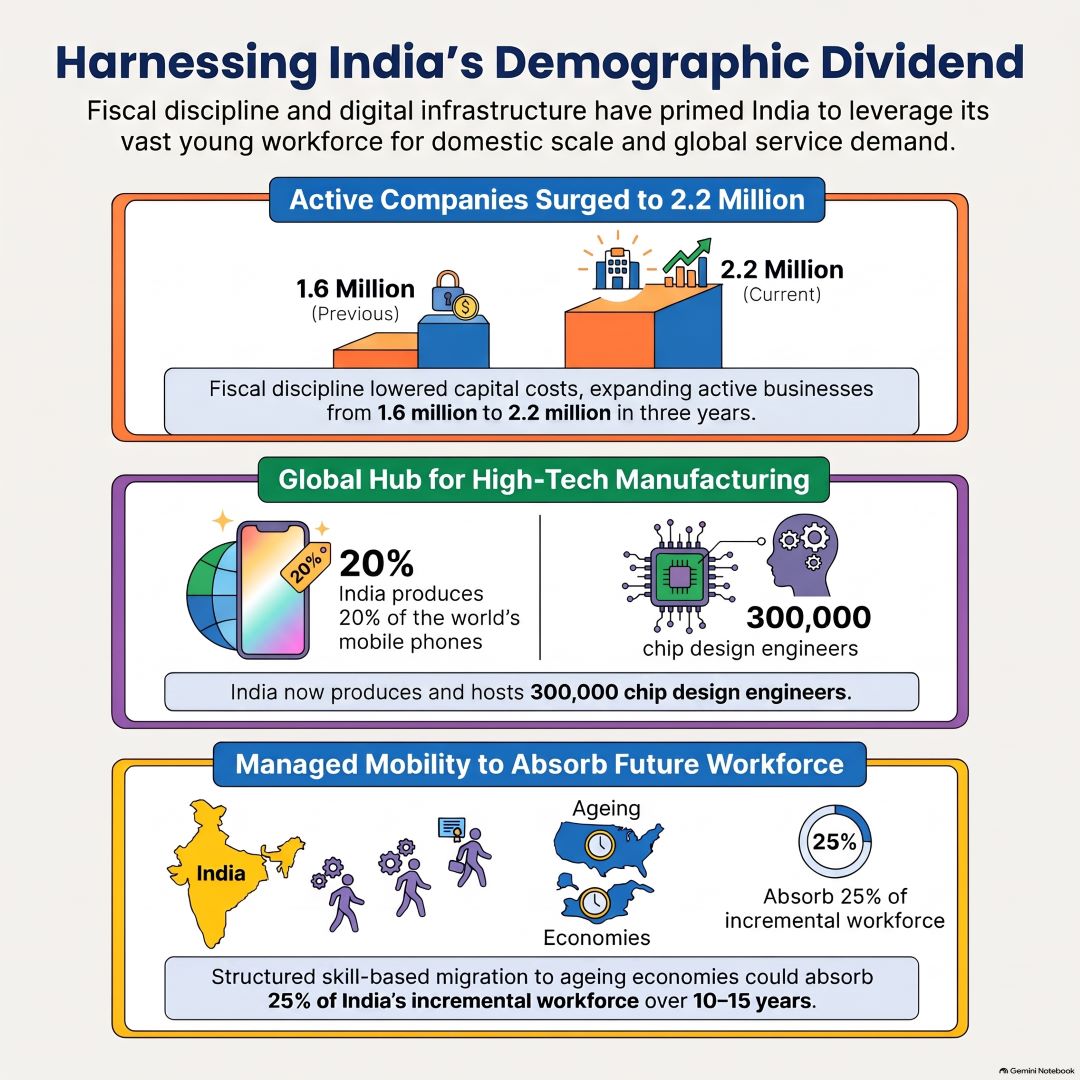
Source: Hindustan Times, 14 Nov 2026
Syllabus: GS III: Indian economy, inflation, manufacturing, employment. GS I: Population and migration
Italic points are static background added from general knowledge, so please verify them.
Why in news?
Speaking at the 24th Hindustan Times Leadership Summit, World Bank executive director Neelkanth Mishra said the Indian economy is on the cusp of a structural change, with cheap capital and technology access for its entrepreneurial class. As India aims for a larger manufacturing share of national income, he said it should also help young Indians find jobs in countries with ageing populations.
Static background
- Demographic dividend: The gain in growth when the working-age share of the population is large. India's window is open, but it pays off only if enough productive jobs are created.
- Flexible inflation targeting (2016): RBI targets CPI inflation of 4% with a band of 2% either side.
- Production-Linked Incentive (PLI) schemes: Launched in 2020, they give incentives on incremental sales of goods made in India, covering 14 sectors. Mobile phones was among the first.
- Digital public infrastructure: Aadhaar, UPI and similar open platforms that businesses can build on.
- Migration and Mobility Partnership Agreements: Government-to-government agreements that allow regulated, skill-based movement of workers.
Inflation and the cost of capital
- Mishra called solving inflation one of the most transformative developments of the last 10 years, achieved through fiscal discipline.
- CPI inflation fell from 10.5% in FY13 to 3.41% in FY19, rose again, and then dropped to a decadal low of 2.06% last fiscal year. Monthly CPI inflation rose to 6.1% in October, per NSO data.
- Discipline on the fiscal side has brought down the cost of capital. The government is effectively telling the private sector and entrepreneurs that money is more productive in their hands, so businesses can be built and jobs created.
- The number of active companies has grown by a third in three years, from 1.6 million to 2.2 million.
- AI and Aadhaar-based digital public infrastructure could be a gamechanger for small and medium businesses.
Manufacturing and PLI
- Electronics: India has reached large volumes in mobile phone exports and accounts for about 20% of annual phone production worldwide (PIB data, December 2025). Critics say assembly adds little value, but Mishra says that is where an industry begins, as in Japan, Korea, Taiwan and China.
- Design strength: There are about 1.5 million chip design engineers in the world and 300,000 are in India. Twenty years ago the work was low-end, but today Indian engineers work on 2-nanometre chips and cutting-edge GPUs.
- PLI limits: Mishra is not confident of similar success in other sectors under the current design, as the mobile PLI worked because it rewarded scale. In footwear, a buyer like Nike purchasing 500 million pairs will not contract half a million or one million pairs, so volumes of 20 to 50 million pairs are needed.
- To raise manufacturing as a share of GDP, domestic demand for materials from construction, infrastructure, real estate and power plants must grow. This cycle is now underway, and he expects manufacturing's share of GDP to start rising.
Labour mobility to ageing economies
- Countries like Japan, the UK, the US and Australia need people for many services.
- Uncontrolled immigration leads to problems of assimilation, cultural change and resistance. A managed route, for example a fixed number of workers with specific skills, avoids this.
- It needs country-to-country coordination. India has migration and mobility partnership agreements with over two dozen countries.
- Such mobility may take 10 to 15 years to reach scale, but could then absorb a fourth of India's incremental workforce.
Conclusion
Mishra's message is that India's macro stability and technology access create an opening, but turning the demographic dividend into jobs needs scale in manufacturing, domestic demand and planned, skill-based migration to countries with ageing populations.