

Anaemia Burden: Iron Alone Is No Solution

Anaemia Burden: Iron Alone Is No Solution
Source: The Hindu
Syllabus: GS II: Health, nutrition, government policies. GS III: Food security
Why in news?
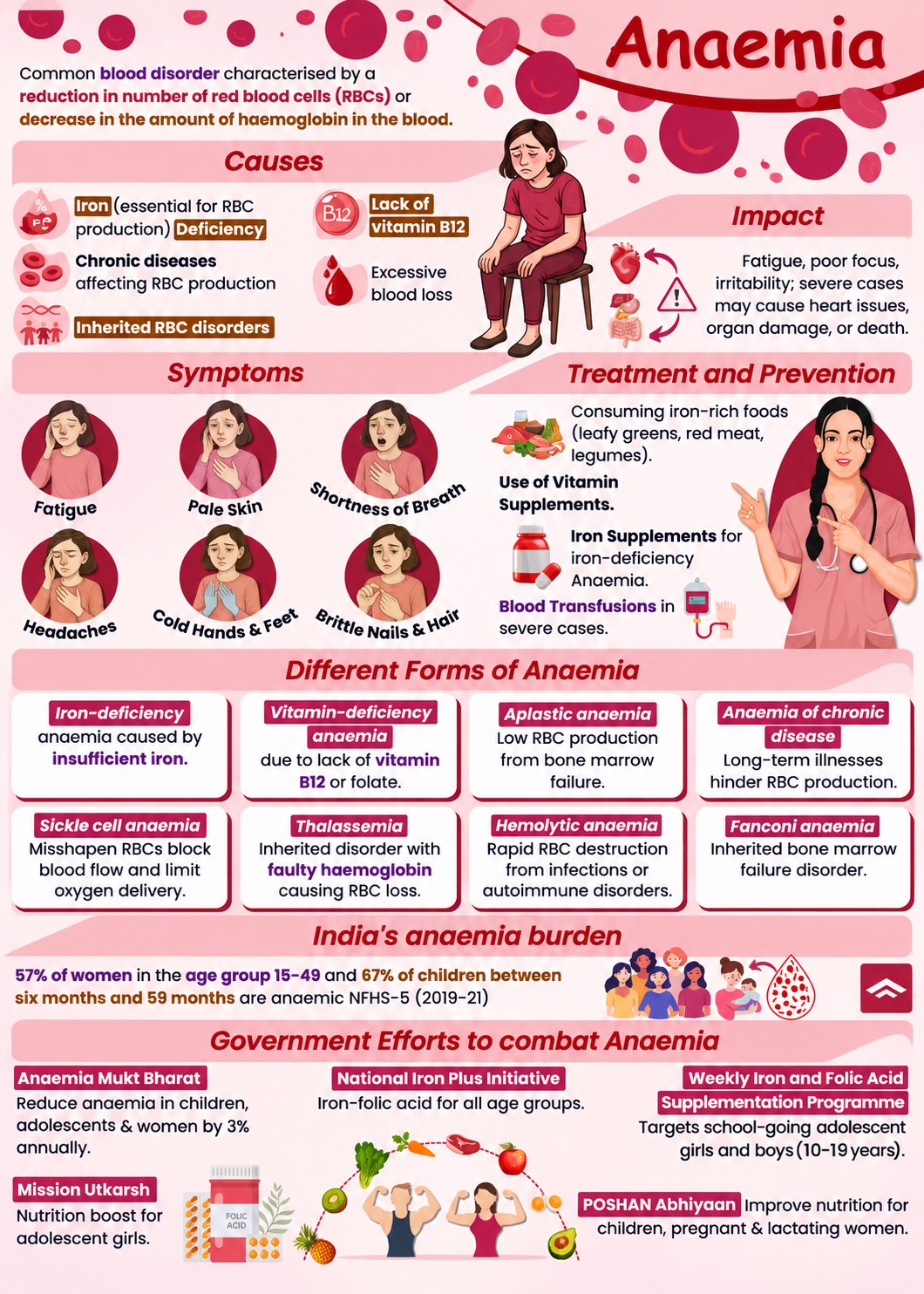
NFHS-5 found that more than half of Indian women and about two-thirds of young children are anaemic. Double-Fortified Salt (DFS), containing iodine and iron, has been proposed as a convenient fix. The editorial argues that convenience does not ensure effectiveness: heavy salt intake, risks of iron accumulation and the many causes of anaemia make universal fortification questionable.
Contradiction between iron fortification and salt reduction
- DFS works only if people keep eating salt.
- Indians eat about twice the WHO limit of 5 g a day. Nearly one in three adults has hypertension, and the National NCD action plan targets a 30% cut in salt intake.
- DFS therefore conflicts with salt-reduction goals.
- Adult men eat more salt than women and children, so those who need more iron may get less.
Risks of excess iron
|
1. International evidence
2. Haemoglobinopathies and iron overload
3. Cumulative iron exposure
|
Lessons from other countries
|
Country |
What worked |
Lesson |
|
Peru |
Double-digit fall in child anaemia in the early 2010s through political priority, tracking each child, iron supplements, micronutrient powders and cash transfers. Progress reversed when COVID-19 disrupted health services |
Sustained health services and institutional accountability matter |
|
Vietnam |
Fall in anaemia among women through weekly IFA, deworming and fish sauce fortified with NaFeEDTA (iron better absorbed in phytate-rich diets), helped by rising incomes and varied diets |
Fortification must suit local diets and come with broader nutrition measures |
Policy recommendations
India should avoid an immediate nationwide DFS rollout and instead:
- Run monitored district-level pilots.
- Measure haemoglobin, ferritin and inflammation markers.
- Assess cumulative iron exposure across schemes.
- Monitor risks in malaria-endemic and haemoglobinopathy-prone regions.
- Use better-absorbed iron forms and targeted fortification.
- Strengthen diagnostics, deworming, malaria prevention and sanitation.
- Improve affordable access to diverse, nutritious food.
Conclusion
Anaemia needs urgent action, but universal iron fortification through DFS may create health risks and clash with salt-reduction goals. Peru and Vietnam show that success needs integrated nutrition programmes, targeted supplementation and strong health delivery. Anaemia is a multidimensional public health challenge, not a deficiency that an additive in the salt bottle can fix.