

Are 40 out of 100 children malnourished in Gujarat?
The Hindu
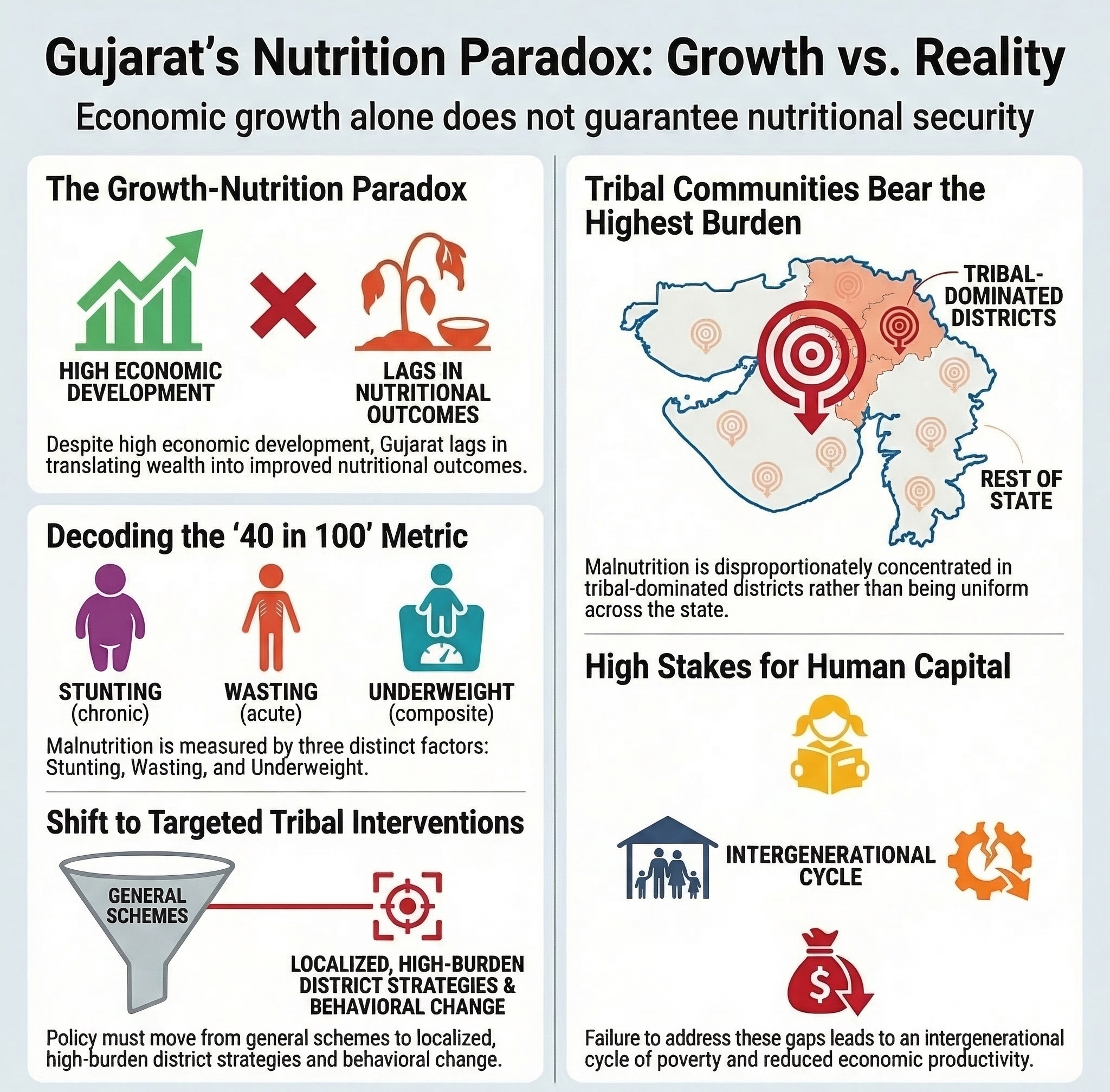
Key Arguments of the Article
Malnutrition Levels are High but Context-Specific
The article confirms that a significant proportion of children in Gujarat suffer from malnutrition (stunting, wasting, underweight), but the figure of “40 out of 100” is not uniformly applicable across all categories.
Different indicators show varying levels of severity.
Tribal Communities Bear Higher Burden
A key argument is that malnutrition is disproportionately concentrated among tribal populations. District-level data shows that tribal-dominated areas report significantly worse outcomes compared to state averages.
This highlights intra-state inequality.
Data Interpretation Matters
The article stresses that malnutrition indicators must be understood carefully.
• Stunting reflects chronic malnutrition
• Wasting indicates acute malnutrition
• Underweight is a composite measure
Simplistic aggregation can lead to misleading conclusions.
Gujarat’s Performance is Mixed
While Gujarat performs better than some states on certain indicators, it lags behind others despite relatively strong economic growth.
This reflects the “growth without nutrition outcomes” paradox.
Role of Welfare Schemes
Government interventions such as ICDS, Poshan Abhiyaan, and supplementary nutrition programmes have improved outcomes, but implementation gaps persist.
Author’s Stance
The author adopts a data-driven and analytical stance. The article neither dismisses the seriousness of malnutrition nor fully endorses exaggerated claims.
The approach is corrective—aimed at nuanced understanding rather than political rhetoric.
Possible Biases
Data-Centric Bias
Heavy reliance on survey data may underplay qualitative factors such as food habits, cultural practices, and local governance issues.
Corrective Framing
The article appears to counter exaggerated claims, which may slightly moderate the perceived severity.
Limited Structural Analysis
Broader determinants like poverty, sanitation, and maternal health receive less detailed treatment.
Advantages of the Article’s Approach
Promotes Evidence-Based Debate
Encourages use of reliable data sources instead of political narratives.
Highlights Regional Inequality
Draws attention to vulnerable groups such as tribal communities.
Improves Policy Targeting
Disaggregated data helps in designing targeted interventions.
Challenges and Concerns
Persistent Malnutrition
High levels of child malnutrition remain a major public health challenge.
Inequality in Outcomes
Tribal and rural areas lag significantly behind urban regions.
Implementation Gaps
Leakages, poor monitoring, and inadequate service delivery affect programme outcomes.
Multi-Dimensional Nature
Malnutrition is linked to sanitation, maternal health, education, and food security, making it a complex issue.
Policy Implications
Targeted Interventions
Focus on tribal districts and high-burden regions through customised strategies.
Strengthening ICDS and Poshan Abhiyaan
Improve delivery mechanisms, monitoring, and accountability.
Convergence Approach
Integrate nutrition with health, sanitation, and education policies.
Behavioural Change
Promote awareness regarding nutrition, breastfeeding, and child care practices.
Real-World Impact
If addressed effectively:
• Reduction in child mortality and morbidity
• Improved cognitive development and productivity
• Better human capital outcomes
If neglected:
• Intergenerational cycle of poverty
• Poor health and learning outcomes
• Reduced economic productivity
Alignment with UPSC GS Papers
GS Paper I
Population issues, health, and social development.
GS Paper II
Government schemes (ICDS, Poshan Abhiyaan), welfare delivery.
GS Paper III
Human capital, inclusive growth, and development challenges.
Balanced Assessment
The article effectively clarifies that while malnutrition in Gujarat is a serious issue, simplistic claims do not capture its complexity. The real concern lies in intra-state disparities and persistent vulnerabilities among tribal populations.
Economic growth alone has not translated into equitable nutritional outcomes.
Future Perspective
India’s nutrition challenge requires a shift from calorie-centric approaches to holistic human development strategies. Data-driven governance, localised interventions, and community participation will be critical.
For civil services aspirants, the issue illustrates the importance of interpreting data carefully while linking it to broader socio-economic realities and policy frameworks.
