

Artemis II: what is at stake for U.S.?
The Hindu
1. Key Arguments
A. Strategic Importance of Artemis Programme
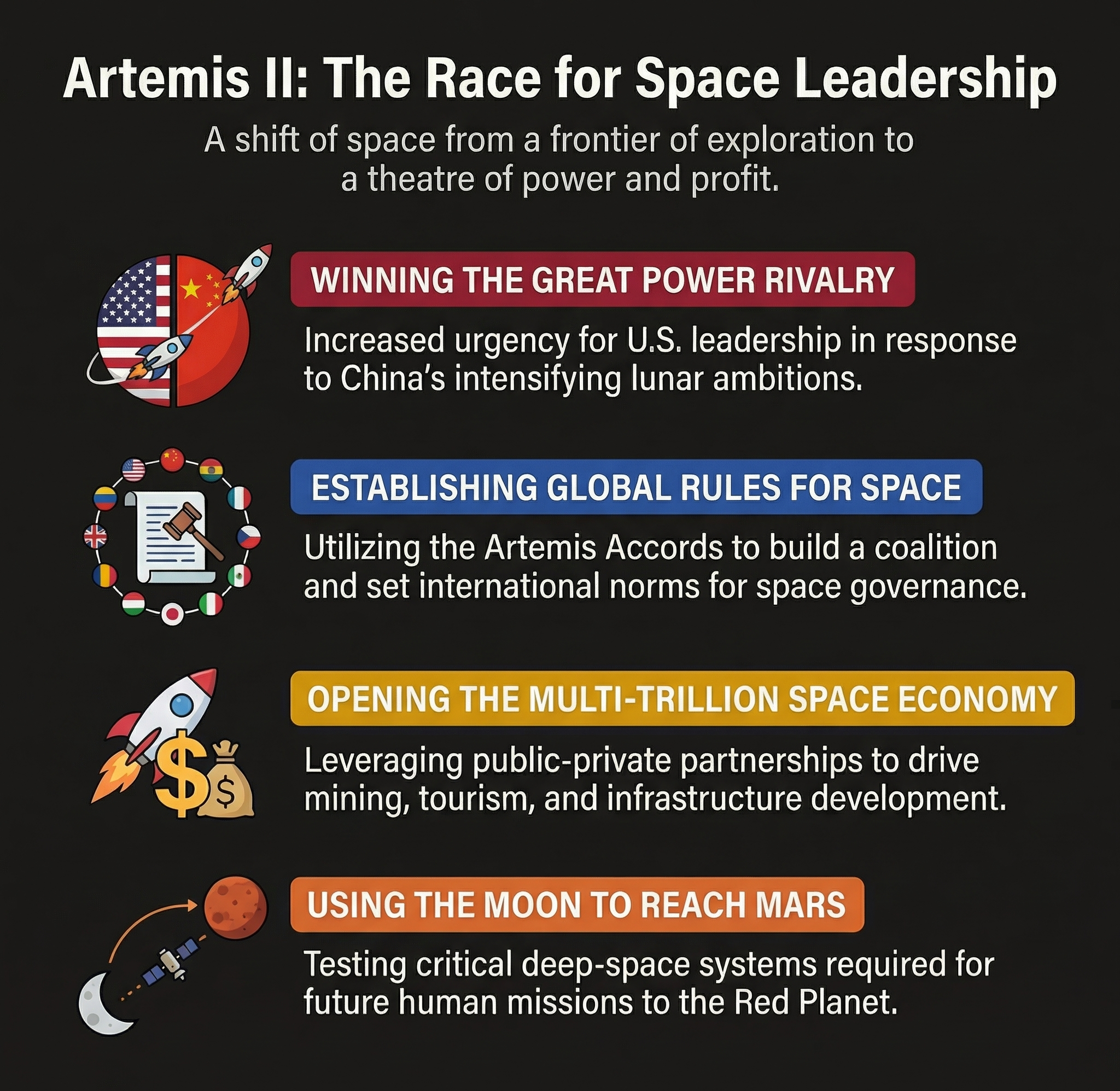
Artemis is positioned as a flagship mission to re-establish U.S. dominance in space.
Human return to the Moon serves both symbolic and strategic purposes.
B. Technological Advancement
Artemis II marks a critical step in deep-space human exploration.
It tests systems for future lunar landing (Artemis III) and Mars missions.
C. Geopolitical Competition with China
Space exploration is emerging as a new domain of great power rivalry.
China’s lunar ambitions intensify urgency for U.S. leadership.
D. Economic and Commercial Opportunities
Space economy (mining, tourism, infrastructure) is a key driver.
Public-private partnerships (e.g., private aerospace firms) are central.
E. International Collaboration
Artemis Accords aim to build a coalition of like-minded countries.
Promotes norms in space governance.
F. High Costs and Risks
Massive financial investment with uncertain returns.
Technological, safety, and mission risks remain significant.
2. Author’s Stance
Analytical with strategic emphasis
Recognises technological and strategic importance
Views Artemis as necessary for leadership.
Highlights geopolitical competition
Frames mission within U.S.-China rivalry.
3. Biases and Limitations
Pro-U.S. strategic bias
Assumes leadership in space is inherently desirable
Limited critique of militarisation of space.
Underplays global commons perspective
Space treated as arena of competition, not cooperation
Limited cost-benefit critique
Economic justification not deeply interrogated
4. Strengths (Pros)
Highlights multi-dimensional importance
Technology + geopolitics + economy.
Timely in context of space race 2.0
Relevant to current global competition.
Focus on international norms (Artemis Accords)
Addresses governance dimension.
5. Weaknesses (Cons)
Limited ethical discussion
Issues like space militarisation not explored.
Overemphasis on competition
Cooperative potential underplayed.
Insufficient attention to opportunity cost
Resources vs domestic priorities debate missing.
6. Policy Implications
A. Space Governance Frameworks
Need for updated international space law
Managing resource extraction and territorial claims.
B. Strategic Investments
Increased funding for space technology
Ensuring competitive edge.
C. Public-Private Partnerships
Leveraging private sector innovation
Reducing costs and accelerating progress.
D. Global Collaboration vs Competition
Balancing rivalry with cooperative exploration
E. India’s Perspective
Opportunities for ISRO collaboration and competition
Enhancing India’s space capabilities.
7. Real-World Impact
Technological Impact
Advancement in space technology and innovation
Economic Impact
Expansion of space economy and new industries
Geopolitical Impact
New arena of power competition
Scientific Impact
Better understanding of Moon and deep space
8. UPSC GS Paper Linkages
GS Paper III (Science & Technology)
- Space technology
- Innovation
- Emerging technologies
GS Paper II (International Relations)
- Space diplomacy
- Global governance
GS Paper III (Economy)
- Space economy
- Public-private partnerships
9. Balanced Conclusion
Artemis II represents a convergence of science, strategy, and economics, marking a new phase in space exploration. However, its long-term success will depend on balancing competition with cooperation and ensuring sustainable use of outer space.
10. Future Perspective
Towards a multipolar space order
Involving multiple nations beyond U.S. and China.
Commercialisation of space
Private sector driving innovation.
Need for global regulatory frameworks
Preventing conflict in space.
Deep space exploration roadmap
Moon as gateway to Mars.
Final Insight
Space is no longer just a frontier of exploration—it is a theatre of power, profit, and policy, where the rules are still being written.
