

Article 124(3): The Unused “Distinguished Jurist” Route to the Supreme Court

Why in News?
More than 76 years after the Constitution came into force, the “distinguished jurist” route under Article 124(3) has never been used. Justice Ujjal Bhuyan recently called it an “unused mandate” and suggested that eminent legal scholars could diversify the Supreme Court Bench.
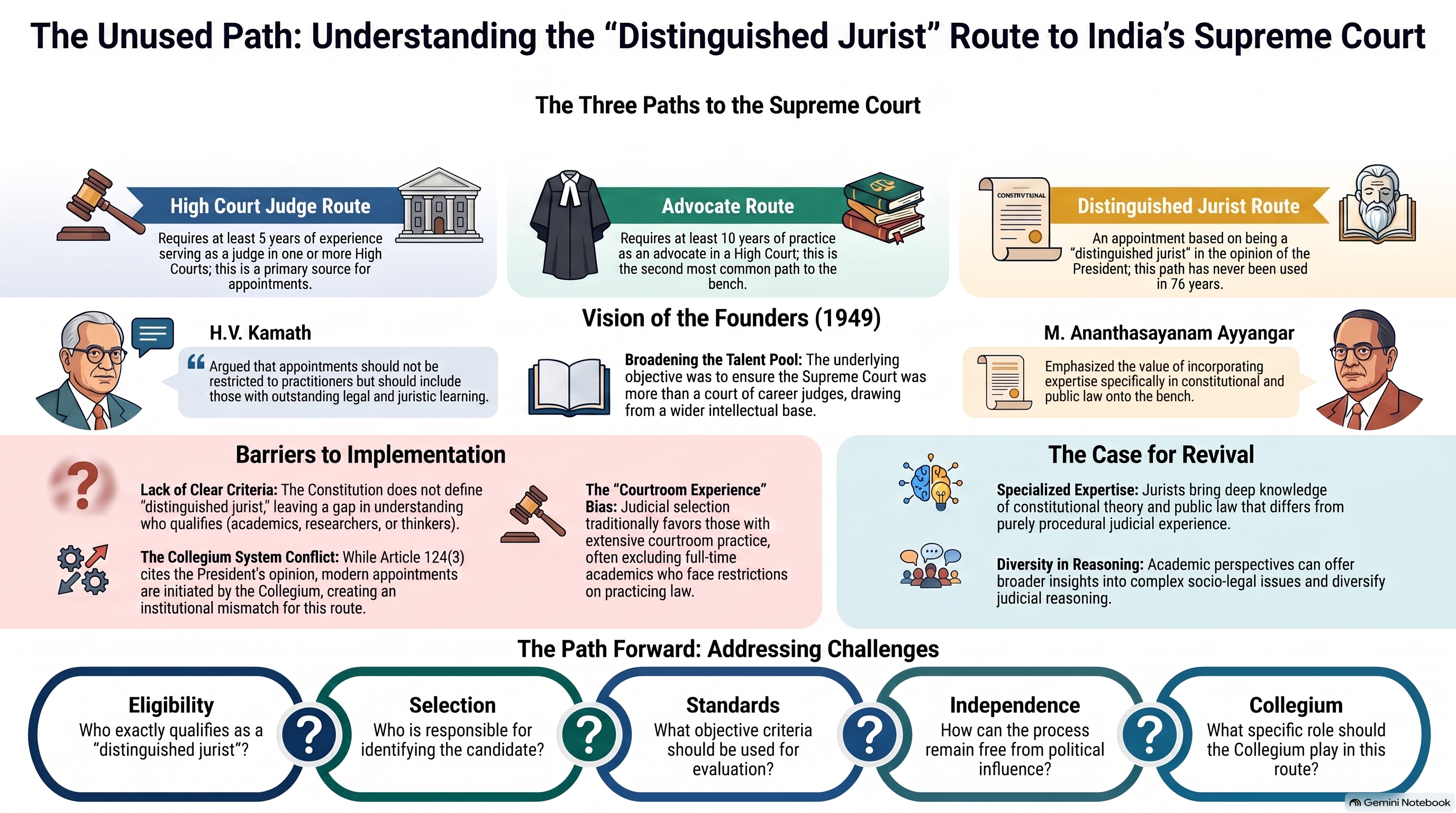
Article 124(3): Three Routes to the Supreme Court
|
Route |
Eligibility |
|
High Court Judge |
At least 5 years as a High Court judge |
|
Advocate |
At least 10 years as an advocate of a High Court |
|
Distinguished Jurist |
A distinguished jurist in the opinion of the President |
The first two routes are routinely used, while the third remains unused.
Why Was the Jurist Route Created?
The idea emerged during the Constituent Assembly debates in 1949.
- H.V. Kamath argued that appointments should not be restricted to judges and practising lawyers and proposed opening the Court to persons with outstanding legal and juristic learning.
- M. Ananthasayanam Ayyangar emphasised the value of expertise in constitutional and public law.
- B.R. Ambedkar did not oppose the principle, though he questioned the terminology used.
The underlying objective was to broaden the intellectual talent pool available to the Supreme Court.
Who Is a “Distinguished Jurist”?
The Constitution does not define the term.
It could potentially include an eminent legal scholar, academic, researcher or jurisprudential thinker with exceptional expertise, even without extensive courtroom practice.
However, full-time legal academics generally face restrictions on simultaneously practising law, creating a gap between academic distinction and conventional judicial experience.
Why Has It Never Been Used?
Possible reasons:
- Unclear criteria: No settled definition of “distinguished jurist”.
- Limited institutional exploration: Governments and the judiciary may not have seriously pursued the route.
- Collegium system: Although Article 124(3) refers to the President’s opinion, contemporary appointments are initiated through the Supreme Court collegium.
- Preference for courtroom experience: Judicial selection has traditionally favoured High Court judges and senior advocates.
Why Revive the Provision?
A distinguished jurist could bring:
- Greater representation of legal academia and scholarship.
- Specialised expertise in constitutional and public law.
- Broader perspectives on complex socio-legal issues.
- Greater diversity in judicial reasoning.
- A wider pool of talent for a constitutional court.
Key Institutional Challenge
The central question is not merely whether India has eminent jurists, but how such jurists should be identified and selected.
|
Issue |
Question |
|
Eligibility |
Who qualifies as a distinguished jurist? |
|
Selection |
Who identifies the candidate? |
|
Standards |
What objective criteria should apply? |
|
Independence |
How can political influence be prevented? |
|
Collegium |
What role should the collegium play? |
Constitutional Significance
Article 124(3) reflects the Constitution-makers’ intention to make the Supreme Court more than a court of career judges and practising lawyers. Its revival could strengthen constitutional adjudication by combining judicial experience with deeper academic and jurisprudential expertise.
