

Article 22: Supreme Court on the 24-Hour Rule and Custodial Safeguards

Article 22: Supreme Court on the 24-Hour Rule and Custodial Safeguards
Source: The Indian Express
Why in news?
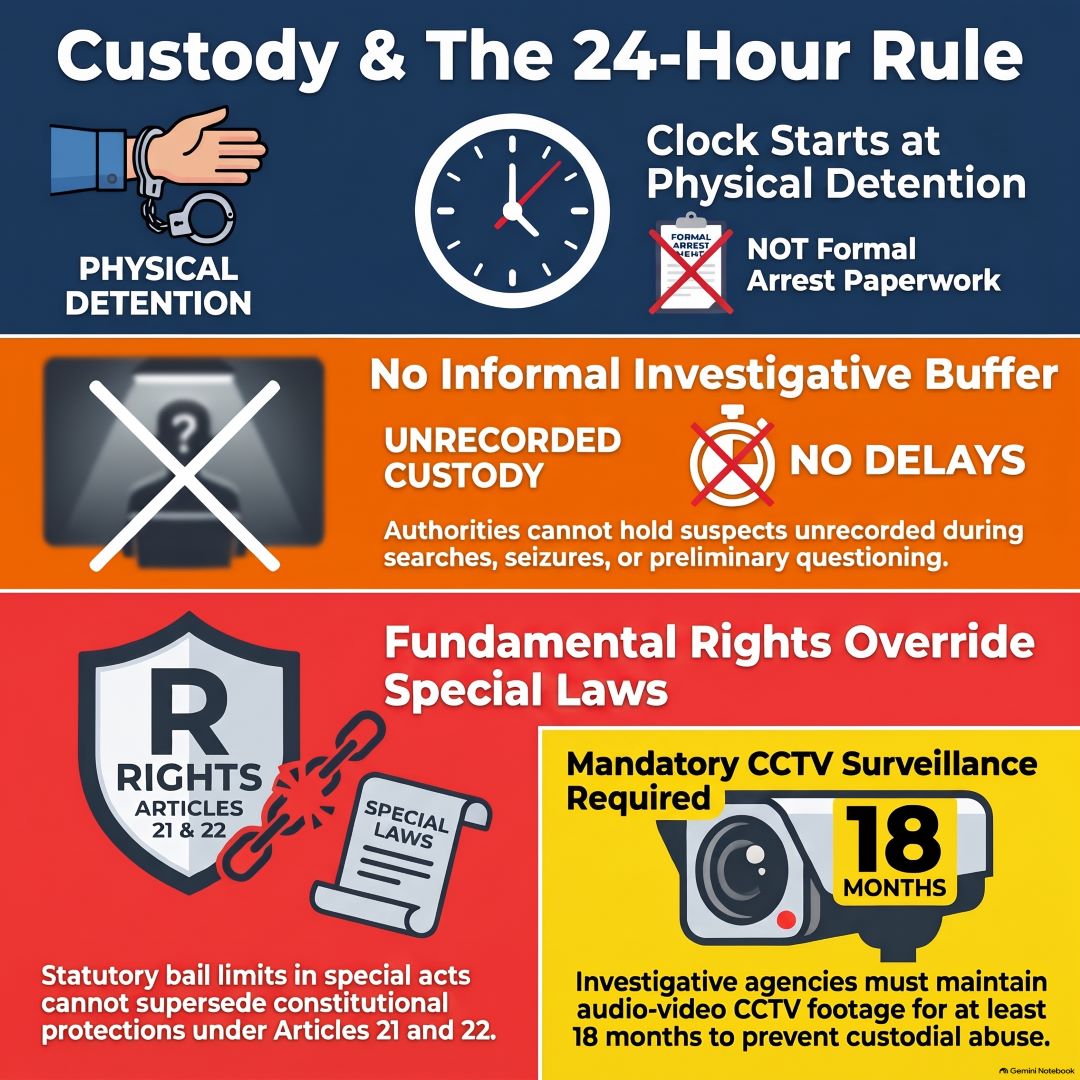
The Supreme Court reinforced Articles 21 and 22 against arbitrary detention and custodial abuse. It held that the 24-hour limit for producing an arrested person before a magistrate runs from the moment their liberty is first curtailed, not from the formal arrest time recorded by the investigating agency. It set aside the Tripura High Court's refusal of bail in a drug-smuggling case.
Static background
- Article 22 (protection against arrest and detention): 22(1) gives the right to be told the grounds of arrest and to consult a lawyer of choice. 22(2) requires production before a magistrate within 24 hours. 22(3) says neither applies to enemy aliens or to persons under preventive detention. 22(4) to (7) say preventive detention beyond three months needs an Advisory Board.
- Article 21: No one can be deprived of life or personal liberty except by procedure established by law. Maneka Gandhi v. Union of India (1978) held the procedure must be fair, just and reasonable.
- Article 20(3): No person accused of an offence can be compelled to be a witness against themselves.
- D.K. Basu v. State of West Bengal (1997): Guidelines on arrest and custody, such as an arrest memo, informing a relative and medical examination.
- Paramvir Singh Saini v. Baljit Singh (2020): Directed CCTV cameras in police stations.
- Remand: Under BNSS Section 187 (earlier CrPC Section 167), a magistrate can authorise police custody, up to 15 days, when the investigation cannot be completed within 24 hours. BNSS Section 58 corresponds to CrPC Section 57.
The case
- Customs officers of the Divisional Preventive Force, Agartala, intercepted the appellants at 2 p.m. with 60 kg of methamphetamine tablets.
- They were under the search team's physical control from 2 p.m., but formal arrest memos were signed only at 11 a.m. the next day.
- They were produced before the magistrate at 4:45 p.m., beyond 24 hours from interception.
- The officers said the gap was used for searches, seizures and questioning. The Special Court and the High Court denied bail.
- The Supreme Court rejected the distinction between interception and formal arrest: actual restriction of liberty decides when the safeguards apply.
Constitutional and legal framework
- Article 22(2): Every arrested person must be produced before the nearest magistrate within 24 hours, excluding journey time. Detention beyond that needs the magistrate's authorisation.
- Section 58, BNSS 2023: A person arrested without a warrant cannot be held beyond a reasonable period, and not beyond 24 hours (excluding journey time) without a magistrate's order. It reinforces judicial oversight of police custody.
- NDPS Act 1985: Empowers officers to search, seize and arrest. Section 37 sets strict bail conditions for serious offences, but the Act gives no exemption from constitutional safeguards on arrest and detention.
Key observations
|
1. Actual curtailment of liberty starts the clock
2. No investigative buffer zone
3. Informal custody must be reasonable
4. Fundamental rights prevail over special-law restrictions
5. CCTV to prevent custodial violence
|
Significance
- Personal liberty: Stops arbitrary detention through manipulated arrest records.
- Judicial accountability: Strengthens magistrates' scrutiny of detention and remand.
- Custodial abuse: Reduces torture, coercion and illegal interrogation outside judicial oversight.
- Rule of law: Executive convenience cannot override constitutional safeguards.
- Uniform application: The protections apply whatever the offence or special law.
Conclusion
The judgment ties the constitutional safeguards to the real moment liberty is lost, closing the gap between detention and recorded arrest, and backs it with judicial scrutiny of remand and CCTV oversight.