

Article 371K: Proposed Constitutional Safeguards for Ladakh

Why in News?
- The Union government has proposed inserting a new Article 371K to provide special constitutional safeguards for Ladakh.
- The proposal follows an “in-principle understanding” between the Ministry of Home Affairs (MHA), the Leh Apex Body (LAB) and the Kargil Democratic Alliance (KDA).
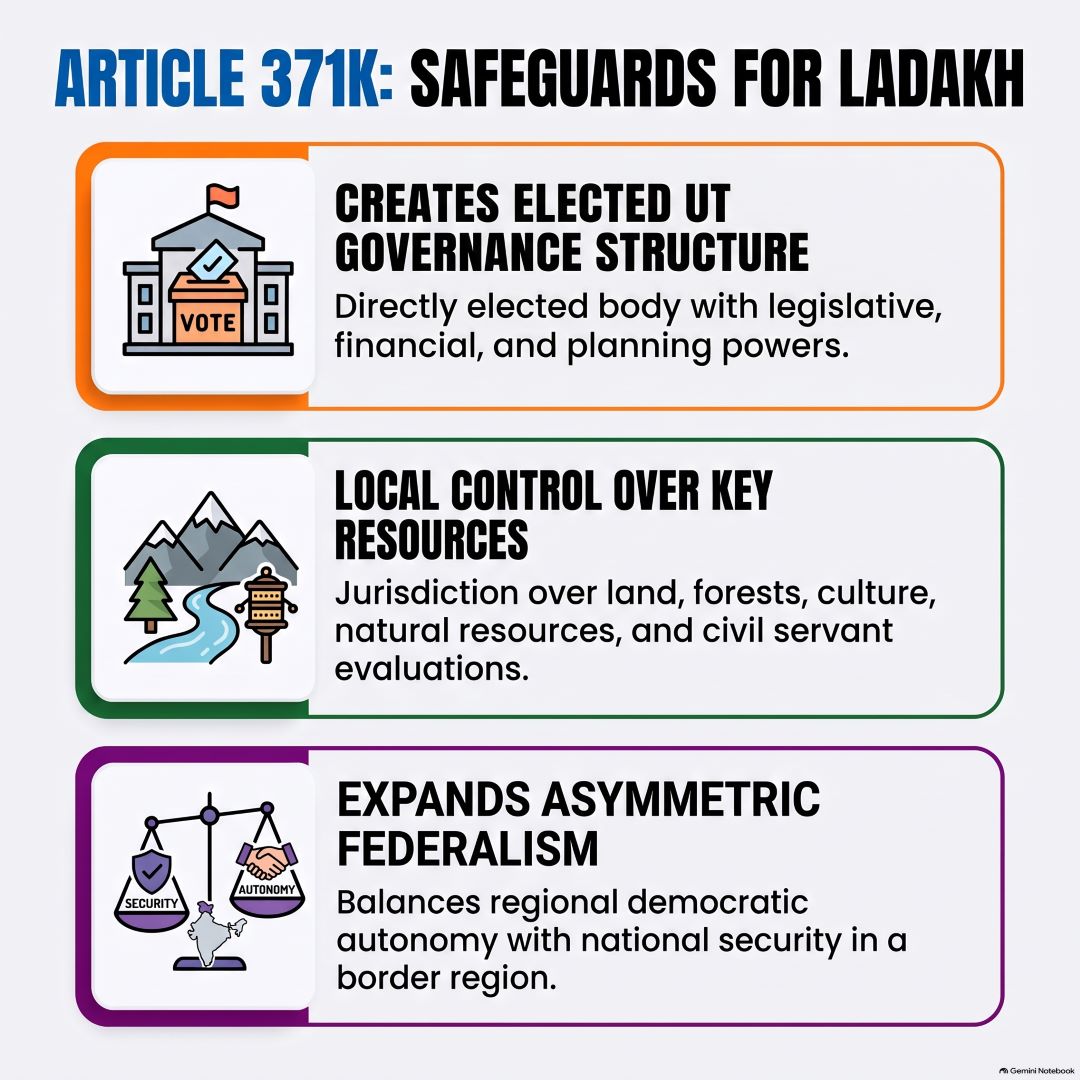
- It envisages a directly elected Union Territory-level body with legislative, executive, financial and planning powers.
- Ladakh has been a Union Territory without a legislature since 2019, making the proposed arrangement constitutionally distinctive.
Evolution of Article 371: From Transition to Asymmetric Federalism
- Original Article 371 (1950):
- Applied to erstwhile Part B States, which largely comprised former princely states.
- Provided for Central supervision of these states during the post-Independence integration process.
- It was therefore a transitional administrative provision, not originally a mechanism for cultural protection.
- 1956: The Seventh Constitutional Amendment and States Reorganisation Act abolished the Part A, B and C classification.
- Article 371 was subsequently recast to provide special arrangements for Maharashtra and Gujarat, including mechanisms for balanced regional development.
- Over time, Articles 371A–371J evolved into region-specific constitutional arrangements addressing distinctive historical, cultural, social and political circumstances.
- This represents asymmetric federalism — the constitutional principle of providing differentiated powers and protections to accommodate India’s regional diversity.
What Could Article 371K Provide for Ladakh?
- The proposed framework could establish a directly elected UT-level governing body with:
- Legislative powers.
- Executive and administrative authority.
- Budgetary and financial powers.
- Planning functions.
- Proposed areas of jurisdiction include:
- Land.
- Culture and language.
- Forests and environment.
- Natural resources.
- Other subjects currently reserved for the UT under Article 240.
- The proposal also envisages greater control of the elected body over civil servants, including Annual Performance Appraisal Reports (APARs) for officials working in its jurisdiction.
- Ladakh’s representatives have sought control over law and order, which would differ from Article 371H, where the Governor has special responsibility for law and order in Arunachal Pradesh.
- Land safeguards are sought along the broader philosophy of Articles 371A and 371G, under which certain Parliamentary laws concerning land and customary practices do not automatically apply.
Why the Drafting of 371K Matters?
- Article 371 provisions are not uniform; their effectiveness depends on the specific powers and safeguards written into the Constitution.
- A provision merely establishing an elected body without securing control over land, resources and administration could provide limited autonomy.
- Stronger constitutional protection could include:
- Local control over land and natural resources.
- Authority over recruitment and administration.
- Protection of local culture and language.
- Restrictions on automatic application of specified Central laws.
- Meaningful executive authority over subjects assigned to the elected body.
- The experience of Article 371C in Manipur illustrates the importance of clear institutional powers and effective implementation; the Hill Areas Committee has been criticised by stakeholders for limited autonomy.
- The final balance will also need to accommodate national security and strategic infrastructure in a sensitive border Union Territory.
Significance for Indian Federalism
- Article 371K would represent a potentially new form of asymmetric federalism because it would create a substantial constitutional governance arrangement for a Union Territory without a conventional legislative assembly.
- It could provide greater democratic participation while addressing Ladakh’s concerns regarding:
- Land and ecological protection.
- Cultural identity.
- Local employment and administration.
- Resource management.
- At the same time, its design must maintain an appropriate balance between:
- Local autonomy and national sovereignty
- Ecological conservation and development
- Leh–Kargil representation and power sharing
- Democratic accountability and strategic security
- Therefore, the significance of Article 371K will depend less on the label itself and more on the constitutional powers, safeguards and institutional accountability ultimately provided in its text.
