Ashoka-era stupa, bigger than Sanchi’: 90 years on, Ujjain mound comes under renewed focus

Ashoka-era stupa, bigger than Sanchi’: 90 years on, Ujjain mound comes under renewed focus
Why in News?
Madhya Pradesh government renews excavation of a massive Ashoka-era stupa in Ujjain, potentially larger than Sanchi, after 90 years.
Key Highlights:
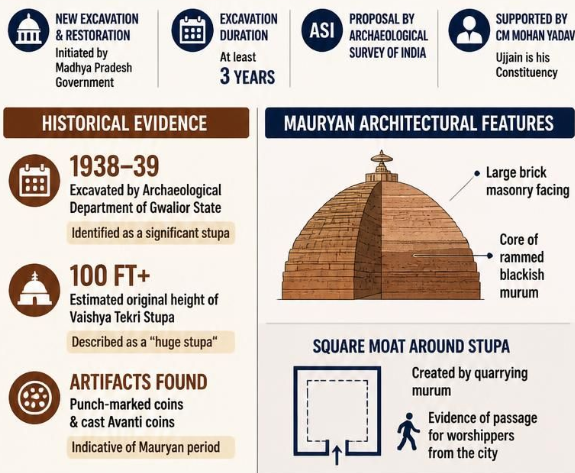
- The Madhya Pradesh government has initiated a fresh excavation and restoration project at Vaishya Tekri in Ujjain.
- The site is believed to contain an Ashoka-era stupa, potentially larger than the renowned Sanchi Stupa.
- The Archaeological Survey of India (ASI) has submitted a proposal for the excavation, which is estimated to take at least three years.
- Previous excavations in 1938-39 by the Archaeological Department of Gwalior State identified the mound as a significant stupa.
- The proposed stupa's base is estimated at approximately 350 feet in diameter, significantly larger than Sanchi's 54 feet height.
- The project is being actively supported by Chief Minister Mohan Yadav, whose constituency is Ujjain.
Detailed Insights:
- Ujjain held considerable importance in the Mauryan world, and Emperor Ashoka was traditionally associated with the city before his ascension.
- The 1938-39 excavation report described Vaishya Tekri as a "huge stupa" with an estimated original height of not less than 100 feet.
- The stupa's construction featured a unique core of rammed blackish murum, faced with exceptionally large brick masonry, indicative of the Mauryan period.
- The discovery of punch-marked coins and cast Avanti coins during the initial excavation further supports the Mauryan period dating of the structure.
- Ancient builders created a regular square moat around the stupa by quarrying murum, with evidence of a passage for worshippers from the city.
- The engineering at the stupa's base included an ingenious bowl-shaped masonry design to support the superstructure and resist oblique thrust.
- The current project necessitates the acquisition of surrounding private land, with a proposal for land acquisition already sent by the Ujjain district administration.
|
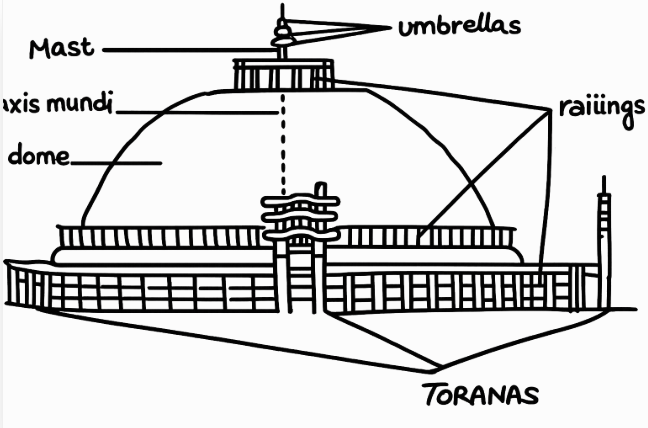
The Great Stupa (Stupa No. 1) Located in Raisen district, Madhya Pradesh, Sanchi is unique because, unlike many other Buddhist sites, it was not directly visited by the Buddha. Instead, it became a major center of Buddhist art under the patronage of Emperor Ashoka in the 3rd Century BCE. Core Architectural Features
The Toranas (Gateways) The most striking features added later by the Satavahana dynasty (1st Century BCE) are the four intricately carved stone gateways.
Historical Significance and Preservation
|