

Atmanirbhar Bharat is managing external dependencies, big-power rivalries
Indian Express
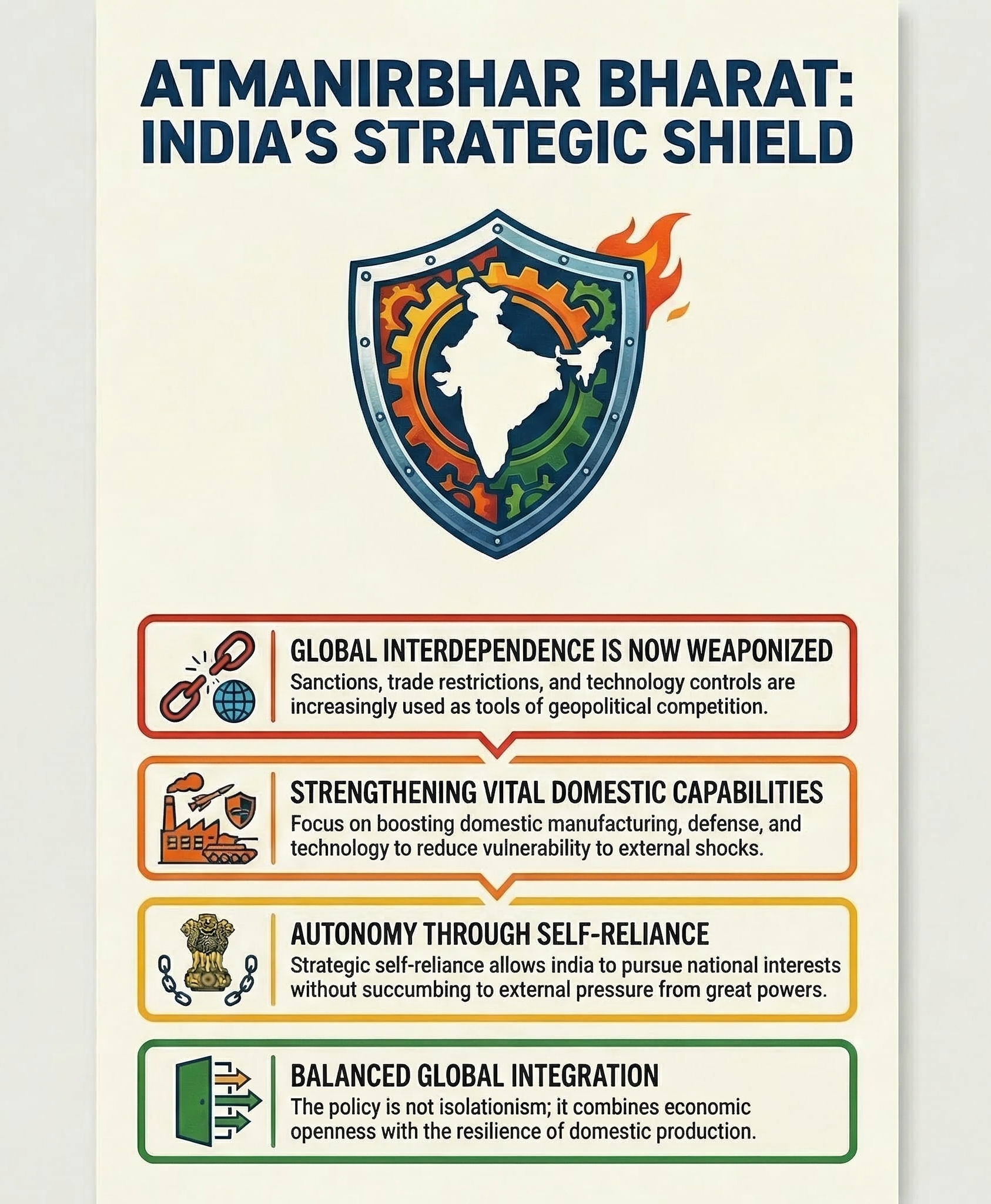
Key Arguments of the Article
Strategic Self-Reliance in a Changing Global Order
The article argues that the idea of self-reliance has regained relevance due to increasing geopolitical tensions and the weaponisation of economic interdependence.
Global supply chains, finance, and energy markets are increasingly influenced by political considerations, making economic autonomy a strategic necessity.
Lessons from Historical Experience
The author draws parallels with earlier phases of Indian economic and foreign policy, particularly the post-independence emphasis on strategic autonomy.
Historical crises, including food shortages, financial vulnerabilities, and energy dependence, shaped India’s approach to external relations.
Weaponisation of Global Interdependence
The article highlights how globalisation is increasingly being used as a strategic tool. Sanctions, trade restrictions, technology controls, and financial pressure are now instruments of geopolitical competition.
Examples include energy sanctions, trade disputes, and restrictions on technology transfers.
Managing Great Power Rivalries
India faces the challenge of navigating relations among major global powers without becoming aligned with any single bloc.
The article argues that India’s diplomacy aims to maintain strategic autonomy while engaging with multiple global partners.
Atmanirbhar Bharat as Strategic Policy
The author views Atmanirbhar Bharat as a pragmatic response to geopolitical uncertainty. The policy seeks to strengthen domestic capabilities in manufacturing, technology, defence, and critical supply chains.
The goal is to reduce vulnerability while remaining integrated with global markets.
Author’s Stance
The author supports the strategic logic of Atmanirbhar Bharat and views it as an adaptive response to contemporary geopolitical realities. The article presents India’s approach as a balanced strategy that combines economic openness with strategic autonomy.
The tone emphasises pragmatic diplomacy and economic resilience.
Possible Biases
Strategic National Perspective
The article largely supports India’s current policy framework and may understate potential limitations or implementation challenges.
Geopolitical Realism
The analysis focuses on power politics and strategic competition, which may overlook cooperative aspects of globalisation.
Limited Domestic Critique
While praising strategic self-reliance, the article does not deeply analyse internal economic constraints.
Advantages of the Atmanirbhar Strategy
Reduced Strategic Vulnerability
Strengthening domestic manufacturing and technological capacity reduces dependence on external actors.
Economic Resilience
Diversifying supply chains and boosting domestic production improves economic stability.
Strategic Autonomy
India can pursue independent foreign policy decisions without excessive external pressure.
Industrial Development
Policies supporting domestic industries can promote technological innovation and employment generation.
Challenges and Risks
Implementation Constraints
Achieving self-reliance requires large investments in infrastructure, technology, and human capital.
Global Trade Dynamics
Excessive protectionism could reduce competitiveness and limit access to global markets.
Technological Gaps
India still depends on foreign technology in several advanced sectors.
Supply Chain Complexity
Modern global supply chains are deeply interconnected, making complete autonomy unrealistic.
Policy Implications
Strengthening Domestic Manufacturing
Initiatives such as production-linked incentives and industrial policy must focus on competitiveness and innovation.
Diversification of Trade Partnerships
Expanding economic ties with multiple partners reduces dependency on any single country.
Technological Capability Development
Investments in research, innovation ecosystems, and advanced manufacturing are critical.
Balanced Global Integration
Self-reliance should complement, not replace, participation in global trade and investment networks.
Real-World Impact
If implemented effectively:
• Greater resilience against global economic shocks
• Stronger domestic industries
• Increased geopolitical influence
If poorly executed:
• Risk of protectionism and inefficiency
• Reduced competitiveness of domestic industries
• Slower integration into global value chains
Alignment with UPSC GS Papers
GS Paper II
India’s foreign policy, international relations, strategic autonomy.
GS Paper III
Indian economy, industrial policy, globalisation, supply chain resilience.
GS Paper IV
Ethics in governance, national interest and responsible policymaking.
Balanced Assessment
The concept of Atmanirbhar Bharat reflects an attempt to recalibrate India’s economic and strategic policies in response to a rapidly changing global environment. While globalisation remains important, geopolitical competition and supply chain vulnerabilities require a greater emphasis on domestic capability building.
The challenge lies in maintaining a balance between strategic self-reliance and continued integration with global economic systems.
Future Perspective
In the coming decades, economic power, technological capability, and geopolitical influence will increasingly shape international relations. India’s strategy of combining domestic capacity building with diversified global partnerships may provide a pathway toward sustainable economic growth and strategic autonomy.
For policymakers and civil services aspirants, the debate highlights the intersection between economic policy, geopolitics, and national development in an era of shifting global power dynamics.
