

Barricades Cannot Silence the Voice of Democracy

Barricades Cannot Silence the Voice of Democracy
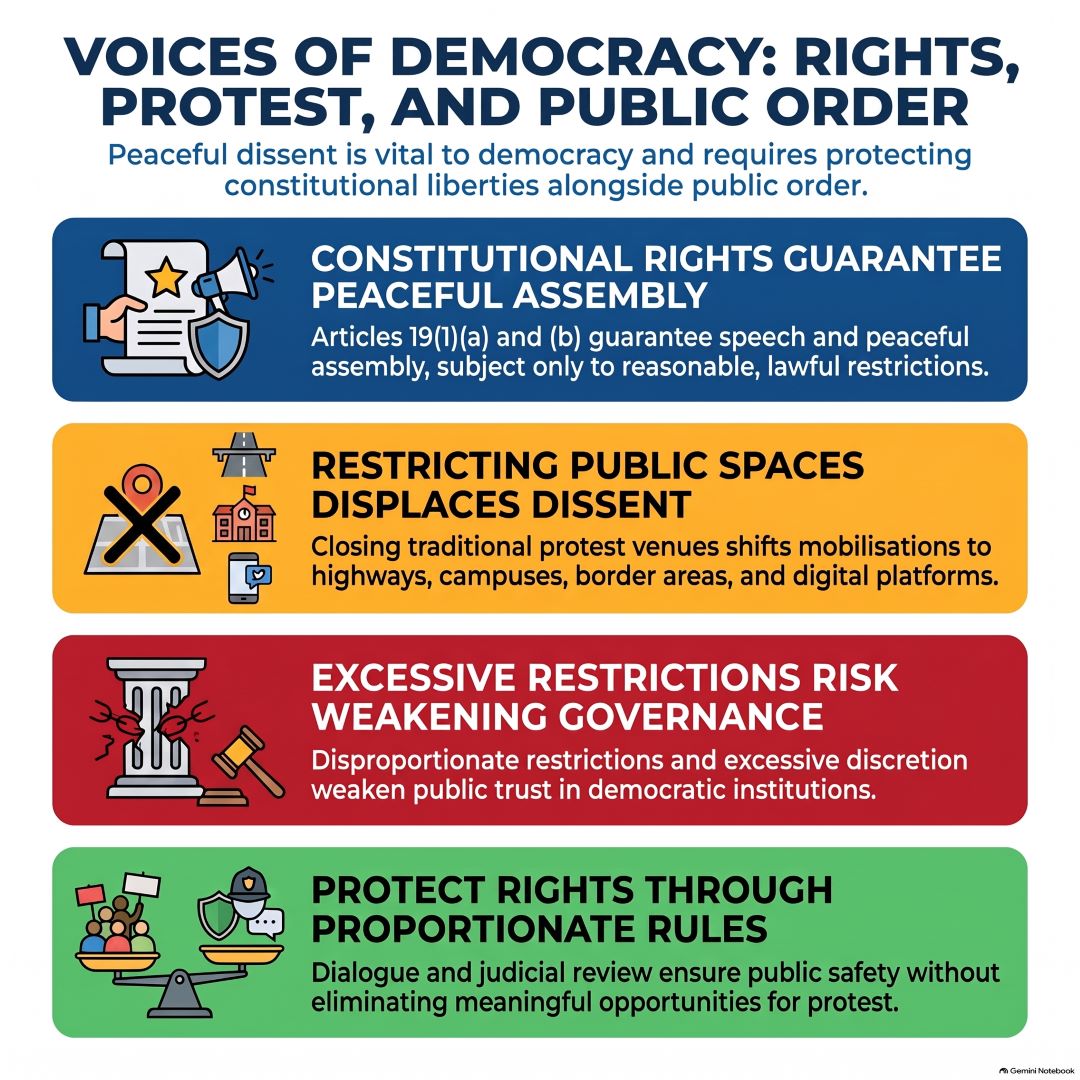
Right to Protest and Constitutional Provisions
- Peaceful protest enables citizens to express dissent, challenge government policies and hold public institutions accountable.
- Article 19(1)(a) guarantees freedom of speech and expression, while Article 19(1)(b) protects the right to assemble peacefully and without arms.
- These rights are subject to reasonable restrictions under Articles 19(2) and 19(3), respectively, on constitutionally specified grounds.
- Section 163 of the Bharatiya Nagarik Suraksha Sanhita (BNSS), 2023, empowers authorities to issue urgent preventive orders to address specified dangers and disturbances. Its use must be lawful and proportionate.
- Restrictions at Jantar Mantar during protests in October 2026 have renewed debate over the balance between public order and democratic freedoms.
Shrinking Spaces for Democratic Dissent
- Delhi’s protest geography has shifted from the Boat Club to Jantar Mantar and other designated venues. Restrictions on access and large gatherings can reduce the visibility of public grievances.
- The Supreme Court in Ramlila Maidan Incident v. Home Secretary, Union of India (2012) emphasised safeguards for peaceful assembly.
- In Mazdoor Kisan Shakti Sangathan v. Union of India (2018), the Court addressed the balance between citizens’ right to protest and the rights of residents and commuters.
- Restrictions on demonstrations at Freedom Park in Bengaluru, Dharna Chowk in Hyderabad and farmers’ marches towards Delhi illustrate the wider challenge of regulating public protests without extinguishing dissent.
Historical Lessons and Changing Forms of Protest
- Movements such as Shaheen Bagh, the 2020–21 farmers’ protests and workers’ and peasants’ mobilisations demonstrate the role of collective action in bringing public concerns into political debate.
- When established protest venues become inaccessible, mobilisation may shift to highways, campuses, border areas and digital platforms.
- Barricading, internet restrictions and preventive detention may disrupt mobilisation temporarily but do not necessarily resolve the grievances underlying it.
- Public spaces are therefore not merely physical locations; they are essential arenas for democratic participation and communication between citizens and the State.
Challenges to Constitutional Governance
- Excessive administrative discretion can make the exercise of fundamental rights dependent on official permission.
- Blanket or disproportionate restrictions may weaken democratic accountability and public trust in institutions.
- Restrictions around protests concerning electoral institutions also raise questions about transparency, electoral integrity and the independence of constitutional bodies.
- The challenge is to protect public order without treating peaceful criticism as a threat to governance.
Way Forward
- Apply clear, transparent and proportionate rules for granting permission and regulating demonstrations.
- Ensure that restrictions are supported by specific reasons, remain open to judicial review and do not unnecessarily eliminate meaningful opportunities for protest.
- Strengthen dialogue between authorities and protest organisers to resolve disputes peacefully.
- Protect access to public spaces while safeguarding the rights of residents, commuters and other citizens.
- Maintain electoral transparency, institutional independence and accountability to reinforce public confidence in democracy.
Democracy requires more than periodic elections. It depends on citizens being able to question authority, express disagreement and seek accountability through peaceful means.
Public order and constitutional liberty must be protected together.