

Belém as a test of a new model of forest finance
The Hindu
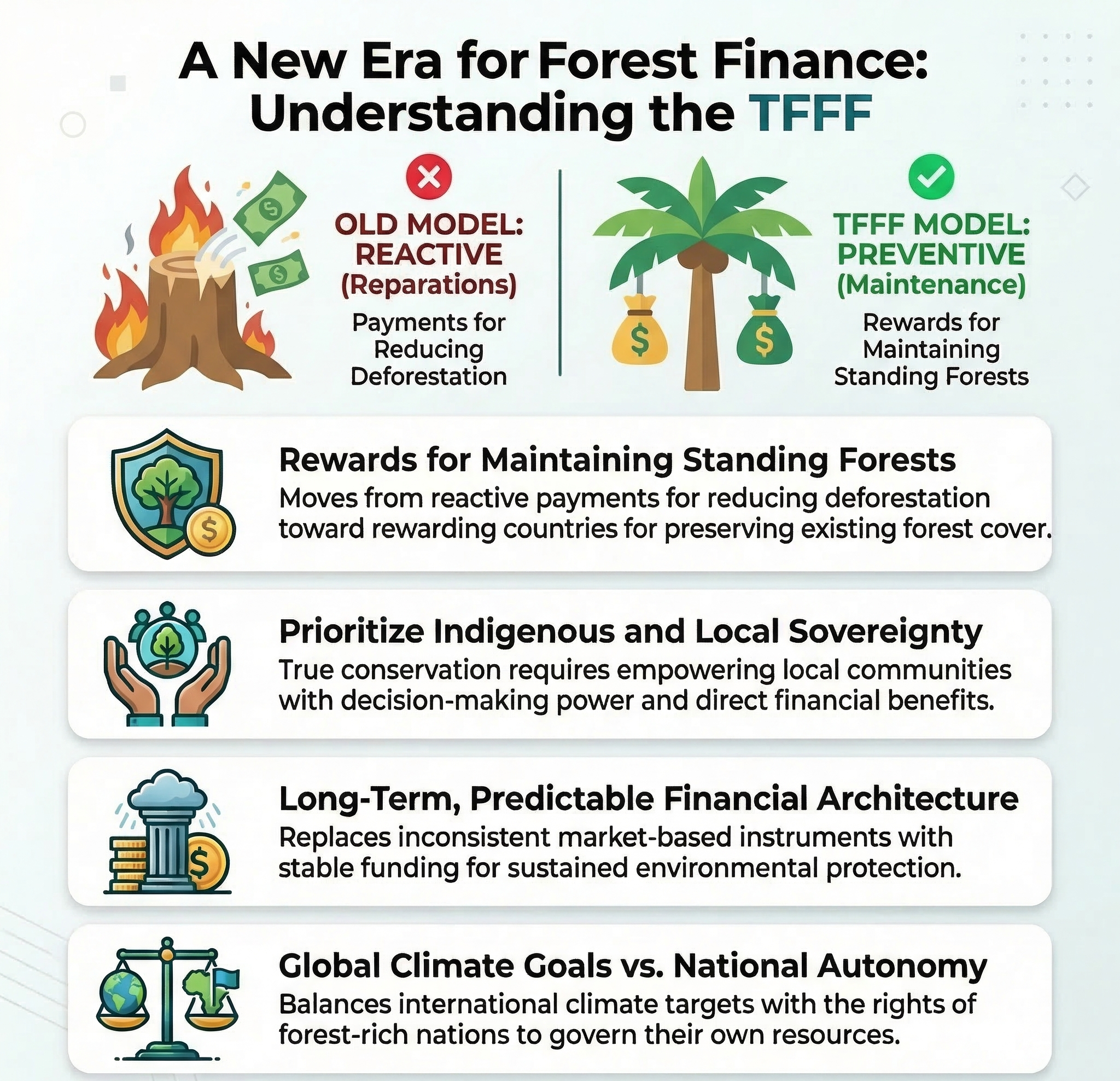
Key Arguments of the Article
Limitations of Existing Forest Finance Models
The article argues that current mechanisms for forest conservation funding have been inadequate. They often rely on conditionalities, market-based instruments, and donor-driven priorities that do not sufficiently empower local stakeholders.
Financial flows remain insufficient and poorly aligned with on-ground realities.
TFFF as a New Financial Architecture
The TFFF is presented as an innovative model aimed at long-term, predictable funding for forest conservation. It seeks to reward countries for maintaining forest cover rather than merely reducing deforestation rates.
This marks a shift from reactive to preventive conservation financing.
Concerns of Sovereignty and Control
A key argument is that global funding frameworks often impose external conditions that may undermine national sovereignty. Forest-rich countries are wary of international interference in domestic environmental governance.
The article highlights tensions between global climate goals and national autonomy.
Role of Indigenous Communities
The article strongly emphasises that indigenous communities are central to forest conservation. However, they are often excluded from decision-making processes and do not receive adequate financial benefits.
Recognition of community rights is portrayed as essential for effective conservation.
Climate Justice and Equity
The article frames forest finance within the broader discourse of climate justice. Developing countries, which host most tropical forests, demand fair compensation for conservation efforts, given their limited historical contribution to climate change.
Author’s Stance
The author adopts a critical yet constructive stance. While acknowledging the potential of TFFF, the article questions whether it can overcome the structural flaws of existing global finance mechanisms.
The tone is sceptical of top-down approaches and advocates for inclusive, community-centred conservation.
Possible Biases
Pro-Global South Perspective
The article strongly highlights the concerns of developing countries and indigenous communities.
Critical of Market Mechanisms
There is a clear scepticism toward market-based solutions for environmental conservation.
Normative Emphasis on Justice
The argument prioritises equity and justice, sometimes over economic efficiency.
Advantages of the TFFF Model
Predictable Funding
Long-term financial commitments can ensure sustained conservation efforts.
Incentivising Conservation
Rewarding countries for maintaining forests can encourage proactive environmental protection.
Global Climate Benefits
Preserving tropical forests contributes to carbon sequestration and biodiversity conservation.
Recognition of Ecological Value
The model acknowledges forests as global ecological assets rather than merely national resources.
Challenges and Concerns
Governance and Accountability
Ensuring transparency and effective utilisation of funds remains a major challenge.
Sovereignty Issues
External funding mechanisms may create tensions with national policies and priorities.
Exclusion of Local Communities
If not designed inclusively, such frameworks may marginalise indigenous populations.
Market-Based Limitations
Financial incentives alone may not address deeper socio-political drivers of deforestation.
Policy Implications
Community-Centric Conservation
Policies must ensure meaningful participation of indigenous and local communities.
Reform of Global Climate Finance
International financial institutions need to design equitable and flexible funding mechanisms.
Strengthening Institutional Capacity
Developing countries require stronger governance frameworks to manage conservation funds effectively.
Integrating Climate and Development Goals
Forest conservation must be aligned with livelihood security and economic development.
Real-World Impact
If implemented effectively:
• Improved forest conservation outcomes
• Enhanced livelihoods for forest-dependent communities
• Strengthened global climate mitigation efforts
If poorly designed:
• Continued deforestation
• Marginalisation of indigenous communities
• Inefficient use of global climate funds
Alignment with UPSC GS Papers
GS Paper I
Geography of forests, environmental resources, human-environment interaction.
GS Paper II
International relations, global governance, climate agreements.
GS Paper III
Environmental conservation, climate change, sustainable development.
Balanced Assessment
The article presents TFFF as a promising yet uncertain innovation in forest finance. While it offers a shift toward long-term and preventive funding, its success will depend on addressing governance challenges, ensuring equity, and respecting sovereignty.
The effectiveness of such mechanisms ultimately hinges on their ability to balance global environmental goals with local realities.
Future Perspective
As climate change intensifies, innovative financial models like TFFF will become increasingly important. However, their legitimacy and success will depend on inclusivity, transparency, and alignment with the needs of forest-dependent communities.
For policymakers, the challenge lies in designing frameworks that combine financial innovation with social justice and ecological sustainability
