

Bound Together in Diversity
The Statesman
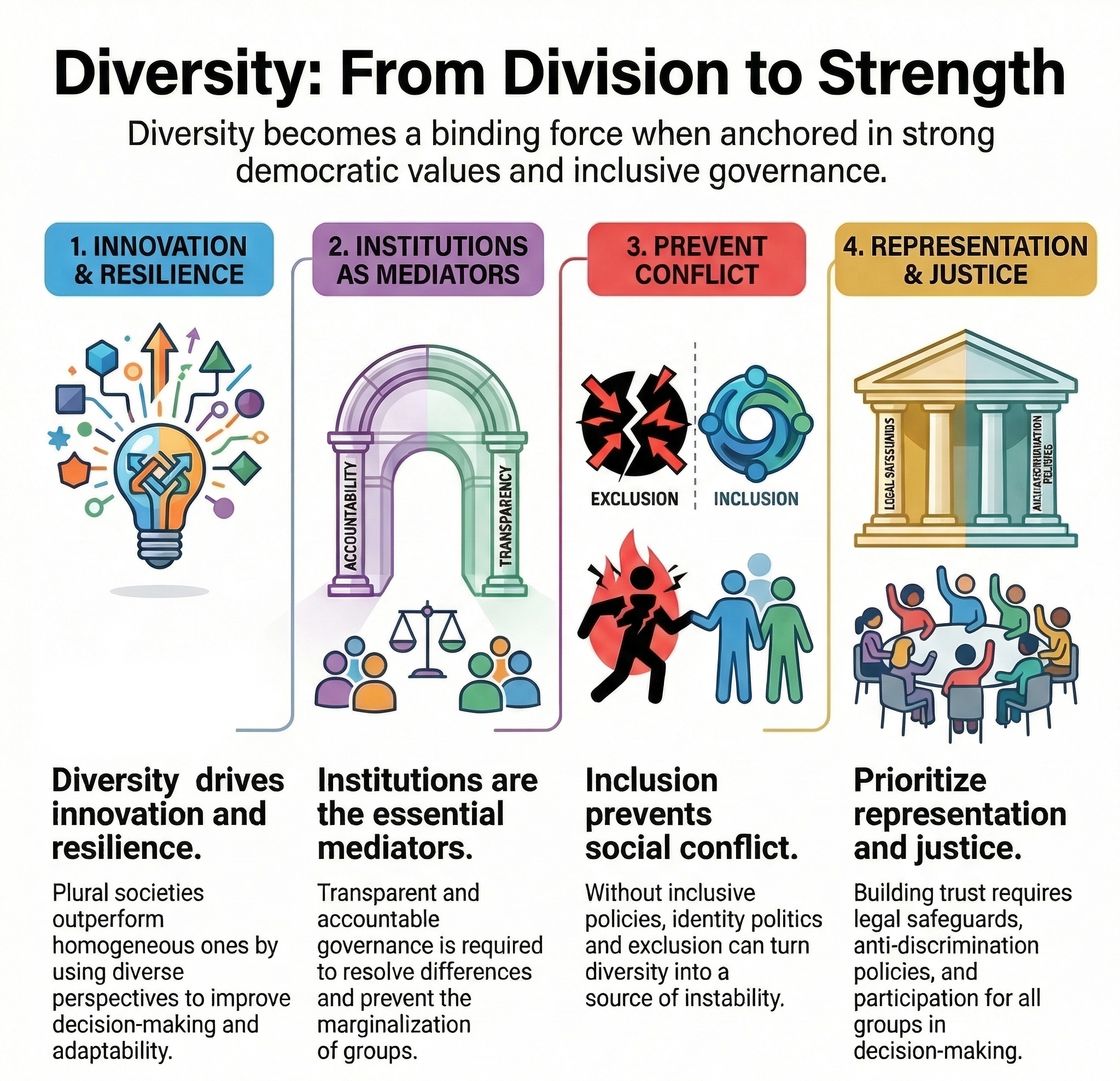
1. Key Arguments
A. Diversity as a Democratic Strength
Pluralism enriches democratic processes and decision-making.
Diverse perspectives improve representation, policy outcomes, and institutional resilience.
B. Risks of Mismanaged Diversity
Without inclusive institutions, diversity can lead to conflict.
Exclusion, discrimination, and identity politics can convert diversity into a source of division.
C. Role of Strong Institutions
Transparent, accountable, and participatory institutions are essential.
They mediate differences, ensure justice, and prevent marginalisation.
D. Cultural and Social Inclusion
Recognition of identities builds trust and belonging.
Inclusive policies foster social harmony and reduce alienation.
E. Global and Comparative Perspective
Countries that embrace diversity tend to be more innovative and stable.
Plural societies, when managed well, outperform homogeneous ones in adaptability.
2. Author’s Stance
Normative and strongly pro-diversity
Advocacy for inclusive governance
The author positions diversity as inherently positive when supported by institutions.
Emphasis on ethical and democratic values
Focus on equality, dignity, and representation.
3. Biases and Limitations
Idealistic framing
Assumes diversity will yield positive outcomes if institutions function well, underplaying deep-rooted conflicts.
Limited conflict analysis
Does not deeply engage with cases where diversity has led to prolonged instability.
Underestimation of identity politics
Political mobilisation around identity is not fully explored.
4. Strengths (Pros)
Strong conceptual clarity
Clearly links diversity with democracy, innovation, and governance.
Contemporary relevance
Important in the context of global polarisation and identity conflicts.
Institutional focus
Highlights governance as the key mediator.
5. Weaknesses (Cons)
Lack of empirical depth
Limited use of data or case studies.
Insufficient policy detailing
Does not specify actionable steps for managing diversity.
Generalised global perspective
Could benefit from region-specific examples.
6. Policy Implications
A. Inclusive Governance Frameworks
Representation of diverse groups in institutions
Ensuring participation in decision-making.
B. Anti-Discrimination Policies
Legal safeguards against exclusion
Strengthening equality laws and enforcement.
C. Education and Awareness
Promoting pluralism and constitutional values
Curriculum reforms and social campaigns.
D. Conflict Resolution Mechanisms
Institutional mediation of identity-based conflicts
Dialogue platforms and grievance redressal systems.
E. Decentralisation
Local governance for diverse needs
Empowering communities while maintaining unity.
7. Real-World Impact
Social Cohesion
Enhanced trust and reduced conflict
Inclusive societies are more stable.
Economic Growth
Diversity drives innovation and productivity
Multiple perspectives foster creativity.
Political Stability
Inclusive systems reduce alienation
Strengthens legitimacy of governance.
Challenges
Risk of polarisation if mismanaged
Identity conflicts can destabilise societies.
8. UPSC GS Paper Linkages
GS Paper I (Society)
- Diversity in India
- Social cohesion and unity
GS Paper II (Governance)
- Inclusive governance
- Role of institutions
GS Paper IV (Ethics)
- Tolerance, pluralism
- Justice and equality
9. Balanced Conclusion
Diversity is neither inherently a strength nor a weakness—it depends on how it is governed.
The article rightly emphasises inclusivity and institutional strength but must be complemented with realistic conflict management strategies.
10. Future Perspective
Strengthening institutional capacity
Ensuring transparency and accountability.
Promoting inclusive development
Bridging socio-economic divides.
Managing identity politics
Balancing representation with national integration.
Building constitutional culture
Embedding pluralism in societal values.
Final Insight
Diversity becomes a binding force only when anchored in justice, inclusion, and shared democratic values.
