

BRICS in a Fragmented World Order

BRICS in a Fragmented World Order
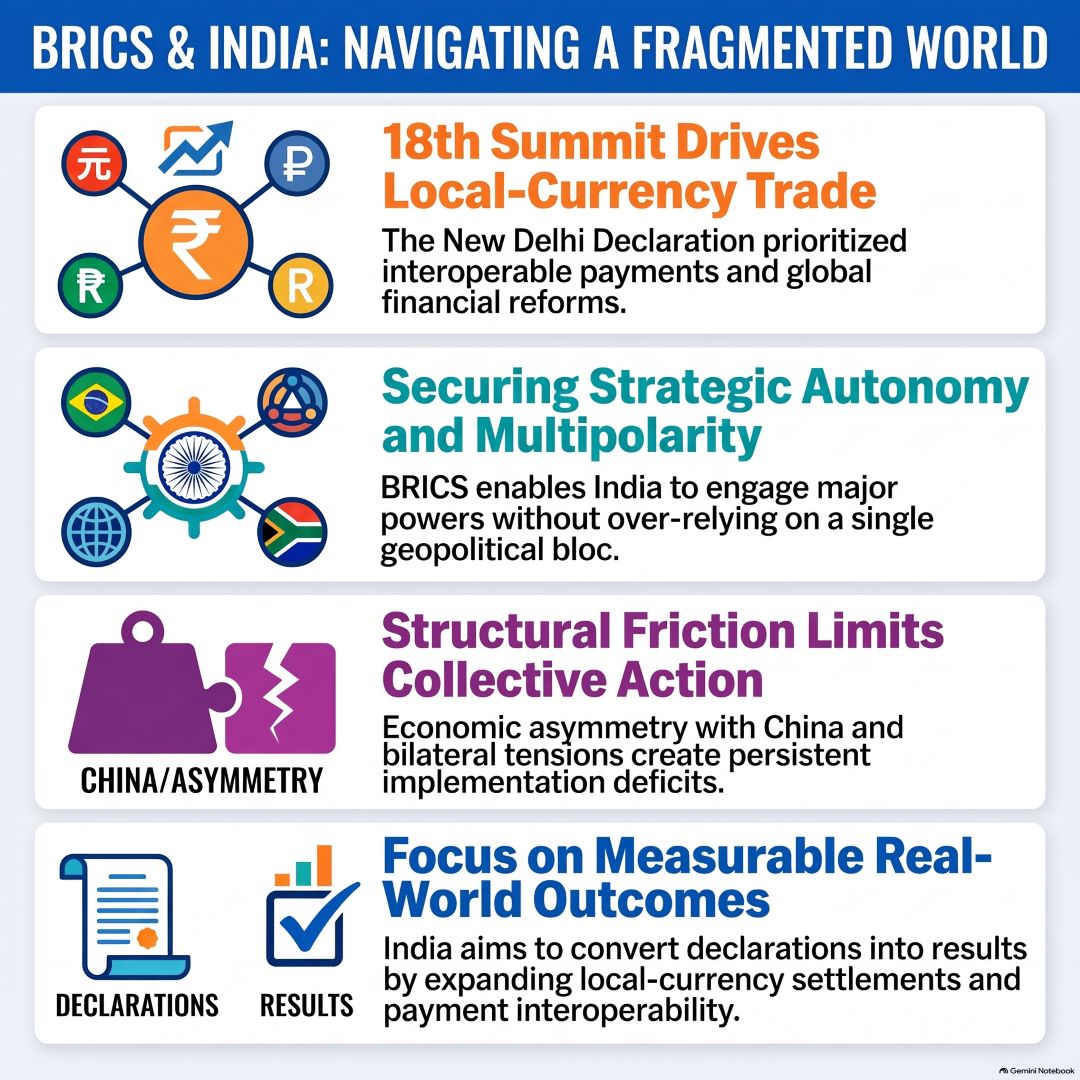
Summit and Key Outcomes
- The 18th BRICS Summit was held in New Delhi on September 12–13, 2026, under India’s chairmanship, culminating in the unanimous adoption of the New Delhi Declaration.
- The declaration covered global governance, trade, finance, energy, climate change, technology, health and agriculture.
- Key priorities included local-currency trade, interoperable cross-border payments, implementation of the BRICS Economic Partnership Strategy 2030 and the Global Value Chain Action Plan 2026–2030.
- Members called for reforms in the UN, IMF and World Bank to improve developing countries’ representation and supported WTO rules-based trade.
- Cooperation in artificial intelligence, food security, sustainable development and humanitarian assistance in Gaza was also emphasised.
Strategic Significance for India
- Strategic autonomy: BRICS enables India to engage with major powers while avoiding excessive dependence on any single geopolitical bloc.
- Multipolarity: India supports a more representative global order in which emerging economies have greater influence over international decision-making.
- Diplomatic engagement: The grouping provides a platform for dialogue among countries with competing strategic interests.
- Development cooperation: Collaboration in AI, healthcare, agriculture, energy and digital payments can help address shared challenges and technological inequalities.
Structural Limitations of BRICS
- Implementation deficit: Long-standing demands for reforming global financial institutions and the UN have produced limited concrete outcomes.
- Divergent interests: Members differ in political systems, economic priorities and foreign-policy objectives, limiting the scope for collective action.
- Economic asymmetry: China’s economic weight creates an imbalance within the grouping and raises concerns about concentration of influence.
- India–China rivalry: Strategic mistrust, including tensions following the 2020 Galwan Valley clash, can constrain consensus-building.
- Limited integration: BRICS has yet to develop the level of economic integration needed to significantly challenge the established Bretton Woods institutions.
Implications for India
- BRICS enhances India’s diplomatic visibility and provides opportunities to build coalitions among developing economies.
- However, membership does not automatically translate into economic gains or greater geopolitical influence.
- India must ensure that cooperation remains balanced and does not become dominated by any single member.
- Engagement with BRICS should complement India’s partnerships with Western economies and other developing countries.
Way Forward
- Pursue realistic reforms of global institutions, including greater representation for developing economies.
- Convert declarations into measurable outcomes through stronger implementation mechanisms and regular progress reviews.
- Expand local-currency settlements, cross-border payment interoperability, investment and regional value chains.
- Establish mechanisms to prevent bilateral disputes from disrupting cooperation.
- Strengthen India’s domestic economic capabilities and diplomatic credibility to increase its influence in international coalitions.