

Bringing Fugitive Gangsters Back to India: Extradition and Deportation

Bringing Fugitive Gangsters Back to India: Extradition and Deportation
Source: The Tribune, 14 November 2026
Why in News?
According to a report, 17 foreign-based gangsters have been deported or extradited to India, while over 100 are suspected to be operating from abroad. The case highlights the challenges of tackling transnational organised crime and securing international cooperation to bring fugitives back.
Key Concepts
- Extradition: Formal surrender of a person by one country to another for trial or punishment. In India, it is governed by the Extradition Act, 1962, and applicable extradition treaties or arrangements. The Ministry of External Affairs (MEA) is the nodal ministry.
- Deportation: Removal of a foreign national under the host country's immigration laws, generally for unlawful stay or other immigration violations. It does not require the formal extradition process.
- Interpol Red Notice: A request to locate and provisionally arrest a person pending extradition or similar legal action. It is not an international arrest warrant.
- Provisional Arrest: Temporary detention of a fugitive on an urgent request before submission of the complete extradition documents.
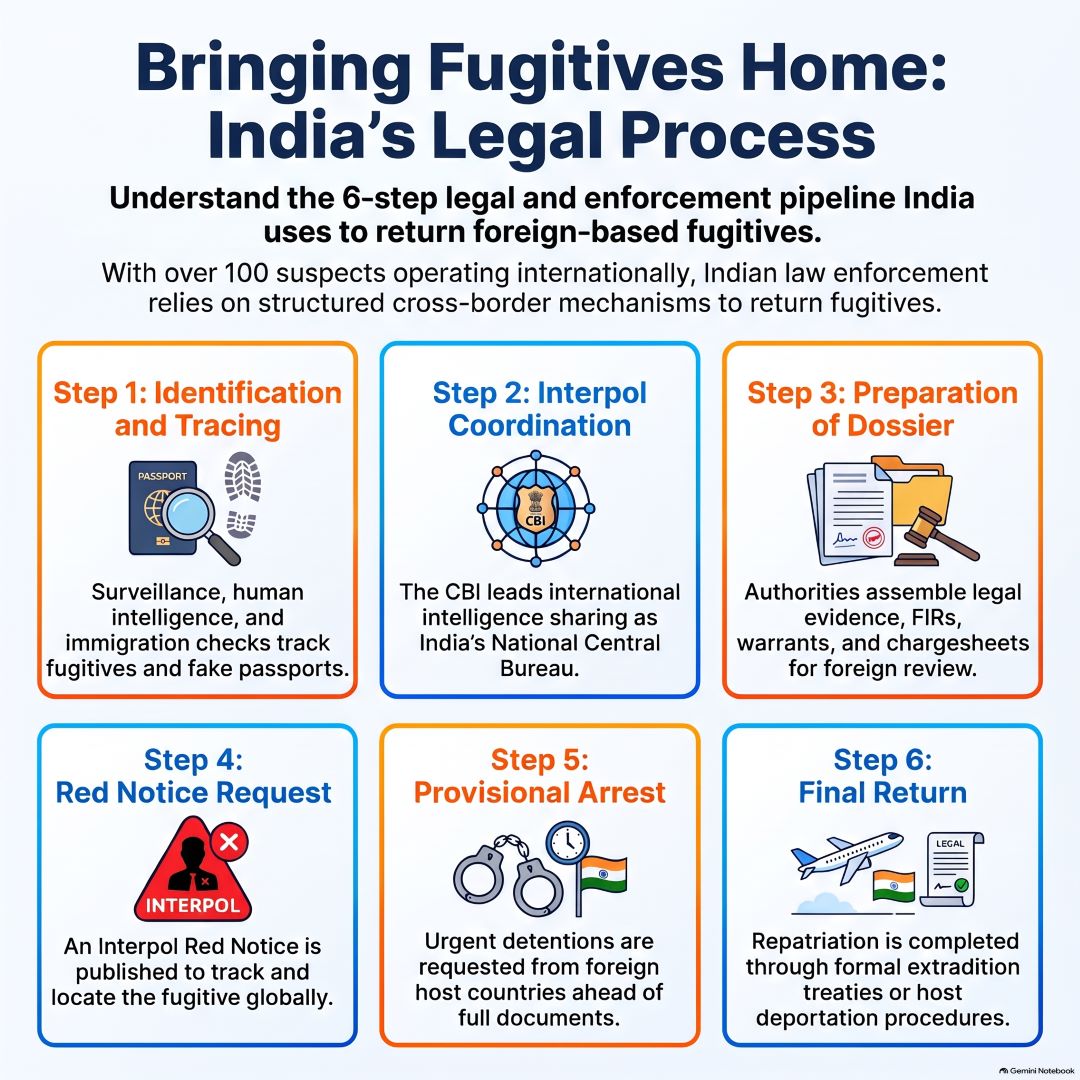
How Does India Bring Back a Fugitive?
The process involves coordination between Indian law enforcement agencies, courts, Interpol and the foreign government.
- Identification and tracing: Human intelligence, surveillance and immigration records are used to identify fake passports, travel routes and the fugitive's location.
- Interpol coordination: India shares information through Interpol channels. The CBI functions as India's National Central Bureau (NCB) for Interpol coordination.
- Preparation of extradition dossier: FIR, chargesheet, evidence, witness statements, forensic reports, identity documents and judicial warrants are compiled and translated as required.
- Red Notice: India seeks publication of an Interpol Red Notice to help locate the fugitive internationally.
- Provisional arrest: Once the location is established, an urgent request may be sent to the foreign country for provisional arrest.
- Final return: India submits a formal extradition request or pursues deportation, depending on the host country's laws and applicable arrangements.
Extradition vs Deportation
|
Basis |
Extradition |
Deportation |
|
Nature |
Formal legal surrender |
Removal under immigration law |
|
Legal basis |
Extradition treaty, arrangement or applicable law |
Domestic immigration law |
|
Process |
Judicial and diplomatic procedures |
Host country's immigration procedures |
|
Purpose |
Trial or punishment for an offence |
Removal of a person under immigration provisions |
Important: Deportation may be quicker, but it depends on the host country's laws. It cannot be treated as a guaranteed alternative to extradition.
Case Study: Gurwinder Singh alias Afridi
- He allegedly travelled using a fake passport issued in the name of Vijendra Singh.
- He was traced to the UAE in January 2026 but subsequently moved across several countries.
- Punjab Police used human intelligence, technical surveillance and multiple Interpol references to track him.
- His presence was eventually confirmed in Ethiopia, from where he was deported to India.
The case demonstrates the importance of coordinated intelligence-sharing and international law-enforcement cooperation.
Challenges in Bringing Back Fugitives
- Fake identities: Use of forged passports and multiple identities makes international tracking difficult.
- Jurisdictional differences: Extradition procedures and evidentiary requirements vary across countries.
- Lengthy legal procedures: Court proceedings, documentation and diplomatic clearances can delay extradition.
- Human rights and due process: Foreign courts may examine concerns relating to fair trial, prison conditions and possible persecution before approving extradition.
- Transnational criminal networks: Gangsters may use multiple countries, financial networks and digital communication to evade law enforcement.
Way Forward
- Strengthen international cooperation: Improve intelligence-sharing, mutual legal assistance and bilateral extradition arrangements.
- Use technology effectively: Strengthen digital surveillance, passport verification and international criminal databases, subject to legal safeguards.
- Improve inter-agency coordination: Ensure timely cooperation among state police, CBI, MHA and MEA.
- Expedite legal procedures: Prepare evidence-based extradition dossiers and strengthen specialised investigation teams.
- Target criminal networks: Investigate financial transactions, illegal arms supply and organised crime networks rather than focusing only on individual fugitives.