

Building Water Buffers: A New Policy Priority
Building Water Buffers: A New Policy Priority
Source: Indian Express (01-07-2026)
Why in News?
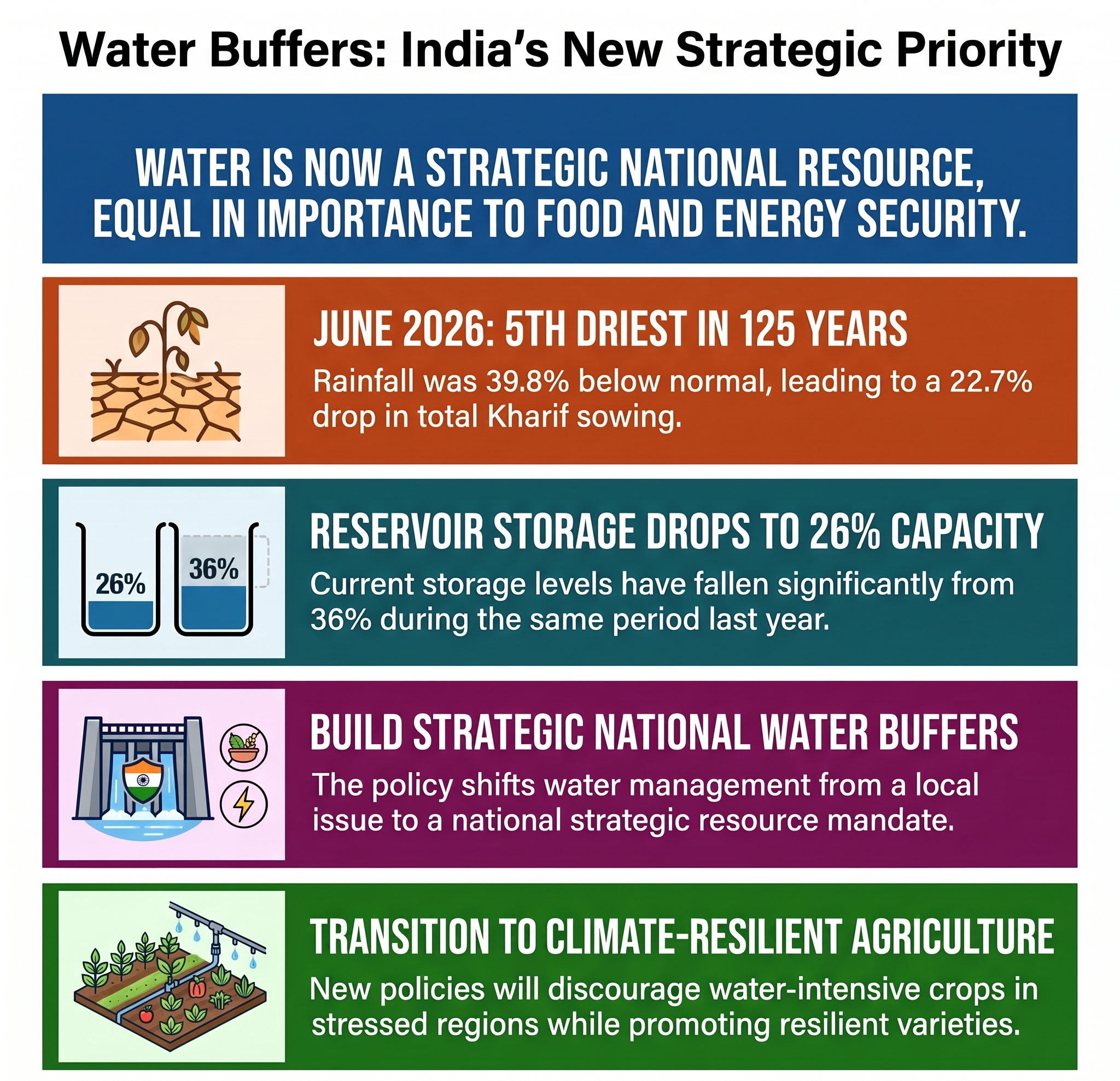
The Ministry of Finance, in its Monthly Economic Review (June 2026), highlighted the growing threat of water scarcity due to deficient monsoon rainfall and stressed that building water buffers should become a national policy priority to strengthen climate resilience and water security.
Key Highlights
Monsoon & Agricultural Concerns
- Weak progress of the Southwest Monsoon has adversely affected kharif sowing.
- As of 26 June 2026, total kharif sowing was 22.7% lower than the corresponding period last year.
- Kharif foodgrain sowing declined by 21.1%.
- IMD has forecast monsoon rainfall at 10% below the Long Period Average (LPA).
- There is a 43% probability of below-normal rainfall over the Monsoon Core Zone, covering much of India's rainfed agricultural region.
- June 2026 recorded only 99.5 mm rainfall, 39.8% below normal, making it the fifth driest June in 125 years.
- IMD has also projected below-normal rainfall during July.
Water Storage Situation
- Reservoir storage stood at 26% of total capacity (25 June 2026), compared to 36% during the same period last year.
- However, storage remained 5.7% above the long-term normal, providing a temporary irrigation buffer.
Why Water Buffers Have Become Important
- Increasing rainfall variability due to climate change.
- Greater frequency of droughts and extreme weather events.
- Heavy dependence of Indian agriculture on monsoon rainfall.
- Rising pressure on irrigation, drinking water and industrial demand.
- Water security has emerged as a strategic resource, similar to energy and food security.
Policy Implications
- Water conservation and efficient water management should become a national priority.
- Strengthen rainwater harvesting, groundwater recharge and wastewater recycling.
- Ensure effective utilisation of funds under the Jal Jeevan Mission.
- Build strategic buffers for critical natural resources alongside food, fertilisers and energy.
- Reorient agricultural pricing policies to:
- Promote climate-resilient crops.
- Discourage cultivation of highly water-intensive crops in water-stressed regions.
Jal Jeevan Mission
- Budget Estimate (2025–26): ₹67,000 crore.
- Revised Estimate (2025–26): ₹17,000 crore.
- Budget Estimate (2026–27): ₹67,670 crore.
Significance
- Strengthens long-term water security.
- Enhances climate resilience of agriculture.
- Supports food security and rural livelihoods.
- Reduces vulnerability to future climate shocks.
- Contributes to sustainable management of water resources.
Challenges
- Erratic monsoon and declining groundwater levels.
- Low irrigation efficiency and high water losses.
- Continued cultivation of water-intensive crops.
- Inadequate storage, recycling and watershed infrastructure.
- Weak implementation of integrated water resource management.
Way Forward
- Expand watershed development and aquifer recharge programmes.
- Promote micro-irrigation and water-efficient farming practices.
- Scale up wastewater treatment and reuse.
- Improve reservoir management and inter-sectoral water planning.
- Strengthen climate-resilient agriculture through appropriate incentives and cropping diversification.
Conclusion
The Finance Ministry has underlined that water security is emerging as one of India's foremost economic and developmental challenges. Building robust water buffers through conservation, efficient resource management and climate-resilient agriculture will be critical for ensuring sustainable growth, food security and long-term resilience against climate variability.
