

Buxa Tiger Reserve: Tiger Reintroduction Programme

Buxa Tiger Reserve: Tiger Reintroduction Programme
Source: The Hindu
Why in News?
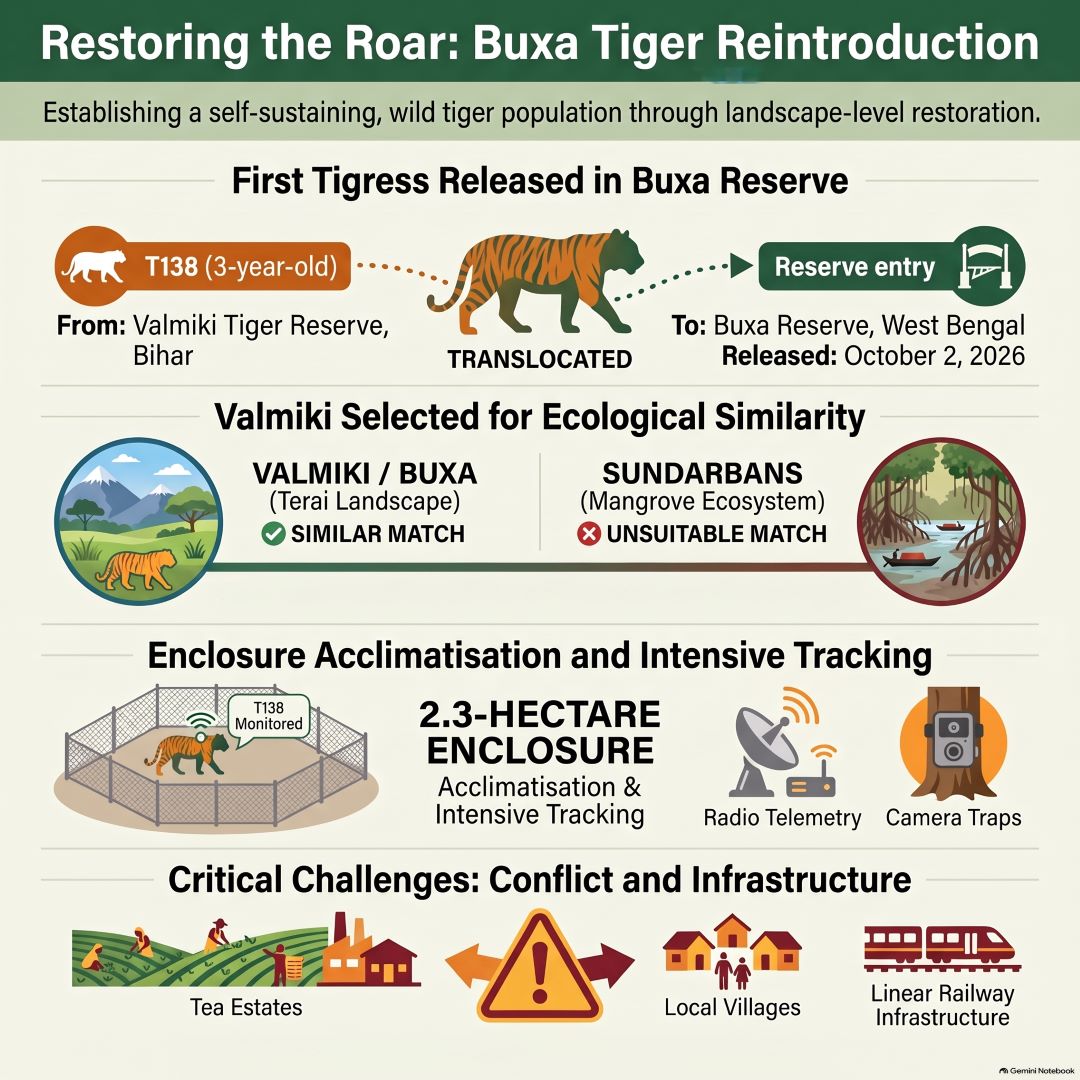
A three-year-old tigress, T138, was released into Buxa Tiger Reserve (BTR), West Bengal, on 2 October 2026, marking the beginning of a phased programme to establish a viable and self-sustaining tiger population in the reserve.
The tigress was translocated from Valmiki Tiger Reserve, Bihar. Three more tigers are expected to be introduced as part of the programme.
Tiger Reintroduction
Reintroduction is a conservation strategy used when a species has become locally extinct but suitable habitat remains available for restoring a breeding population.
T138 will initially remain in a 2.3-hectare enclosure for acclimatisation. Her movement, health and behaviour will be monitored using:
- Radio/telemetry tracking
- Camera traps
- Field-based observations
The objective is not merely to increase tiger numbers but to establish a breeding population capable of surviving independently in the wild.
About Buxa Tiger Reserve
|
Why was Buxa Chosen for Reintroduction?
Buxa had experienced a prolonged absence of a stable resident tiger population due to factors such as:
Habitat degradation + fragmentation + anthropogenic pressure + reduced prey availability
The NTCA identified Buxa, along with Dampa and Palamu, as reserves requiring tiger reintroduction efforts.
|
Why Valmiki Tiger Reserve? Valmiki Tiger Reserve (Bihar) was selected as the source landscape because:
Tigers from the Sundarbans were not considered suitable because the mangrove ecosystem is substantially different from Buxa's terrain and habitat. Lessons from Earlier Reintroduction Efforts India has considerable experience with tiger reintroduction. Major efforts began with Sariska Tiger Reserve and Panna Tiger Reserve. However, results have not always been uniform. Satkosia Tiger Reserve, Odisha, for example, faced challenges involving:
Therefore, modern reintroduction programmes emphasise scientific feasibility assessment, source-animal selection, habitat suitability and intensive post-release monitoring |
NTCA Reintroduction Protocol
The National Tiger Conservation Authority (NTCA) protocol covers:
- Feasibility and site-suitability assessment
- Selection of release sites
- Selection of suitable source tigers
- Socio-economic assessment
- Preparation for release
- Post-release monitoring
- Long-term management
This represents a shift from simply increasing tiger numbers towards landscape-level population recovery.
Major Challenges in Buxa
· Human-wildlife conflict: The reserve is surrounded by villages and tea estates. Relocation of some families is being undertaken to improve conservation prospects.
· Prey and habitat: Successful tiger establishment requires adequate prey and suitable habitat.
· Linear infrastructure: Roads and railway infrastructure can disrupt animal movement and increase mortality risks.
· Connectivity: Maintaining corridors connecting Buxa with neighbouring landscapes is essential for gene flow and population viability.
Way Forward
Successful tiger reintroduction requires more than releasing animals. It needs:
Suitable habitat + adequate prey + ecological corridors + scientific monitoring + community participation + conflict mitigation
Conclusion
The Buxa initiative represents a shift from species-focused conservation to ecosystem and landscape restoration. Its success will depend on whether the reintroduced tigers can survive, reproduce and establish a self-sustaining population while maintaining ecological connectivity and community support.
