

Can a Divorce Abroad End an Indian Marriage? SC on Foreign Rulings and Bigamy

Can a Divorce Abroad End an Indian Marriage? SC on Foreign Rulings and Bigamy
Source: The Indian Express, 14 Nov 2026
Syllabus: GS II: Judiciary, family law, Indian legal system. GS I: Social issues
Why in news?
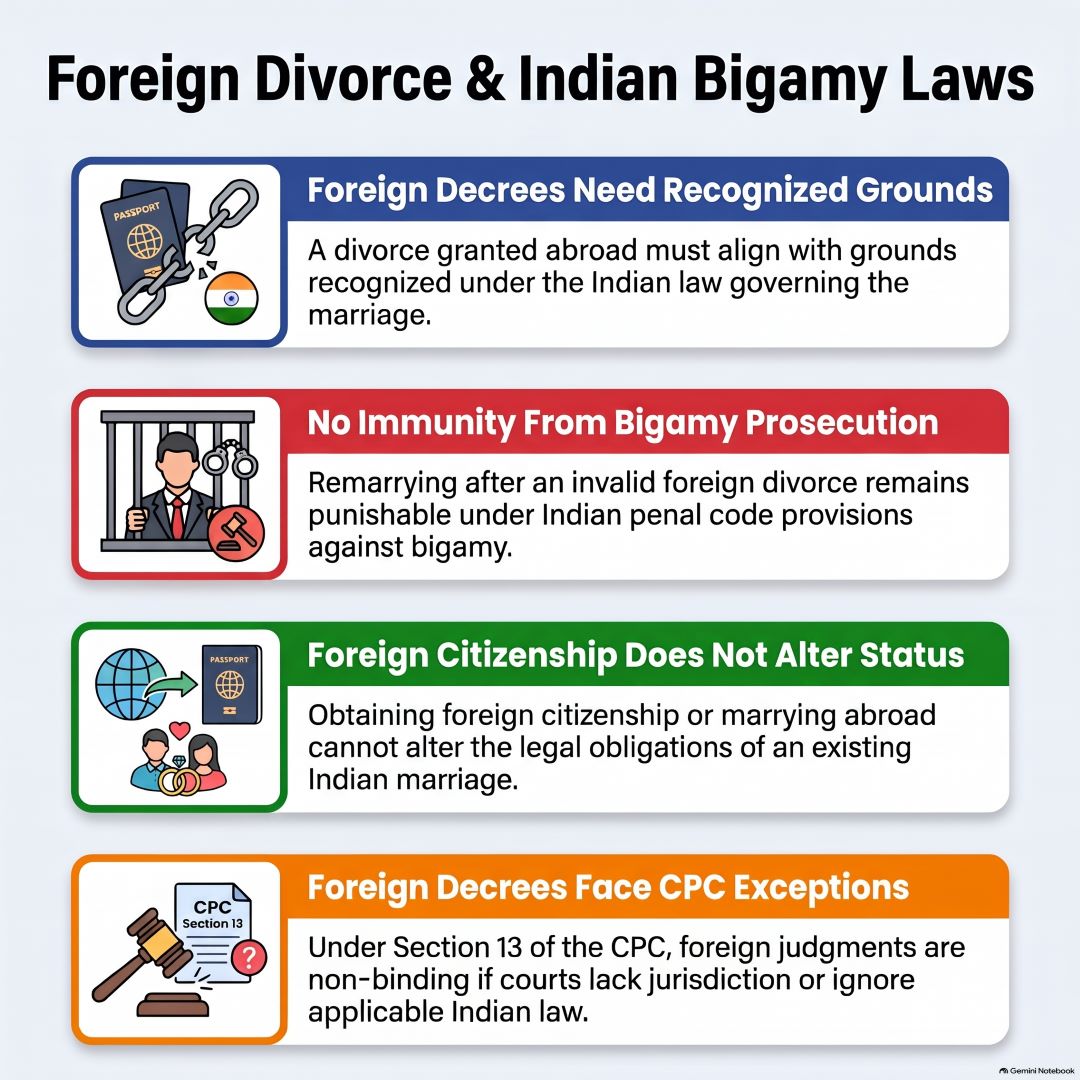
On 3 November the Supreme Court (Justices Prashant Kumar Mishra and Shree Chandrashekar) held that a person married under Indian law cannot use a foreign divorce decree to escape bigamy proceedings in India if the divorce was granted on a ground not recognised in India. A change in citizenship, or the second marriage taking place abroad, cannot alter the legal consequences of a marriage that continues under Indian law.
Static background
- Hindu Marriage Act, 1955: Section 5(i) allows marriage only if neither party has a living spouse. Section 17 makes bigamy punishable under the penal code. Grounds for divorce are in Section 13, such as adultery, cruelty and desertion, and Section 13B allows divorce by mutual consent.
- Irretrievable breakdown of marriage is not a statutory ground under the HMA. The Supreme Court can dissolve a marriage on this basis using Article 142, as in Shilpa Sailesh v. Varun Sreenivasan (2023).
- Bigamy: Section 494 of the IPC, now Section 82 of the Bharatiya Nyaya Sanhita (BNS), 2023.
- Private international law: Rules on when one country recognises another country's court judgments. In India they are in Sections 13 and 14 of the Code of Civil Procedure (CPC).
Facts of the case
- The couple married under Hindu rites and customs in 2003 and later moved to the UK, where the relationship deteriorated.
- The husband filed for divorce in a Guntur court, but the petition was dismissed. His appeal in the Andhra Pradesh High Court was withdrawn.
- After getting British citizenship in February 2013, he approached the Cambridge County Court in August 2013. It granted divorce in January 2014 on the ground of irretrievable breakdown, and he married another woman in the UK in March 2014.
- The first wife complained of bigamy under Section 494 IPC, which carries imprisonment of up to seven years or a fine. She said she had objected to UK jurisdiction and that irretrievable breakdown is not a ground under the HMA, 1955.
Indian law on foreign rulings
- Section 13, CPC: Six exceptions in which a foreign judgment is not conclusive in India. They include a foreign court lacking jurisdiction, a judgment not given on merits, one obtained by fraud, and a court refusing to recognise Indian law that applies.
- Section 14, CPC: A foreign judgment is presumed valid unless the contrary is proved. The presumption is easily rebutted once a Section 13 exception is shown.
- In matrimonial cases this means a divorce granted abroad does not automatically end a marriage governed by Indian law. The decree must meet the CPC requirements for recognition.
- Precedent (1991 case): A foreign divorce decree must be consistent with the matrimonial law under which the parties married. Two principles follow: the ground for divorce must be recognised in India, and both spouses must have agreed to place themselves before the foreign court.
Conclusion
The ruling confirms that a marriage under Indian law cannot be ended by a foreign decree on a ground Indian law does not recognise, and that bigamy proceedings can continue regardless of citizenship or where the second marriage happened.