

Caste Census 2026

Caste Census 2026
Why in News?
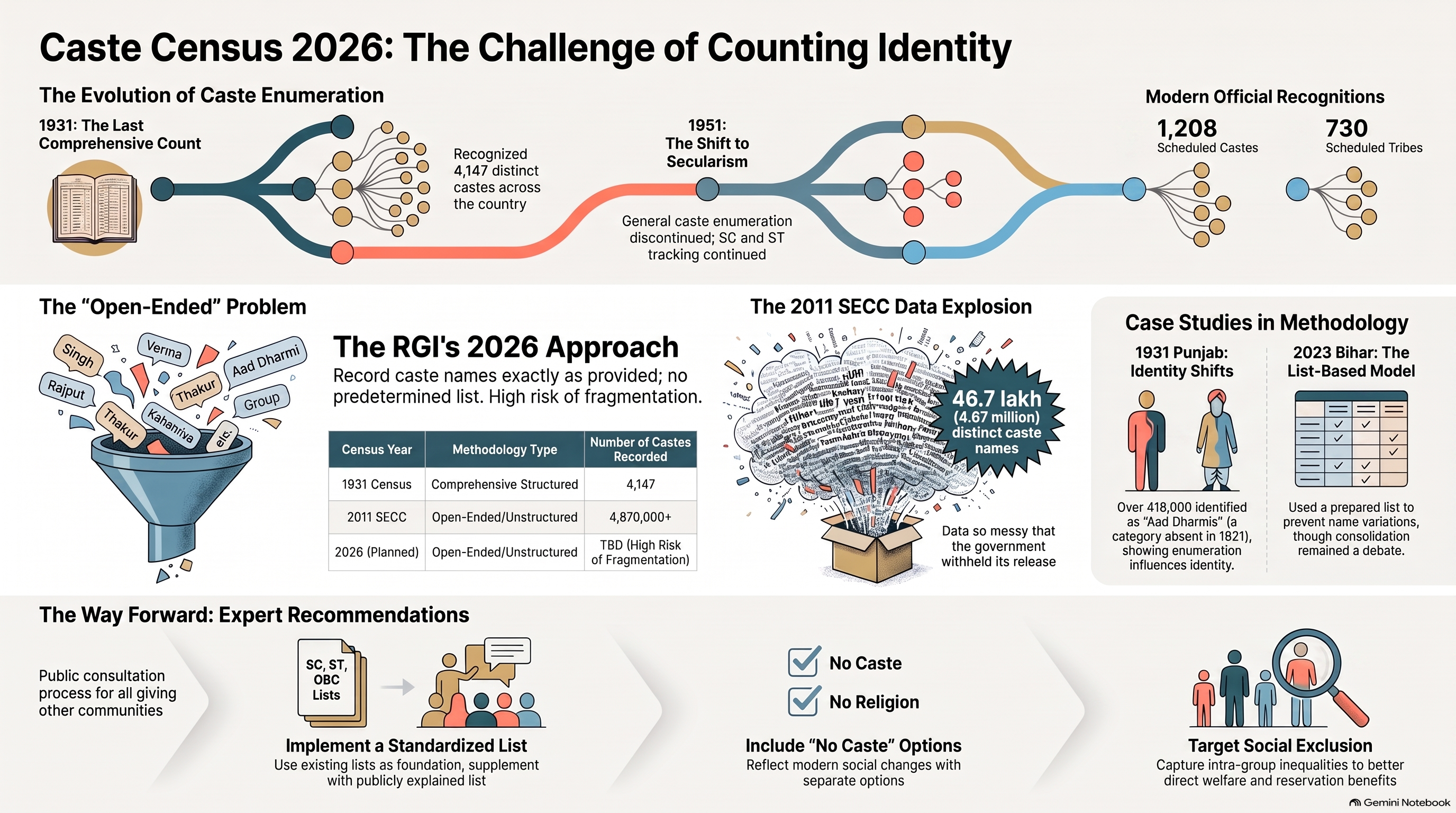
- The Registrar General of India has decided to use an open-ended question for caste enumeration instead of a predetermined list of castes.
- Under this approach, respondents will state their caste and enumerators will record it as provided.
- Concerns have been raised that variations in names, surnames and regional identities could produce a very large and difficult-to-use dataset.
Background of Caste Enumeration
- The 1931 Census was the last comprehensive census to enumerate and publish caste data. It recorded 4,147 castes.
- Caste details were collected in the 1941 Census but were not included in the final tabulation because of wartime financial constraints.
- After Independence, the 1951 Census discontinued general caste enumeration, influenced by the constitutional ideals of equality and secularism.
- Since then, Scheduled Castes and Scheduled Tribes have continued to be enumerated using official lists.
- The Ministry of Social Justice and Empowerment currently recognises 1,208 Scheduled Castes, while official records list 730 Scheduled Tribes.
Problem with Open-Ended Enumeration
- A single caste may have several names, while the same name may refer to different communities across regions.
- For example, Rajput, Thakur, Singh and Kshatriya may be used differently by respondents.
- Surnames such as Singh and Verma cut across multiple caste groups.
- If no standardised list exists, spelling variations and different descriptions can become separate entries.
- This can make aggregation and comparison of caste data extremely difficult.
Experience of the 1931 Census
- The colonial census itself demonstrated how open-ended caste enumeration could influence social identities.
- Some communities adopted new identities to assert social or religious status.
- In Punjab, 418,789 people identified themselves as Aad Dharmis in 1931, a category that had not appeared in the 1921 Census.
- Several communities also attempted to consolidate themselves under broader identities to strengthen their numerical or social position.
- Grazier communities such as Ahirs, Goalas, Gopis and Idaiyans increasingly sought enumeration under the broader Yadava identity.
- Occupational groups such as carpenters, smiths and goldsmiths sought common identities such as Vishwakarma or Jangida.
Lessons from SECC 2011
- The Socio-Economic and Caste Census (SECC) 2011 also used an open-ended approach.
- It generated nearly 46.7 lakh distinct caste names, compared with 4,147 castes recorded in 1931.
- The Union government eventually withheld the raw caste data because of difficulties in processing and standardising it.
- This experience is a major concern for the current exercise.
Bihar Caste Survey Experience
- The 2023 Bihar caste survey used a prepared list of castes rather than relying entirely on open-ended responses.
- This helped avoid multiple names being automatically treated as separate categories.
- However, the construction of the list itself generated concerns.
- For example, some Yadav sub-castes were consolidated, while Dangi was separately identified among Kushwahas.
- Several sub-castes among the Mallah community were also separately enumerated.
- This demonstrates that even a standardised list involves important methodological and political choices.
Way Forward
- Experts have recommended using a predetermined and publicly explained caste list.
- Existing SC, ST and OBC lists could provide the foundation, supplemented by a comprehensive list for other communities.
- A standardised list could reduce errors while still allowing limited flexibility for genuine regional variations.
- Separate options could be provided for people identifying as having “no caste” or “no religion”.
- Separate questionnaires may be considered for SCs and STs because the forms of exclusion affecting these groups differ.
- Enumeration could also capture intra-group inequalities and social exclusion to improve the targeting of welfare and reservation policies.
- The methodology and classification criteria should be transparent and discussed with relevant stakeholders to reduce political and administrative disputes.
Significance
- Reliable caste data can help assess social and educational backwardness, representation and inequalities.
- It can improve evidence-based welfare policies and help evaluate the distribution of benefits.
However, the usefulness of the census will depend not merely on collecting caste identities but on producing standardised, comparable and analytically usable data.
