

Census Duty Increases Workload of Government Teachers
Business Standard
1. Core Issue and Context
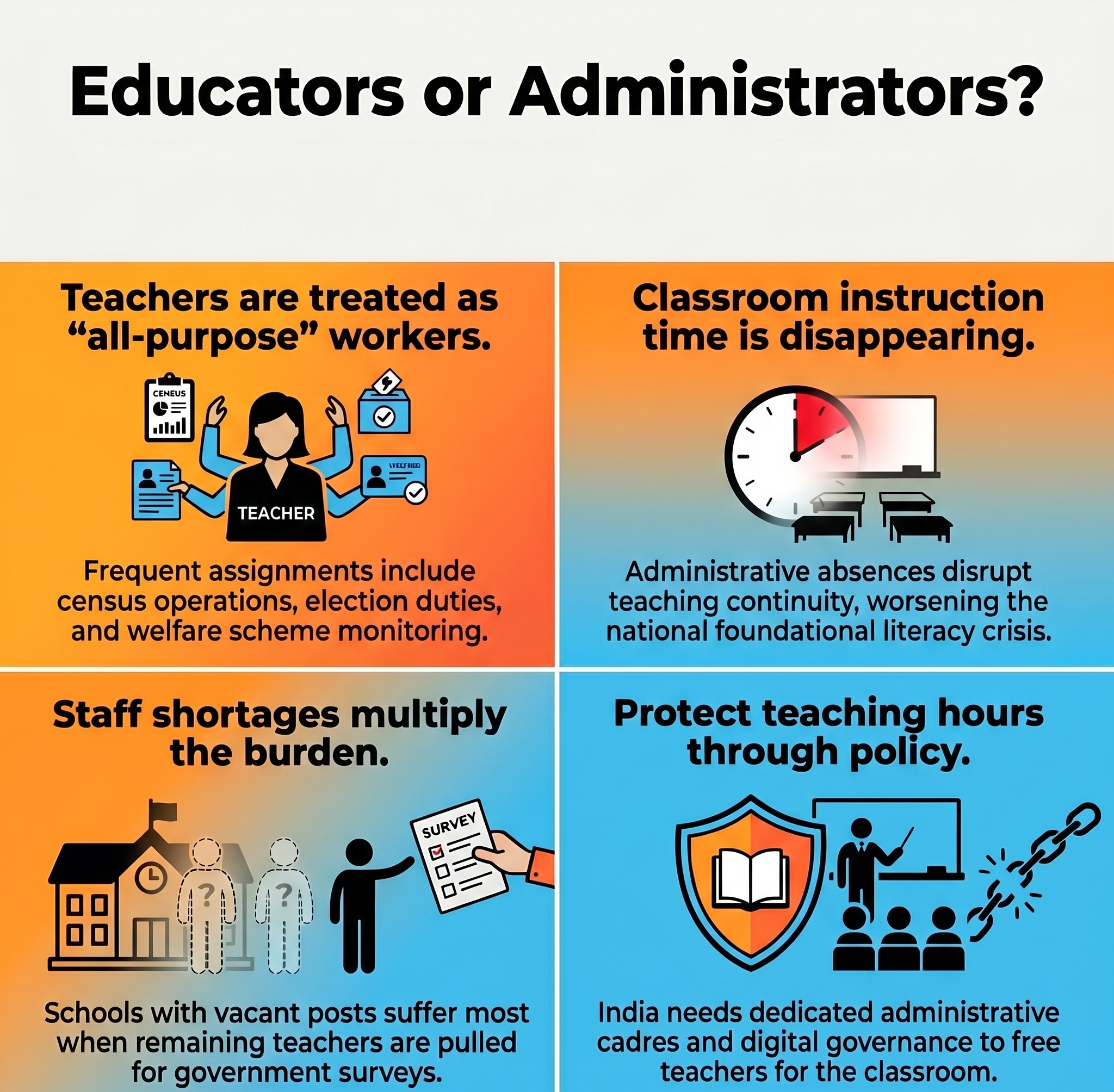
The article highlights the growing burden on government school teachers who are increasingly being assigned non-teaching administrative duties such as census work, election duty, surveys, welfare scheme implementation, and data collection exercises.
The central concern is that repeated deployment of teachers for government administrative tasks adversely affects:
Classroom teaching
Learning outcomes
Educational quality
Student-teacher engagement
The issue becomes more significant in the context of India’s ongoing learning crisis and attempts to improve foundational literacy and numeracy.
2. Key Arguments in the Article
Teachers are overburdened with non-academic duties
The article argues that government teachers are frequently assigned:
Census operations
Election-related duties
Survey and data collection work
Welfare scheme monitoring
This reduces the time and energy available for actual teaching.
Classroom learning suffers directly
According to the article:
Frequent absence of teachers disrupts continuity in teaching
Students lose instructional hours
Learning gaps widen, especially in foundational classes
The burden is particularly severe in government schools already facing teacher shortages.
Administrative dependence on teachers
Governments often rely on teachers because:
They are geographically available
They possess literacy and organisational skills
They represent an easily deployable state workforce
The article questions whether this dependence has crossed reasonable limits.
Impact extends beyond workload
The article suggests that non-teaching assignments:
Create stress and burnout
Reduce teaching motivation
Affect educational accountability
This weakens overall public education quality.
3. Author’s Stance
Strongly sympathetic toward teachers
The article clearly supports the view that:
Teachers should primarily focus on education
Excessive administrative duties undermine public education
The tone is critical of systemic overdependence on teachers for governance tasks.
4. Underlying Biases
Education-centric bias
The article prioritises:
Classroom learning
Academic outcomes
Pedagogical responsibilities
Administrative necessity receives comparatively less emphasis.
Public school advocacy perspective
The discussion implicitly supports:
Strengthening government schools
Protecting teaching time
Improving state educational capacity
Teacher welfare framing
The article frames teachers as:
Overburdened public servants
rather than
Multi-purpose administrative functionaries
5. Structural Issues Highlighted
Teacher shortage
Many schools already face:
Vacant teaching posts
Multi-grade classrooms
High pupil-teacher ratios
Additional duties worsen existing shortages.
Weak administrative capacity
The state often lacks:
Dedicated field staff
Data collection personnel
Administrative infrastructure
As a result, teachers become the default workforce for governance exercises.
Learning crisis
India continues facing concerns regarding:
Foundational literacy
Numeracy deficits
Post-pandemic learning loss
Loss of classroom time aggravates these problems.
Role conflict
Teachers are increasingly expected to function simultaneously as:
Educators
Survey agents
Census workers
Welfare administrators
This dilutes professional identity.
6. Pros (Arguments Supporting Census/Administrative Duty)
Teachers possess organisational reach
Teachers are:
Present across rural and urban areas
Trusted by communities
Literate and administratively capable
This makes them effective for large-scale government exercises.
Ensures efficient state implementation
Census and welfare surveys require:
Large manpower
Local familiarity
Rapid deployment
Teachers help governments execute nationwide programs effectively.
Strengthens state-community interaction
Administrative duties may increase:
Grassroots engagement
Awareness generation
Local governance participation
7. Cons and Concerns
Disruption of teaching-learning process
The biggest concern is:
Reduced classroom instruction
Interrupted academic schedules
Decline in learning quality
Teacher burnout and demotivation
Continuous non-teaching duties lead to:
Work overload
Mental stress
Reduced job satisfaction
Impact on vulnerable students
Government school students, especially from poorer backgrounds, suffer the most because:
They depend heavily on classroom teaching
Alternative educational support is limited
Erosion of educational professionalism
Overuse of teachers for administrative tasks may:
Devalue teaching as a profession
Shift focus away from pedagogy
8. Policy Implications
Need for dedicated administrative cadres
Governments should create:
Census support staff
Field survey personnel
Welfare monitoring teams
to reduce dependence on teachers.
Legal protection of teaching time
Policies should ensure:
Minimum protected instructional hours
Limits on non-teaching assignments
Strengthening school staffing
Need for:
Faster teacher recruitment
Reduced vacancies
Better workforce planning
Digital governance reforms
Technology can reduce manual workload through:
Digital surveys
Automated databases
Integrated governance systems
9. Real-World Impact
Declining educational quality
Frequent teacher absence weakens:
Student performance
Foundational learning
School discipline
Increased inequality
Private school students are less affected, while government school students face:
Greater learning disruption
Widening educational inequality
Reduced teacher morale
Professional dissatisfaction may:
Reduce classroom innovation
Increase absenteeism
Affect long-term educational outcomes
Governance efficiency vs education quality dilemma
The issue reflects a broader governance challenge:
Administrative efficiency often comes at the cost of educational priorities.
10. UPSC GS Paper Linkages
GS Paper II (Governance & Education)
Relevant themes:
Educational administration
Public service delivery
State capacity
Governance reforms
GS Paper I (Society)
Relevant themes:
Educational inequality
Social justice
Rural education challenges
GS Paper IV (Ethics)
Relevant themes:
Professional ethics
Duty versus institutional overload
Public accountability
11. Critical Examination from UPSC Perspective
Education vs administrative governance conflict
The article highlights a recurring Indian governance problem:
Weak institutional capacity forces multitasking by existing personnel.
Teachers become substitute administrators because of:
Staff shortages
Bureaucratic dependence
Resource constraints
Need to treat education as core state function
If teachers remain diverted toward administrative tasks, long-term consequences may include:
Lower human capital formation
Weak productivity growth
Reduced demographic dividend benefits
Balancing governance needs
Certain national exercises like:
Census
Elections
Disaster response
require large-scale mobilisation.
Thus, the issue is not complete removal of duties but:
Rationalisation
Limitation
Better workforce planning
12. Balanced Conclusion
The article effectively draws attention to the growing administrative burden on government teachers and its consequences for India’s public education system.
While teachers play an important role in governance implementation due to their reach and credibility, excessive deployment for non-academic work undermines:
Classroom teaching
Learning outcomes
Teacher morale
India must therefore strike a balance between administrative necessity and educational priorities.
13. Future Perspective
Future reforms should focus on:
Dedicated governance support staff
Digital administrative systems
Protection of teaching hours
Better school staffing
Strengthening public education infrastructure
Ultimately, improving India’s educational outcomes requires recognising teachers primarily as educators rather than as an all-purpose administrative workforce.
