

Centre unveils seven-pronged Prahaar counter-terror policy
Hindustan Times
I. Core Context
The article reports the unveiling of a comprehensive national counter-terror strategy titled “Prahaar”, structured around seven pillars of counter-terrorism. It signals a shift toward an intelligence-driven, coordinated, and multi-agency framework aimed at preventing, disrupting, and responding to terrorist threats.
The policy appears to integrate:
- Intelligence and data analytics
- Rapid response mechanisms
- Counter-radicalisation measures
- International cooperation
- Human rights safeguards
II. Key Arguments Presented
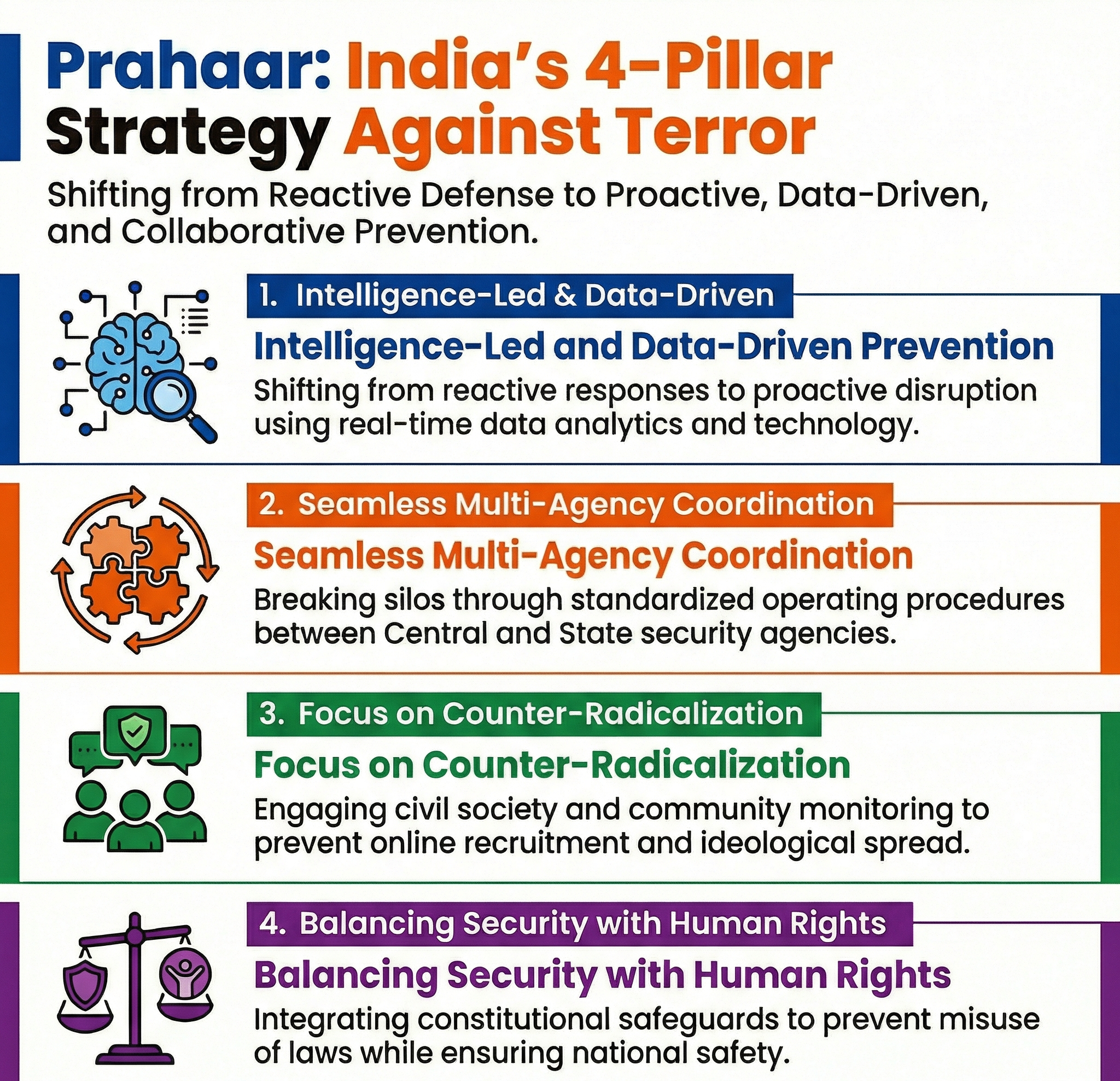
1. Intelligence-Led and Data-Driven Approach
The first pillar emphasises:
- Proactive intelligence gathering
- Data sharing among agencies
- Technology integration
The strategy recognises that contemporary terrorism is networked and digital.
2. Multi-Agency Coordination
The document stresses:
- Seamless coordination between central and state agencies
- Standardised operating procedures
- Institutionalised communication platforms
This addresses past criticisms of fragmented response systems.
3. Counter-Radicalisation and Community Engagement
A notable inclusion is:
- Community-based monitoring
- Preventing recruitment and online radicalisation
- Engagement with civil society
The framework acknowledges ideological and social dimensions of terrorism.
4. International Collaboration
The policy underlines:
- Cross-border intelligence cooperation
- Global partnerships
- Action against terror financing and safe havens
This reflects the transnational nature of contemporary threats.
5. Human Rights and Rule of Law
The inclusion of rights protection signals an attempt to:
- Balance security with constitutional safeguards
- Prevent misuse of counter-terror laws
- Ensure legal accountability
III. Author’s Stance
The article adopts a largely affirmative tone.
It presents the policy as:
- Comprehensive
- Structured
- Forward-looking
There is limited overt criticism, suggesting a supportive framing of executive action.
IV. Possible Biases and Limitations
1. Limited Scrutiny of Implementation
The article focuses on policy design but underplays:
- Resource constraints
- Federal coordination challenges
- Ground-level capacity gaps
Execution remains the real test.
2. Rights Concerns Underexplored
While human rights are mentioned, the article does not deeply examine:
- Potential misuse of preventive detention laws
- Surveillance overreach
- Data privacy concerns
3. Political Context
The timing and political signalling of the policy are not critically analysed. Counter-terror strategies often intersect with electoral narratives and security optics.
V. Pros and Cons of the Policy
Pros
• Holistic multi-pillar structure
• Emphasis on intelligence integration
• Focus on counter-radicalisation
• International cooperation embedded
• Recognition of human rights principles
Cons
• Risk of surveillance overreach
• Federal friction between Centre and States
• Capacity and training gaps
• Potential civil liberties concerns
VI. Policy Implications
1. Institutional Strengthening
Requires:
- Modernised intelligence infrastructure
- Real-time data fusion centres
- Interoperable communication systems
2. Legal Safeguards
Clear guidelines must ensure:
- Judicial oversight
- Transparency in surveillance
- Periodic review of anti-terror laws
3. Capacity Building
States and local police forces need:
- Training in cyber-terror detection
- Community engagement skills
- Forensic and analytical capability
4. Counter-Radicalisation Framework
Long-term success depends on:
- Education reforms
- Digital literacy
- Socio-economic inclusion
Security cannot rely solely on coercive power.
VII. Real-World Impact
Short-term:
- Institutional restructuring
- Increased inter-agency coordination
Medium-term:
- Improved response time
- Better intelligence fusion
Long-term:
- Enhanced preventive capacity
- Possible debates over civil liberties
VIII. UPSC Relevance
GS Paper II
• Internal security architecture
• Centre–State relations
• International cooperation against terrorism
GS Paper III
• Role of technology in internal security
• Cyber security and data analytics
• Terror financing
GS Paper IV
• Ethical dilemmas in national security
• Balancing liberty and security
Essay Themes
• Security vs freedom
• Technology in governance
• Preventive state and constitutional morality
IX. Balanced Conclusion and Future Perspective
The Prahaar counter-terror policy reflects a strategic evolution from reactive to intelligence-led prevention. Its structured seven-pillar design suggests institutional maturity in addressing complex security threats.
However, counter-terror effectiveness is determined not by policy articulation but by:
- Coordination efficiency
- Legal accountability
- Community trust
- Technological competence
A robust security framework must protect citizens without eroding constitutional freedoms. The durability of Prahaar will depend on maintaining this delicate balance between decisive action and democratic restraint.
