

China is mapping ocean floor as it prepares for sub warfare with US
Times Of India
1. Key Arguments
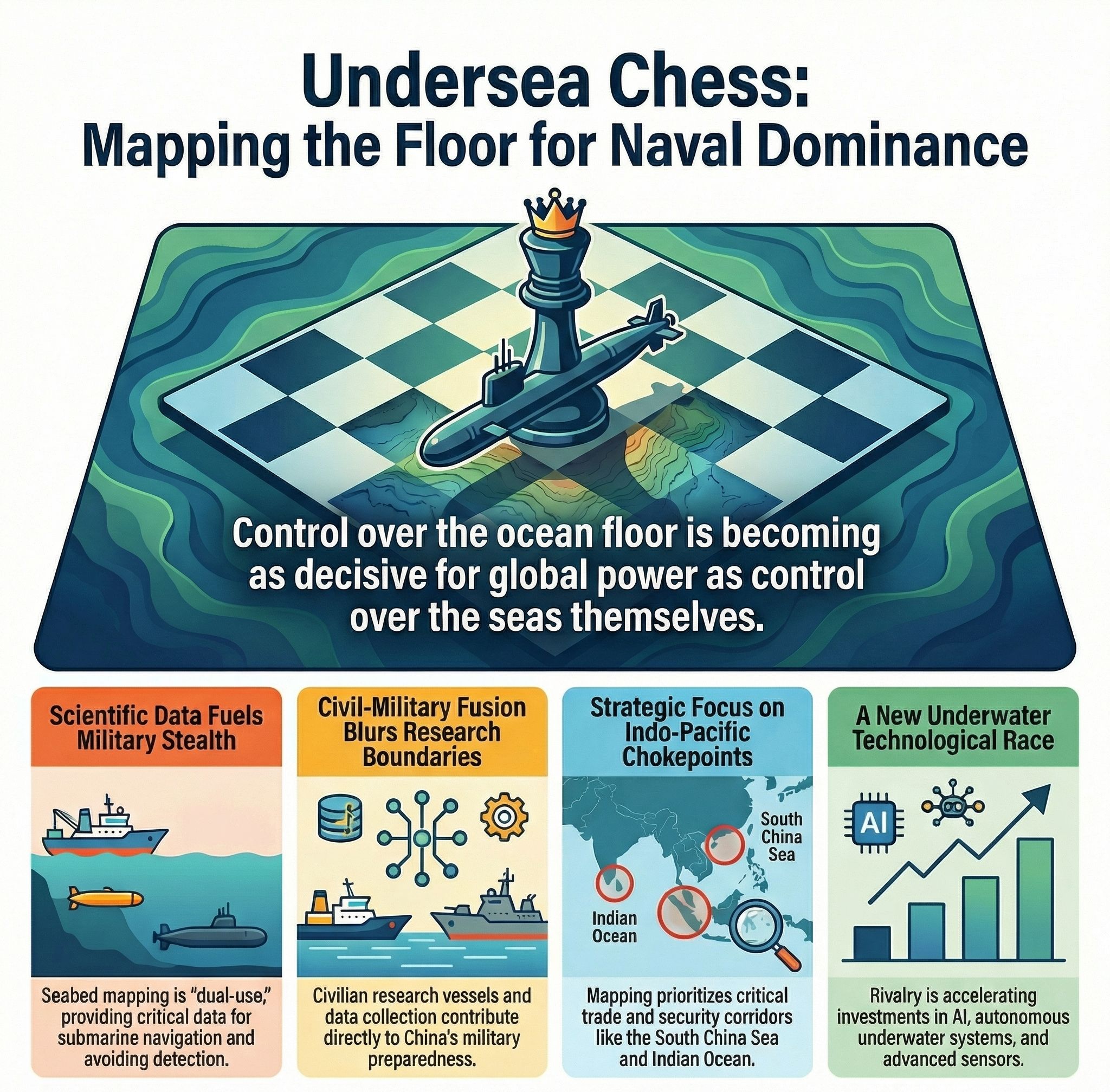
A. Dual-Use Nature of Ocean Mapping
Scientific exploration overlaps with military objectives.
Seabed mapping aids submarine navigation, stealth operations, and detection avoidance.
B. Strategic Importance of Indo-Pacific Waters
Key maritime chokepoints and sea lanes are central to global power competition.
Regions like the South China Sea and Indian Ocean are critical for trade and security.
C. China’s Expanding Naval Capabilities
Investment in submarines and underwater systems is rising.
Mapping enhances operational efficiency and strategic reach.
D. Civil-Military Fusion
Blurred boundaries between civilian research and defence applications.
Research vessels and data collection contribute to military preparedness.
E. Growing US-China Rivalry
Ocean mapping is part of broader geopolitical competition.
Reflects intensifying strategic rivalry in maritime domain.

2. Author’s Stance
Security-oriented and cautious
Highlights strategic risks
The article frames China’s activities as a potential threat.
Implicit concern for regional stability
Emphasises implications for global and regional security.
3. Biases and Limitations
Security bias
Focuses heavily on military implications, underplaying legitimate scientific research.
Limited Chinese perspective
Does not fully represent China’s stated objectives or justification.
Geopolitical framing dominance
Economic and environmental aspects are less explored.

4. Strengths (Pros)
Timely geopolitical relevance
Addresses evolving maritime security dynamics.
Clear linkage between technology and strategy
Explains how data translates into military advantage.
Focus on Indo-Pacific significance
Important for India’s strategic interests.
5. Weaknesses (Cons)
Limited technical depth
Does not fully explain technological aspects of seabed mapping.
Absence of international legal context
UNCLOS and maritime laws are not discussed in detail.
Overemphasis on rivalry narrative
May oversimplify complex geopolitical interactions.
6. Policy Implications
A. Strengthening Maritime Security
Enhancing naval capabilities and surveillance systems
Focus on submarine detection and monitoring.
B. Strategic Partnerships
Collaboration with like-minded countries
QUAD and Indo-Pacific alliances.
C. Investment in Oceanography
Developing indigenous seabed mapping capabilities
Reducing strategic dependence.
D. Legal and Diplomatic Measures
Leveraging international maritime law
Ensuring transparency and compliance.
E. Technological Development
Advancing underwater technologies
AI, sensors, and autonomous systems.
7. Real-World Impact
Security Dynamics
Increased militarisation of oceans
Heightened tensions and strategic competition.
Trade and Economy
Risks to global supply chains
Disruptions in key sea routes.
Regional Stability
Potential escalation in Indo-Pacific
Strategic rivalry impacts neighbouring countries.
Technological Race
Acceleration of defence innovation
Focus on underwater warfare capabilities.
8. UPSC GS Paper Linkages
GS Paper II (International Relations)
- Indo-Pacific geopolitics
- US-China relations
- Strategic alliances
GS Paper III (Security & Technology)
- Maritime security
- Defence technology
- Cyber and underwater warfare
GS Paper I (Geography)
- Ocean resources
- Strategic sea routes
9. Balanced Conclusion
Ocean mapping reflects both scientific advancement and strategic competition.
While it enhances knowledge and capabilities, its militarisation raises concerns for global stability.
10. Future Perspective
Towards regulated maritime governance
Strengthening international norms.
Balancing competition and cooperation
Promoting scientific collaboration alongside security measures.
Enhancing India’s maritime strategy
Focus on capacity building and partnerships.
Technological preparedness
Investing in future naval and oceanographic capabilities.
Final Insight
In the emerging geopolitical order, control over the ocean floor may be as decisive as control over the seas themselves.
