

CHINA’S TBM EXPORT CURBS AND INDIA’S INFRASTRUCTURE CHALLENGE

CHINA’S TBM EXPORT CURBS AND INDIA’S INFRASTRUCTURE CHALLENGE
Context
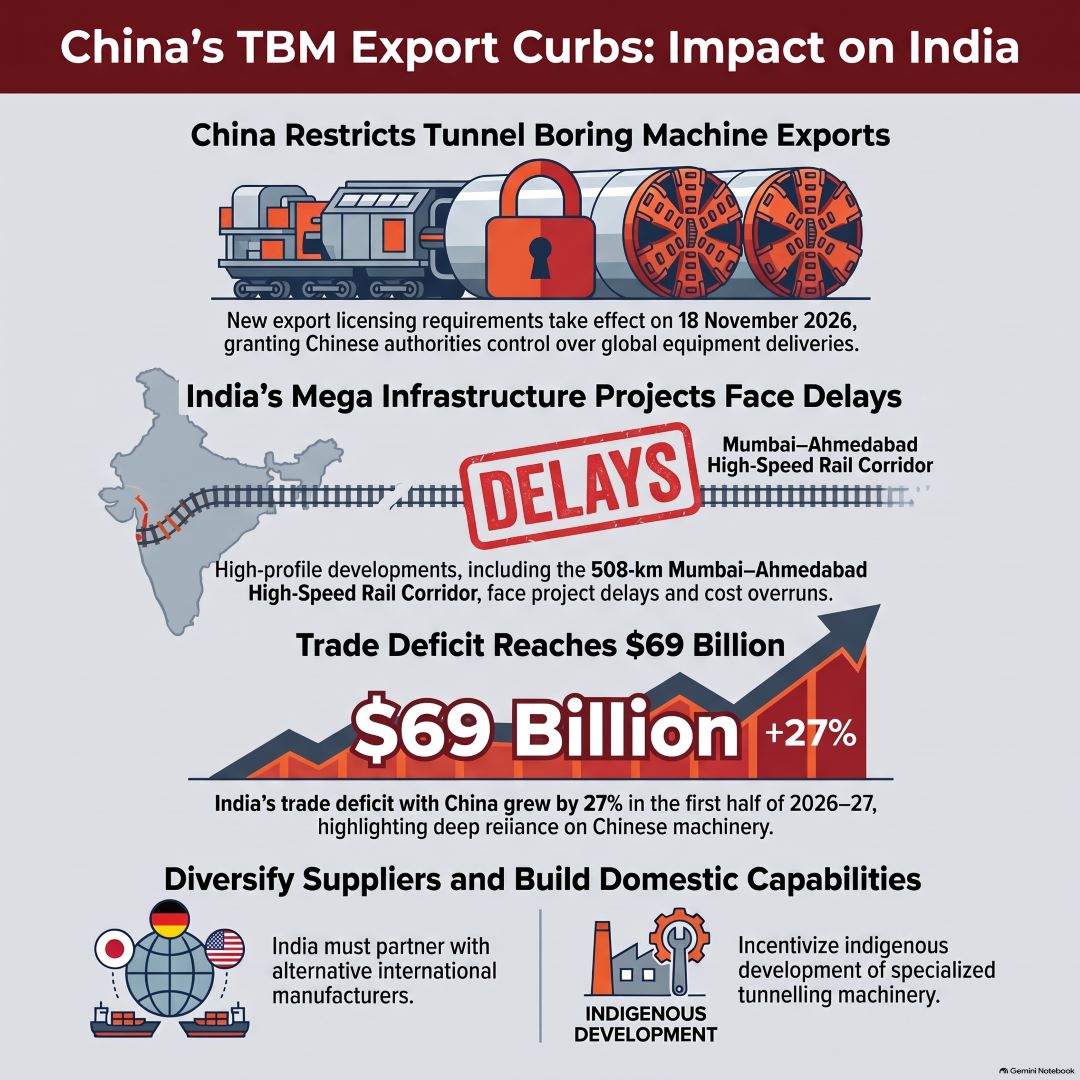
China has introduced export licensing requirements for tunnel boring machines (TBMs), critical equipment used in metro rail, highway and underground tunnel construction. The restrictions could affect India's infrastructure projects, particularly the 508-km Mumbai–Ahmedabad High-Speed Rail Corridor, which includes a 7-km undersea tunnel.
According to the supplied article, the new restrictions will take effect on 18 November 2026. They follow earlier Chinese restrictions on rare earth magnets and highlight India's dependence on foreign suppliers for strategically important technologies.
Why Tunnel Boring Machines (TBMs) Matter?
- Function: TBMs excavate tunnels through soil and rock while supporting tunnel walls, improving safety and reducing surface disruption compared with conventional excavation methods.
- Infrastructure Applications: They are widely used in metro rail networks, high-speed railways, road tunnels, water conveyance systems and underground utilities.
- Strategic Importance: Large, specialised TBMs require advanced engineering, precision manufacturing and substantial technical expertise, making supply-chain disruptions difficult to overcome quickly.
- Dual-Use Technology: TBMs are primarily civilian construction equipment but may fall under export-control rules depending on their technical specifications and the applicable regulations.
China’s Export Restrictions
- Licensing Requirements: The article reports that exporters will need licences under China's export-control framework for specified TBMs.
- Strategic Leverage: Licensing requirements give Chinese authorities greater discretion over export approvals and delivery timelines.
- Supply-Chain Disruption: Delays in obtaining equipment can affect tunnel excavation schedules, construction costs and project completion timelines.
- Selective Application: The actual impact on India will depend on which machines are covered, how licences are processed and whether specific exports are delayed or denied.
India’s Existing TBM Challenges
- Import Delays: India has faced delays in TBM deliveries since 2024, according to the supplied article.
- Dependence on Foreign Manufacturers: Advanced TBMs are manufactured by a limited number of specialised international firms, creating supplier concentration risks.
- Mumbai–Ahmedabad Bullet Train Project: Delays in procuring or deploying suitable machines could disrupt underground construction and associated project schedules.
- Geopolitical Uncertainty: India’s infrastructure development remains exposed to changes in export policies, bilateral relations and international trade restrictions.
India–China Trade Relations
- Growing Trade Deficit: The article reports that India's trade deficit with China reached $69 billion in the first half of 2026–27, an increase of 27% over the corresponding period in the previous year.
- Chinese Investment: India has considered opening selected strategic sectors, including parts of the power sector, to Chinese investment under specified conditions.
- Trade Remedies: India has increased anti-dumping and anti-subsidy investigations to address concerns about unfairly priced imports and injury to domestic industries.
- Unequal Trade Structure: India's dependence on Chinese machinery, electronics, industrial inputs and components creates vulnerabilities when exports are restricted.
China’s Wider Trade Strategy
- Critical Technology Controls: Export restrictions on specialised equipment and rare earth-related products can strengthen China's leverage in international trade negotiations.
- US–China Trade Tensions: Export controls form part of a broader environment of trade negotiations, tariff disputes and strategic competition.
- European Union Relations: Disagreements over Chinese electric vehicles, batteries and industrial imports have intensified trade tensions between China and the EU.
- Global Manufacturing Competition: The supplied article cites a September 2026 Rhodium Group report projecting that China's growing share of global exports could reduce the export shares of several other economies by 2030.
Implications for India
- Infrastructure Delays: Restrictions could affect project timelines if alternative machines are unavailable or require significant technical adaptation.
- Higher Costs: Changing suppliers may involve higher procurement costs, modifications to tunnel designs, staff retraining and delays in equipment commissioning.
- Strategic Vulnerability: Dependence on a narrow group of foreign manufacturers can expose critical infrastructure projects to external policy decisions.
- Domestic Manufacturing Opportunity: The situation creates an incentive to develop indigenous capabilities in heavy engineering, precision machinery and specialised tunnelling equipment.
- Need for Trade Diversification: India must balance economic engagement with China against the need to protect critical supply chains and domestic industrial capacity.
Way Forward
1. Diversify Suppliers: Explore alternative manufacturers in Europe, Japan, South Korea and other technologically capable economies to reduce dependence on a single source.
2. Develop Indigenous TBMs: Encourage domestic engineering firms, research institutions and infrastructure companies to collaborate on designing and manufacturing specialised tunnelling equipment.
3. Strengthen Technology Transfer: Promote joint ventures and licensing arrangements that facilitate technology absorption, local manufacturing and workforce training.
4. Create Strategic Procurement Plans: Identify critical equipment with long delivery periods and establish contingency arrangements for major infrastructure projects.
5. Improve Trade Negotiations: Pursue dialogue with China to secure predictable export approvals while addressing broader trade concerns through appropriate bilateral mechanisms.
6. Expand Industrial Research: Support research in precision components, cutting tools, automated control systems, tunnelling sensors and other technologies required for advanced TBMs.
7. Balance Trade Remedies and Investment: Use anti-dumping measures where justified by evidence while maintaining access to essential industrial inputs and productive investment.
Conclusion
China's reported TBM export restrictions highlight the risks of depending on concentrated foreign supply chains for critical infrastructure technology. For India, the response should combine supplier diversification, strategic procurement, domestic manufacturing and technology development. Building indigenous tunnelling capabilities while maintaining diversified international partnerships can strengthen infrastructure resilience and reduce exposure to geopolitical disruptions.