

Climate change, deforestation worsened impact of SE Asia cyclones
Indian Express
Core Thesis and Central Argument
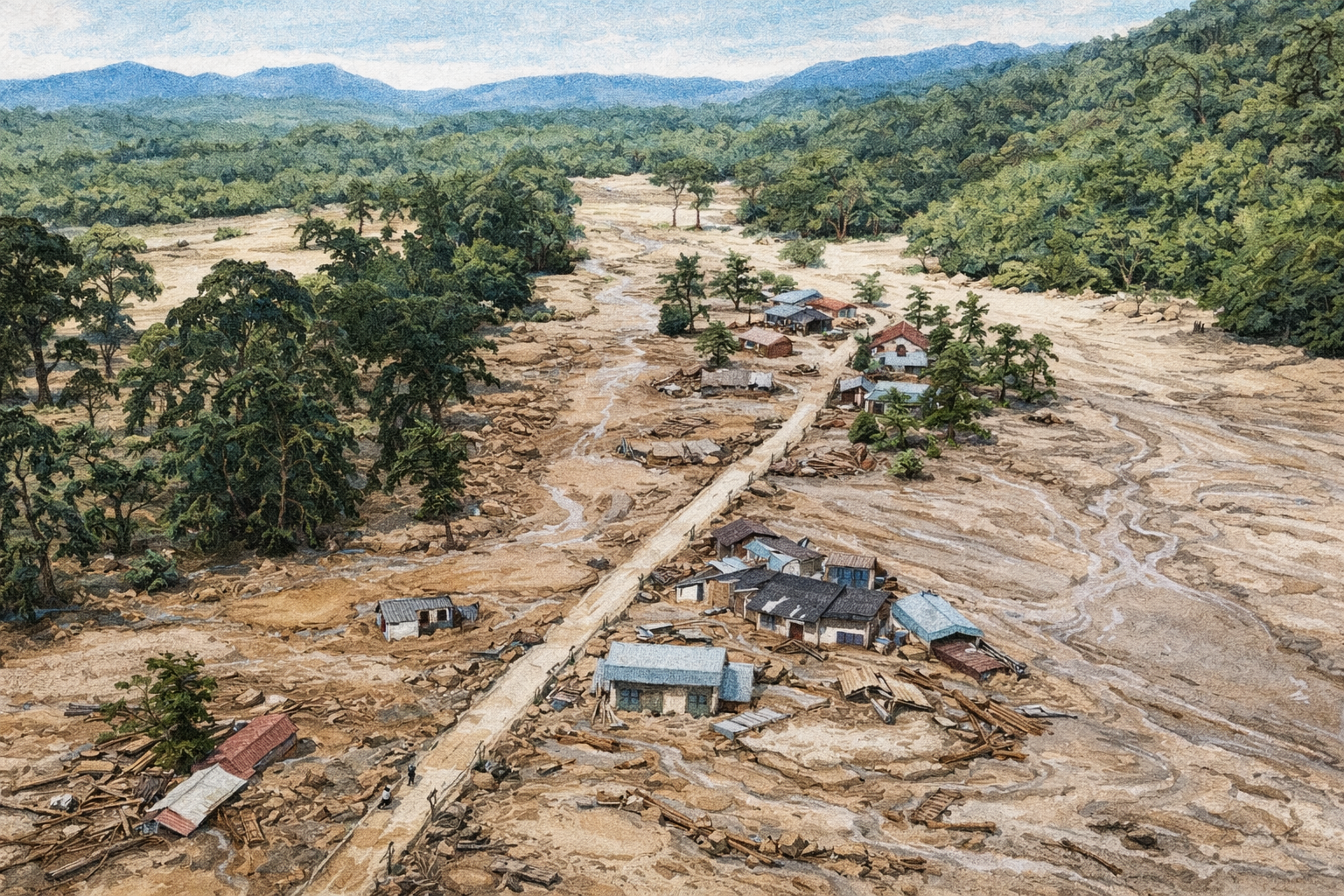
The article argues that the severity and destructiveness of recent cyclones in Southeast Asia cannot be explained by meteorological factors alone. Instead, it posits that climate change–induced warming, coupled with deforestation and rapid urbanisation, has significantly amplified rainfall intensity, flooding, landslides, and human losses in countries such as Sri Lanka, Malaysia, Indonesia, and Thailand.
The central claim is that human-induced environmental degradation has converted natural hazards into large-scale disasters, transforming cyclones from episodic weather events into systemic development crises.
II. Key Arguments Presented
1. Role of Global Warming in Cyclone Intensification
The article highlights rising sea surface temperatures and atmospheric moisture as key drivers of extreme rainfall associated with cyclones. Warmer oceans increase evaporation, while warmer air holds more moisture, leading to heavier precipitation.
2. Attribution Science Evidence
Citing climate attribution studies, the article notes that rainfall linked to recent cyclones was significantly more intense due to anthropogenic warming, crossing historical thresholds.
3. Deforestation as a Disaster Multiplier
Loss of forest cover in Sri Lanka and Indonesia is shown to have reduced slope stability and natural water absorption capacity, intensifying floods and landslides during extreme rainfall events.
4. Rapid Urbanisation and Exposure
Urban expansion into floodplains and high-risk zones has increased population exposure. Critical infrastructure such as roads, railways, and settlements have expanded without adequate climate resilience.
5. Economic and Human Costs
The article quantifies large-scale economic losses, agricultural damage, and fatalities, linking them directly to environmental mismanagement rather than treating them as unavoidable natural calamities.
III. Author’s Stance
The author adopts a clear climate-science-aligned and environmentally deterministic stance, arguing that policy failures in land use, forest management, and urban planning have magnified climate risks. The tone is cautionary and implicitly normative, urging governments to treat climate adaptation and ecological conservation as central development priorities.
IV. Implicit Biases and Framing
1. Strong Climate Attribution Bias
The article strongly foregrounds climate change and deforestation, potentially underplaying governance failures such as disaster preparedness, early warning dissemination, and evacuation capacity.
2. Regional Generalisation Risk
Southeast Asia is treated as a relatively uniform ecological and governance space, despite wide variations in institutional capacity across countries.
3. Limited Counterfactual Analysis
The article does not sufficiently explore how similar cyclonic systems might have impacted regions with stronger ecological protection or urban planning controls.
V. Strengths of the Article
1. Science-Based Explanation
The article effectively translates complex climate science and attribution studies into accessible policy-relevant insights.
2. Multi-Causal Analysis
It avoids monocausal explanations, linking climate change, deforestation, and urbanisation in a reinforcing chain.
3. Strong Development Lens
Natural disasters are framed as outcomes of development choices, not acts of fate.
4. High UPSC Relevance
The content aligns closely with GS-I (Geography), GS-III (Environment, Disaster Management), and GS-II (Public Policy and Governance).
5. Evidence-Driven Narrative
Use of quantitative indicators strengthens credibility and analytical rigour.
VI. Limitations and Gaps
1. Disaster Governance Underexplored
Institutional preparedness, early warning systems, and response mechanisms receive limited attention.
2. Adaptation Strategies Not Detailed
While causes are well explained, solutions such as nature-based adaptation, climate-resilient infrastructure, and zoning reforms are not elaborated.
3. Equity Dimensions Missing
Differential impacts on the poor, informal settlers, and marginalised communities are not sufficiently foregrounded.
VII. Policy Implications (UPSC Alignment)
GS Paper I – Geography
• Demonstrates interaction between atmospheric processes and land-use change
• Highlights regional climatology of tropical cyclones
GS Paper III – Environment & Disaster Management
• Reinforces need for ecosystem-based disaster risk reduction
• Underlines importance of forest conservation in climate adaptation
• Shows how unplanned urbanisation increases disaster vulnerability
GS Paper II – Governance
• Points to failures in land-use regulation and urban planning
• Raises questions of state accountability in climate adaptation
VIII. Real-World Impact Assessment
Immediate Impacts
• Higher fatalities and displacement
• Massive agricultural and infrastructure losses
• Increased fiscal burden on disaster relief
Long-Term Impacts
• Rising insurance and reconstruction costs
• Entrenchment of poverty traps in disaster-prone regions
• Increased climate migration and social instability
Systemic Risk
• Repeated disasters threaten development gains and fiscal sustainability
IX. Balanced Conclusion
The article convincingly establishes that climate change acts as a force multiplier, while deforestation and unplanned urbanisation convert climatic stress into humanitarian and economic catastrophe. By grounding its argument in scientific attribution studies, it moves beyond anecdotal disaster reporting to systemic diagnosis.
However, its analytical focus would have been stronger with deeper engagement on governance capacity, adaptation planning, and social vulnerability. Disasters emerge not only from environmental degradation but also from institutional choices made long before cyclones strike.
X. Future Perspectives
• Integrate forest conservation into national disaster risk strategies
• Enforce climate-sensitive land-use and urban zoning regulations
• Expand nature-based solutions such as mangroves and watershed restoration
• Strengthen climate attribution science for policy planning
• Shift disaster management from response-centric to prevention-centric models
In essence, the article reinforces a critical UPSC-relevant insight: in the age of climate change, disasters are no longer “natural” events but reflections of governance, ecology, and development priorities.
