

Climate Change Overrides La Niña, Driving Early Heatwaves and a Shrinking Indian Winter
The Statesman
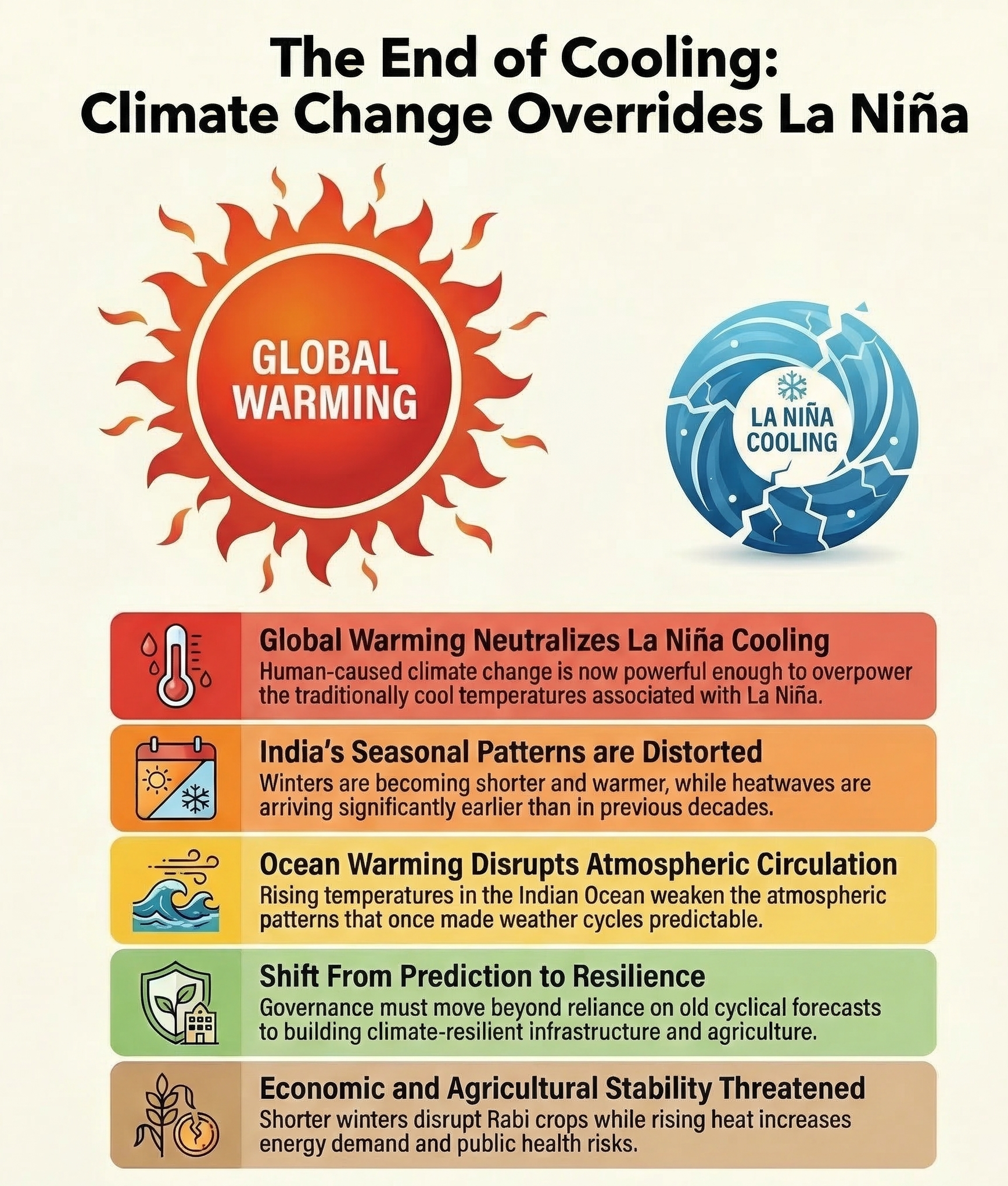
Key Arguments
Long-term warming is overpowering short-term climatic cycles
The article argues that anthropogenic climate change has become strong enough to neutralise the cooling impact of La Niña, traditionally associated with lower temperatures.
India is witnessing seasonal distortion
Winters are becoming shorter and warmer, while heatwaves are arriving earlier—indicating a shift in seasonal patterns rather than isolated anomalies.
Ocean warming is central to the disruption
The Indian Ocean’s rising temperatures weaken atmospheric circulation patterns, reducing the effectiveness of ENSO-driven cooling.
ENSO predictability is declining
La Niña and El Niño are becoming less reliable indicators of seasonal outcomes due to structural climatic shifts.
Author’s Stance
Strong climate change attribution
The author clearly positions climate change—driven by greenhouse gas emissions—as the dominant explanatory factor behind current weather anomalies.
Implicit urgency for systemic response
While not overtly prescriptive, the tone suggests an urgent need to rethink climate governance, forecasting, and adaptation mechanisms.
Biases and Limitations
Over-attribution to climate change
The article tends to downplay natural variability and inter-annual climatic complexity, presenting climate change as the primary, near-exclusive driver.
Limited empirical depth
Absence of detailed datasets, regional comparisons, or long-term statistical evidence reduces analytical robustness.
Insufficient policy articulation
The piece highlights the problem but stops short of discussing concrete institutional or policy pathways.
Strengths (Pros)
Scientifically aligned narrative
Consistent with global climate science, including IPCC assessments on warming trends and weakening natural climate regulators.
India-specific contextualisation
Links global warming to Indian realities—heatwaves, winter shrinkage, and agricultural stress.
Timely and relevant
Addresses emerging climatic shifts that are directly affecting governance and planning.
Weaknesses (Cons)
Simplification of complex systems
Climate systems are multi-causal; the article risks oversimplification by foregrounding a single dominant cause.
Neglect of sectoral impacts
Limited exploration of implications for agriculture, water security, labour productivity, and urban systems.
Lack of regional differentiation
India’s climatic diversity is not adequately reflected; impacts vary significantly across regions.
Policy Implications
Recalibration of forecasting systems
Institutions like IMD must integrate ocean warming and altered atmospheric dynamics into predictive models.
Strengthening adaptive governance
Heat Action Plans, water management strategies, and climate-resilient agriculture need scaling up.
Urban climate planning
Cities must address heat island effects, energy demand surges, and public health risks.
Mitigation commitments
Accelerated transition to renewable energy and emission reduction remains critical.
Real-World Impact
Agriculture
Shorter winters disrupt Rabi crops; increased evapotranspiration raises irrigation demand.
Public health
Rising incidence of heat stress, dehydration, and mortality among vulnerable populations.
Economy
Higher energy consumption, reduced labour productivity, and infrastructure stress.
Environment
Ecosystem imbalance, biodiversity stress, and increasing water scarcity.
UPSC GS Paper Linkages
GS Paper I (Geography)
Climatology, ENSO cycles, Indian monsoon system, impact of global warming on seasons.
GS Paper II (Governance)
Disaster preparedness, role of institutions like IMD, policy response to climate risks.
GS Paper III (Environment & Economy)
Climate change impacts, adaptation strategies, agriculture, energy transition.
GS Paper IV (Ethics)
Environmental responsibility, intergenerational equity.
Balanced Conclusion
Climate change is reshaping, not completely replacing, natural climatic systems.
The article rightly highlights the growing dominance of anthropogenic warming over traditional cycles like La Niña. However, a balanced understanding requires recognising the continued, though altered, role of natural variability.
Future Perspective
From prediction to resilience
Policy must shift from reliance on cyclical forecasts to building climate-resilient systems.
Localized climate strategies
District-level planning and region-specific adaptation will be crucial.
Integrated climate governance
Coordinated action across sectors—energy, agriculture, urban planning—is necessary.
Long-term sustainability transition
India’s response must align development with climate resilience to manage emerging risks effectively.
