

Climate Justice and Energy Justice: India's Approach

Climate Justice and Energy Justice: India's Approach
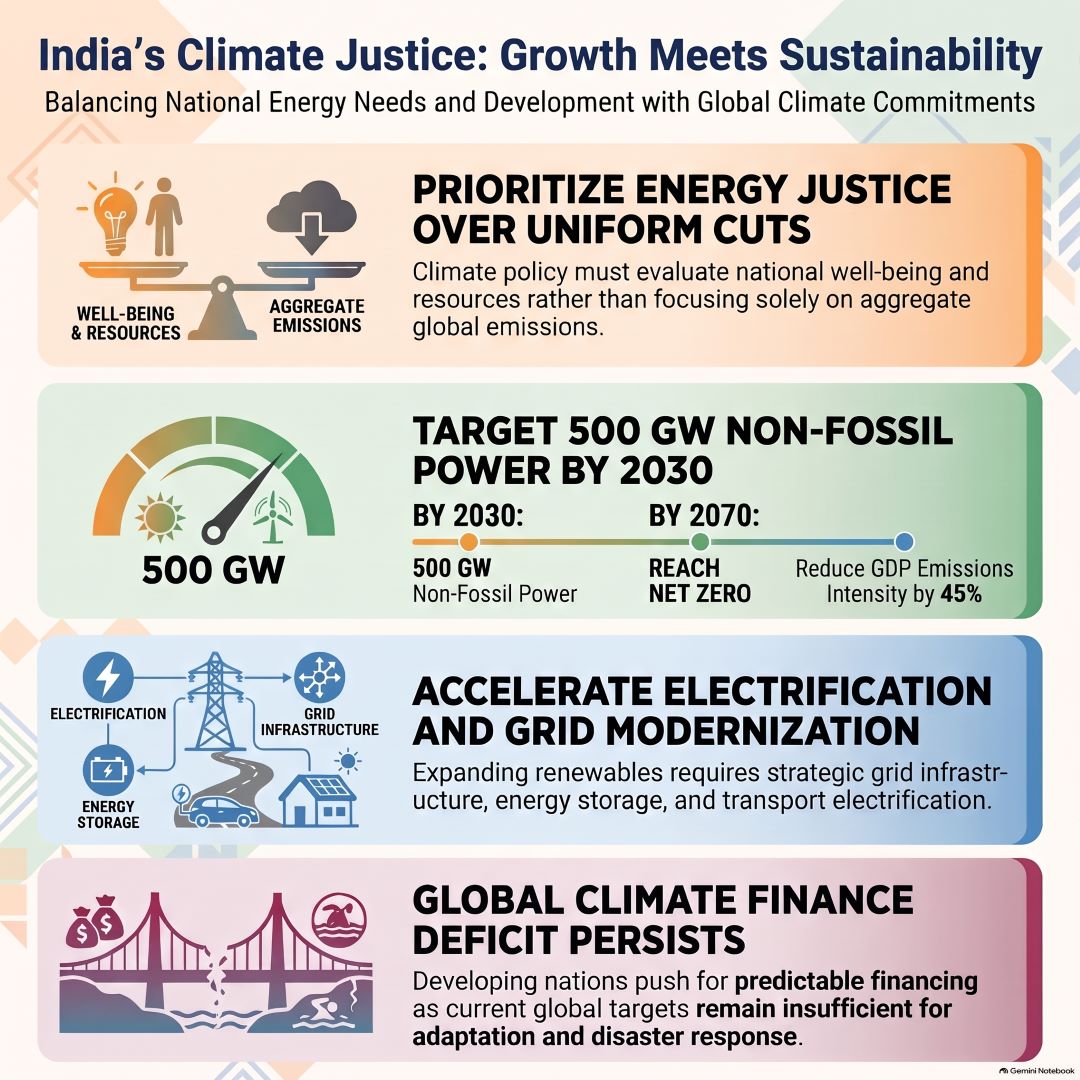
GS Paper: GS-III (Environment, Climate Change, Energy) | GS-II (International Relations, Global Groupings) |
Source: The Hindu
Why in News?
The renewed global debate on climate policy has drawn attention to the need for India to prioritise energy justice, equitable energy consumption and nationally driven climate action alongside global emissions targets. Experts argue that climate policy focused only on global CO2 cuts ignores differences in development and capacity.
What Is Climate Justice? The Core Argument
• Climate justice links climate action with fairness, development and the unequal distribution of responsibilities and resources. Countries differ in historical energy use, development level, financial capacity and ability to cope with disasters.
• Climate policy should not look only at global emissions; it should ask how energy use contributes to national well-being and whether countries have equitable access to the resources needed for development.
• For developing countries like India, the challenge is to expand access to reliable energy while moving to cleaner sources.
Limitations of the Global Climate Consensus
• International policy is shaped by global scientific assessments, emissions projections, multilateral negotiations and common rules, so a uniform framework may not reflect different energy needs and development priorities.
• Critics say the gap between ecological limits and the energy needs of urbanising developing countries is not adequately addressed.
• Delivery gaps: shortfalls in climate finance and technology transfer to the Global South.
• Carbonisation before decarbonisation: developed countries industrialised through heavy energy use; developing countries may need a phase of higher fossil fuel use before substantial decarbonisation. The objective should be to reduce the energy intensity of economic activity and improve well-being with lower resource consumption.
Electrification and Renewables: The Pathway
• Electrification of transport (EVs replacing internal combustion engines) and meeting added electricity demand through renewables can cut fossil dependence. Experts point to China's expansion of solar and wind and its new energy vehicles.
• Renewables need more than falling technology costs. Solar and wind are intermittent and decentralised, so integrating them needs strategic public policy, grid infrastructure (storage, transmission) and decisions on how generation and consumption should evolve.
• India's priorities: expand solar, wind and hydropower; electrify transport and other energy-intensive activities; meet rising demand while improving efficiency; and align renewable deployment with national development needs.
Reframing Policy and Finance: Way Forward
• Shift the focus from aggregate emissions and production patterns to national energy use, consumption and well-being; assess climate action through energy access, economic development and resilience rather than only emissions indicators. This does not remove the need to cut emissions; it places it alongside development needs.
• Climate finance and resilience: developing countries face high disaster risk with limited insurance and financial resources. Experts call for a review of the adequacy of climate finance, global early-warning systems and regional technical cooperation in disaster relief.
• For India: balance development, affordable and reliable energy, and sustainability, and push for equitable access to clean technology, predictable climate finance, national policy flexibility and practical cooperation on adaptation and disaster management.
|
Key Concepts • Climate justice: the idea that those who contributed least to climate change suffer most and need support. Linked to equity and CBDR-RC (Common but Differentiated Responsibilities and Respective Capabilities) in the UNFCCC (1992) and Paris Agreement (2015). • India's targets: net zero by 2070; 500 GW non-fossil capacity and 50% of installed power capacity from non-fossil sources by 2030; 45% cut in emissions intensity of GDP (from 2005 level) by 2030; LiFE (Lifestyle for Environment) as a mission. Verify the latest status before quoting figures. • Climate finance: developed countries' earlier $100 billion a year goal was replaced at COP29 (Baku, 2024) by a New Collective Quantified Goal (NCQG) of at least $300 billion a year by 2035, with an aspiration of $1.3 trillion. India criticised it as too low. • Loss and Damage Fund: agreed at COP27 and operationalised at COP28 to help vulnerable nations. Early Warnings for All (UN, 2022) aims to cover everyone by 2027. India's initiative: CDRI (Coalition for Disaster Resilient Infrastructure) and the International Solar Alliance (ISA).
|