

Coal Gasification
The Statesman
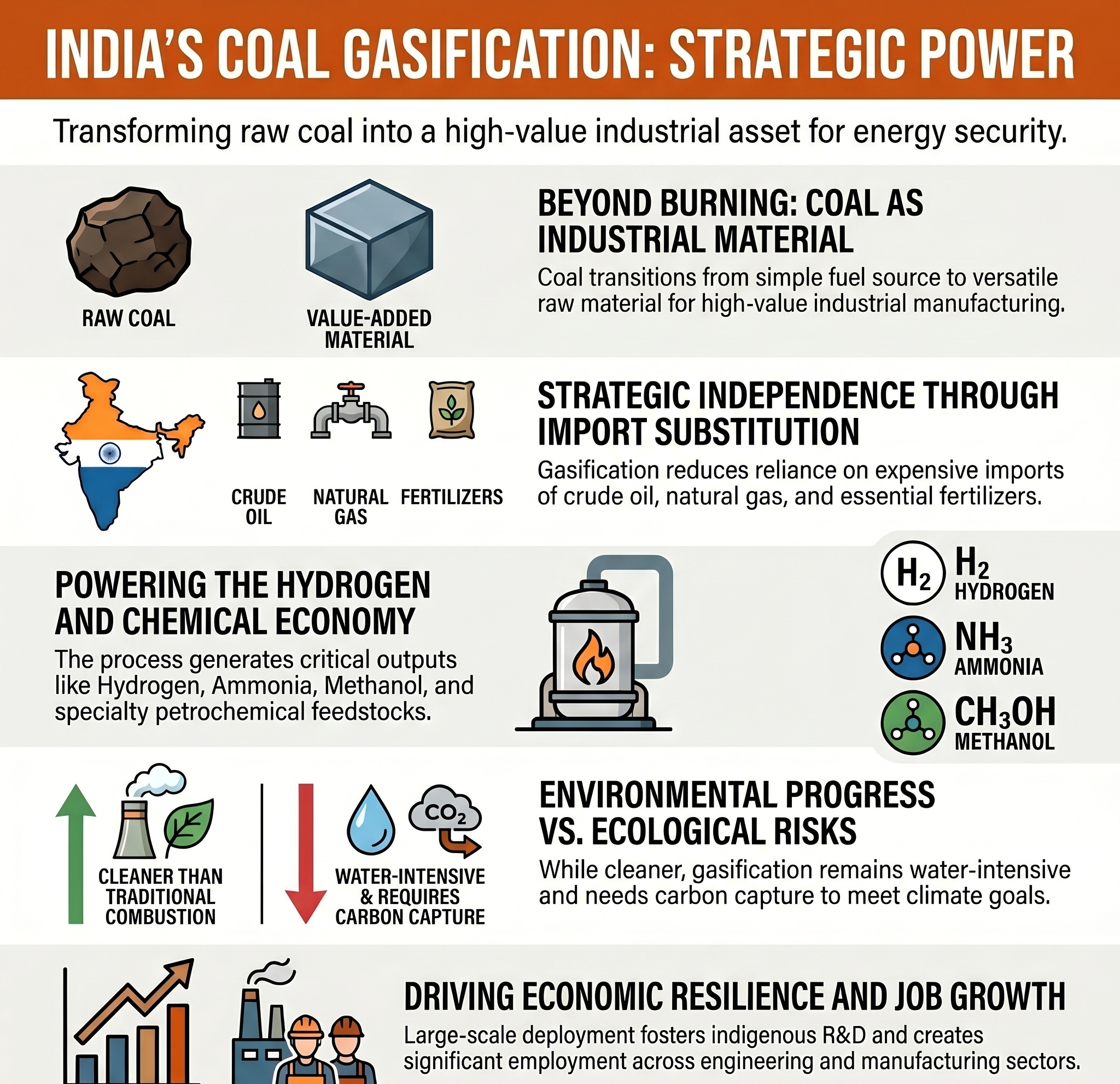
Core Arguments of the Article
Coal gasification can transform India's energy landscape
The article argues that:
- India possesses one of the world's largest coal reserves.
- Coal gasification can convert this resource into higher-value products.
The author views this as a means to:
- Enhance energy security,
- Reduce import dependence,
- Improve industrial competitiveness.
Import substitution is strategically important
India imports:
- Crude oil,
- Natural gas,
- Fertilisers,
- Petrochemical feedstocks.
The article argues that:
- Gasification can replace a significant portion of these imports.
This aligns with:
- Atmanirbhar Bharat,
- Strategic economic resilience.
Gasification supports industrial diversification
According to the article:
- Coal should not be viewed solely as a fuel.
- It should be viewed as an industrial raw material.
Potential outputs include:
- Methanol,
- Ammonia,
- Urea,
- Hydrogen,
- Olefins,
- Specialty chemicals.
Technology can reduce environmental impacts
The author contends that:
- Advanced gasification technologies are cleaner than traditional coal combustion.
This includes:
- Higher efficiency,
- Lower particulate emissions,
- Better pollution control mechanisms.
India must invest in indigenous technological capability
The article strongly advocates:
- Domestic R&D,
- Public-private partnerships,
- Technological innovation.
The author sees technological self-reliance as critical for long-term success.
Author’s Stance
Strongly supportive of coal gasification
The article is largely an advocacy piece.
The author clearly believes:
- Coal gasification is strategically necessary.
- India should aggressively scale this technology.
Developmentalist perspective
The article prioritises:
- Economic growth,
- Industrial expansion,
- Resource utilisation.
It reflects a developmental-state approach where:
- Technology is seen as the solution to multiple economic challenges.
Technology optimism
The author assumes:
- Future technological advancements will resolve current limitations.
This is a recurring theme throughout the article.
Key Strengths of the Article
Connects energy security with industrial policy
The article effectively demonstrates how:
- Energy policy and industrial policy are increasingly interconnected.
This is an important insight for policymakers.
Highlights value addition
Rather than exporting raw resources or using coal solely for power generation, the article advocates:
- Higher-value industrial utilisation.
This aligns with modern resource economics.
Emphasises technological innovation
The article rightly notes that:
- Indigenous innovation is critical for competitiveness.
Strategic perspective
The discussion moves beyond electricity generation and incorporates:
- Fertilisers,
- Chemicals,
- Manufacturing,
- Hydrogen economy.
This broader framework strengthens the argument.
Weaknesses and Limitations
Environmental concerns are understated
The article acknowledges environmental issues but tends to minimise them.
Key concerns include:
- Carbon emissions,
- Water consumption,
- Land degradation,
- Coal mining impacts.
These issues deserve deeper treatment.
Climate commitments receive limited attention
India has:
- Net-zero commitments,
- Renewable energy targets,
- International climate obligations.
Large-scale coal-based industrial expansion may conflict with:
- Decarbonisation pathways.
Economic viability remains uncertain
Coal gasification projects globally have faced:
- High capital costs,
- Cost overruns,
- Market uncertainty.
The article does not sufficiently examine:
- Financial risks.
Overreliance on technological solutions
The article assumes:
- Technological innovation can overcome most barriers.
However:
- Institutional,
- Financial,
- Environmental,
- Governance challenges are equally important.
Hidden Biases in the Article
Resource nationalism bias
The article reflects a belief that:
- Domestic natural resources should be maximally utilised.
While strategically appealing, this may sometimes conflict with:
- Sustainability goals.
Industrial growth bias
Economic and industrial objectives receive greater emphasis than:
- Ecological concerns.
Technological determinism
The article assumes:
- Technology can solve structural problems.
This underestimates:
- Policy failures,
- Governance challenges,
- Market dynamics.
Environmental Perspective
Potential environmental benefits
Compared with traditional coal combustion:
Coal gasification may:
- Reduce particulate pollution,
- Improve thermal efficiency,
- Enable carbon capture integration,
- Lower sulphur emissions.
Environmental risks
However, significant challenges remain:
Carbon emissions
Gasification still depends on:
- Fossil fuel extraction and utilisation.
Without carbon capture:
- Emissions remain substantial.
Water intensity
Gasification processes require:
- Large volumes of water.
This is particularly concerning in:
- Water-stressed regions.
Mining impacts
Expanded coal utilisation may increase:
- Land degradation,
- Biodiversity loss,
- Displacement of communities.
Economic Implications
Positive implications
Reduced import bill
Potential reduction in imports of:
- Natural gas,
- Fertilisers,
- Petrochemicals.
Employment generation
New opportunities in:
- Engineering,
- Manufacturing,
- Chemicals,
- Mining,
- Technology sectors.
Industrial competitiveness
Domestic feedstock availability may strengthen:
- Fertiliser,
- Petrochemical,
- Manufacturing industries.
Risks
High capital expenditure
Gasification plants require:
- Massive upfront investment.
Market uncertainties
The economics depend heavily upon:
- Oil prices,
- Gas prices,
- Carbon regulations.
Strategic and Geopolitical Importance
The article correctly identifies that:
Energy security is increasingly a national security issue.
Coal gasification may help India:
- Reduce external vulnerabilities,
- Improve strategic autonomy,
- Strengthen supply chain resilience.
Particularly important given:
- Global energy disruptions,
- Geopolitical conflicts,
- Resource nationalism.
Policy Implications
Need for integrated energy planning
India must balance:
- Coal gasification,
- Renewable energy,
- Hydrogen economy,
- Energy efficiency.
A silo-based approach may create contradictions.
Investment in R&D
Key areas include:
- Carbon capture technologies,
- Gasification efficiency,
- Clean hydrogen production,
- Advanced catalysts.
Regulatory framework
Strong regulation is necessary for:
- Environmental monitoring,
- Water management,
- Community safeguards.
Public-private partnerships
Large-scale deployment requires:
- Industry participation,
- Government support,
- Research institutions.
Real-World Impact
If implemented effectively, coal gasification could:
Positively contribute to:
- Energy security,
- Industrial growth,
- Employment generation,
- Import reduction.
Negatively contribute to:
- Carbon emissions,
- Water stress,
- Mining-related environmental damage,
if safeguards are weak.
UPSC GS Paper Linkages
GS Paper I
Geography
- Distribution of coal resources
- Industrial location
Society
- Development versus environment debates
GS Paper II
Governance
- Energy policy
- Public sector reforms
- Resource management
GS Paper III
Science & Technology
- Gasification technology
- Clean coal technologies
Environment
- Climate change
- Carbon emissions
- Sustainable development
Economy
- Energy security
- Industrial growth
- Import substitution
Internal Security
- Strategic resource security
Arguments in Favour
Strengthens energy security
Reduces dependence on imported fuels.
Supports industrialisation
Creates value-added industries.
Enhances strategic autonomy
Reduces vulnerability to global disruptions.
Generates employment
Supports manufacturing ecosystems.
Enables cleaner utilisation of coal
Compared to conventional combustion.
Arguments Against
Continues fossil-fuel dependence
May delay renewable transition.
High carbon footprint
Without carbon capture, emissions remain significant.
Water-intensive process
Unsuitable in water-scarce regions.
High financial risks
Large investments with uncertain returns.
Potential conflict with climate goals
Could complicate India's decarbonisation commitments.
Balanced Conclusion
The article presents coal gasification as a strategic opportunity capable of transforming India's energy and industrial sectors. Its strongest contribution lies in highlighting how coal can be converted from a conventional fuel into a versatile industrial resource supporting fertilisers, chemicals, hydrogen, and manufacturing.
The author effectively connects:
- Energy security,
- Industrial competitiveness,
- Technological self-reliance,
- Economic resilience.
However, the article exhibits a clear pro-gasification bias and underestimates critical concerns relating to:
- Climate change,
- Water usage,
- Carbon emissions,
- Economic feasibility.
Coal gasification should therefore not be viewed as a standalone solution but as one component of a broader energy transition strategy.
Future Perspective
India's future energy architecture will likely involve a mix of:
- Renewable energy,
- Green hydrogen,
- Nuclear power,
- Energy storage,
- Selective clean-coal technologies including gasification.
The success of coal gasification will ultimately depend upon:
- Technological innovation,
- Carbon capture deployment,
- Environmental safeguards,
- Economic competitiveness,
- Alignment with India's net-zero commitments.
If these conditions are met, coal gasification can serve as a transitional bridge between India's current coal-dependent economy and a cleaner, more diversified energy future.
