

Compressed Biogas (CBG): India's Green Energy Pillar and the Delhi Dairy Waste Initiative
Compressed Biogas (CBG): India's Green Energy Pillar and the Delhi Dairy Waste Initiative
Relevance: GS Paper III (Energy Security, Environment, Waste Management, Agriculture)
Why in the News?
- By July 2026, Compressed Biogas (CBG) has transitioned from a voluntary initiative to a compliance-driven pillar of India's energy security strategy, backed by new regulatory frameworks and incentives.
- Separately, the Municipal Corporation of Delhi (MCD) and the National Dairy Development Board (NDDB) signed an MoU, witnessed by Union Home Minister Amit Shah, to set up CBG plants in Delhi using dairy waste.
Understanding Compressed Biogas (CBG)
|
Key Policy Developments in 2026
Regulatory and Market Integration
- Grid Injection Guidelines (February 2026): The Petroleum and Natural Gas Regulatory Board (PNGRB) allowed direct injection of CBG into Natural Gas Pipeline (NGPL) and City Gas Distribution (CGD) networks, replacing expensive bottling and providing producers a reliable, ready-made market.
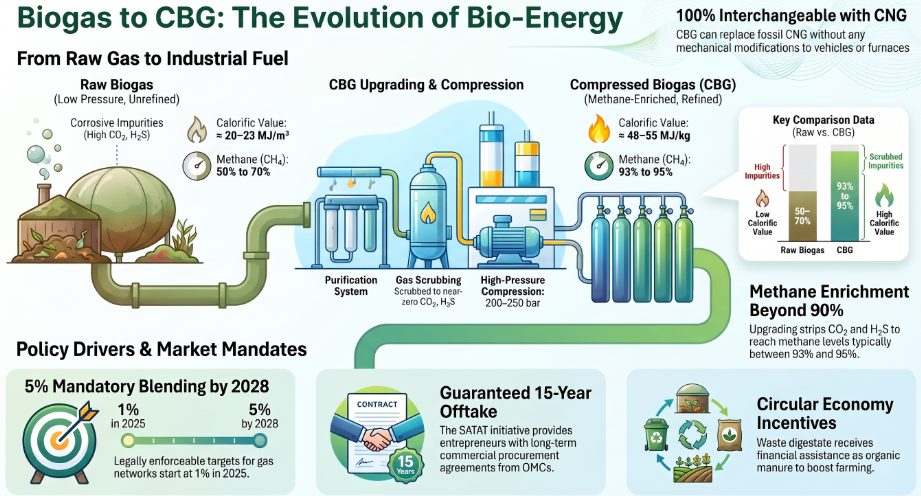
- Mandatory Blending Obligation (CBO): Implemented from FY 2025-26, requiring specific CBG blending percentages into CNG/PNG — starting at 1% and scaling to 5% by FY 2028-29, ensuring long-term demand assurance for producers.

Fiscal and Financial Support
- Union Budget 2026-27: Introduced a central excise duty exemption on the CBG portion of blended CNG, improving project economic viability.
- Viability Gap Funding (VGF): Expanded by the Ministry of New & Renewable Energy (MNRE), covering up to 25% of project costs for plants with capacities between 5-15 tonnes per day (TPD).
- State-level initiatives: States like Maharashtra (May 2026) offer substantial VGF — up to Rs 15 crore per project — to encourage local waste-to-energy processing.
- Pricing mechanism (June 2025): Procurement price revised to 85% of the average CNG retail selling price, translating to approximately Rs 1,478 per mmBtu, giving developers a stable, market-aligned revenue stream.
Challenges and Market Outlook
- Execution gap: Over 1,200 Letters of Intent (LOIs) have been issued, but fewer than 400 plants were operational as of mid-2026; policy convergence and financial incentives are expected to accelerate operationalisation.
- Feedstock aggregation: Logistics for collecting, storing, and transporting seasonal agricultural waste remain complex; the Biomass Aggregation Machinery (BAM) scheme provides financial assistance for machinery to de-risk this process.
- Infrastructure: While grid injection is now legally permitted, the pipeline infrastructure needed for widespread adoption is still scaling up, with PNGRB guidelines and the CBO expected to drive further development.
- Investment: Financing avenues exist (NABARD green bonds, priority sector lending), but specialised project financing frameworks are still needed; improved IRR and payback periods due to subsidies and stable pricing are attracting more investment.
- 2026 is being viewed as a potential "breakout year" for the sector, driven by long-term off-take agreements via Oil Marketing Companies (OMCs), supportive pricing, and capital subsidies improving project viability.
The Delhi MCD-NDDB Dairy Waste Initiative
- MCD and NDDB signed an MoU to establish CBG plants in Delhi for the scientific utilisation of cow dung, witnessed by Union Home Minister Amit Shah.
- Primary goals: preventing cattle dung from polluting the Yamuna river, and converting it into CBG and organic fertiliser.
- Expected benefits: increased income for livestock farmers, improved urban cleanliness, and a boost to organic farming.
- The agreement targets processing waste from approximately 1.25 lakh cattle, with a commitment to ensure no dirty water enters the Yamuna by December 2028.
- Cow dung will be processed at plants in Nangli, Ghoga-Goyla, and Ghazipur, with farmers receiving Re 1 per kg for their contribution.
About the Key Institutions
- NDDB is a statutory body under the Ministry of Fisheries, Animal Husbandry and Dairying, focused on promoting dairy development and farmer-owned organisations.
- MCD is one of the world's largest municipal bodies, responsible for civic services, including waste management, across most of Delhi.
Significance
- CBG's growing policy support — spanning regulatory integration, fiscal incentives, and pricing stability — positions it as a key pillar of India's energy security and self-reliance strategy.
- The Delhi dairy waste initiative illustrates a practical, localised application of the broader CBG/GOBAR-Dhan framework, linking waste management, river rejuvenation, farmer income, and clean energy goals in one project.
