

Counting the Cost of Inaction
Morning Standard
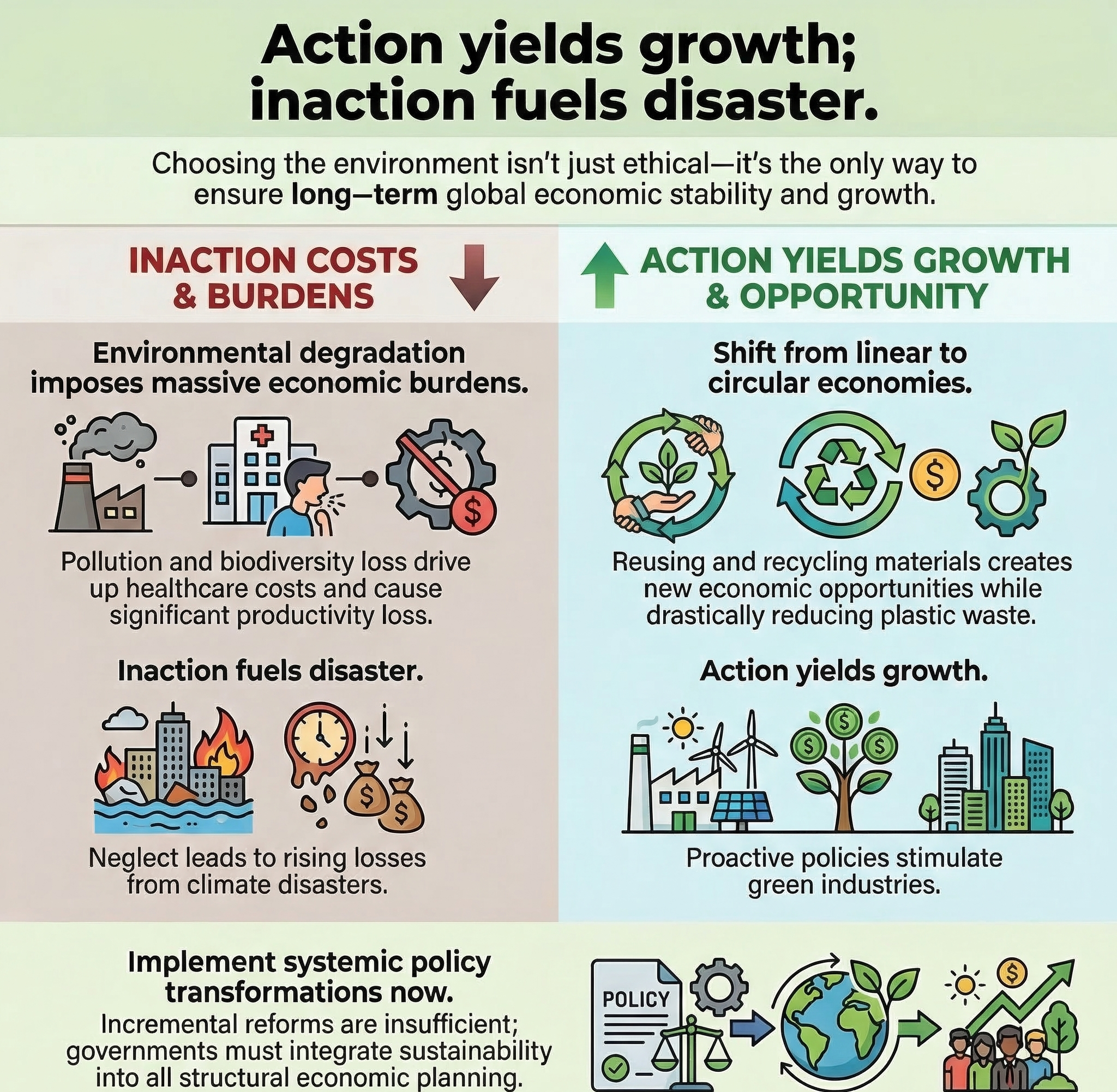
Key Arguments of the Article
Environmental Degradation Imposes Enormous Economic Costs
The article argues that pollution, biodiversity loss, climate change, and ecosystem degradation impose massive economic burdens on societies. These costs include health expenditures, loss of productivity, ecosystem damage, and long-term economic instability.
Environmental degradation therefore directly affects economic growth and human well-being.
Plastic Pollution as a Major Environmental Threat
Plastic pollution is highlighted as a significant contributor to environmental damage, affecting marine ecosystems, food chains, and public health.
The article suggests that transitioning to circular economy models—where materials are reused, recycled, and redesigned—can significantly reduce plastic waste and associated environmental costs.
Circular Economy as a Sustainable Alternative
The article emphasises that shifting from a linear consumption model to a circular economy can reduce resource depletion and environmental pollution.
Recycling, redesigning products, and improving waste management systems can generate economic opportunities while reducing environmental harm.
Economic Benefits of Environmental Action
The article argues that investments in sustainability and environmental restoration generate long-term economic benefits. These include improved public health, reduced climate risks, and new opportunities in green industries.
Environmental investments should therefore be viewed as productive economic strategies rather than regulatory burdens.
Need for Systemic Policy Transformation
Addressing environmental challenges requires structural changes in production systems, energy transitions, and resource management. Governments must adopt policies that encourage sustainable consumption, renewable energy, and conservation of natural resources.
Incremental reforms alone may not be sufficient to address the scale of environmental challenges.
Author’s Stance
The author strongly advocates proactive environmental policies and emphasises the urgency of addressing climate and ecological crises. The article presents environmental action as both an ethical responsibility and an economic necessity.
The tone reflects a sustainability-oriented policy perspective.
Possible Biases
Environmental Advocacy Perspective
The article strongly emphasises environmental protection and may downplay short-term economic challenges associated with sustainability transitions.
Global Environmental Framework
The analysis relies on global environmental reports, which may emphasise broad global trends rather than country-specific contexts.
Limited Industrial Perspective
The article gives less attention to the challenges faced by industries in adapting to sustainability regulations.
Advantages of Environmental Action
Economic Sustainability
Investing in environmental protection prevents costly long-term ecological damage.
Public Health Benefits
Reducing pollution improves health outcomes and reduces healthcare expenditures.
Green Economic Opportunities
Environmental reforms can stimulate growth in renewable energy, sustainable agriculture, and green technologies.
Climate Risk Reduction
Proactive climate policies reduce the risk of extreme weather events and environmental disasters.
Challenges and Limitations
High Initial Investment
Transitioning to sustainable systems requires significant financial investment.
Policy Coordination
Environmental challenges require coordinated action across governments, industries, and international institutions.
Economic Trade-offs
Certain sectors may face transitional costs during the shift toward sustainable production systems.
Global Governance Complexity
Environmental problems often require international cooperation, which can be difficult to achieve.
Policy Implications
Strengthening Environmental Governance
Governments must integrate environmental considerations into economic planning and development policies.
Promoting Circular Economy Models
Encouraging recycling, waste reduction, and sustainable product design can reduce environmental pressures.
Investing in Renewable Energy
Expanding renewable energy infrastructure reduces dependence on fossil fuels and mitigates climate risks.
International Environmental Cooperation
Global challenges such as climate change require coordinated international policy frameworks.
Real-World Impact
If environmental action is strengthened:
• Reduced climate risks
• Improved ecosystem resilience
• Growth in green industries
• Better public health outcomes
If inaction continues:
• Rising environmental degradation
• Increased economic losses from climate disasters
• Greater social and health vulnerabilities
Alignment with UPSC GS Papers
GS Paper III
Environment, climate change, sustainable development, resource management.
GS Paper II
International environmental agreements and global governance.
GS Paper IV
Ethics of sustainability, intergenerational justice, responsible policymaking.
Balanced Assessment
The article highlights the long-term costs of environmental neglect and underscores the economic rationale for sustainability. While the transition to environmentally sustainable systems involves short-term costs and institutional challenges, the long-term benefits for economic stability, ecological balance, and public health are substantial.
Environmental policy must therefore balance economic growth with ecological sustainability.
Future Perspective
As climate change and environmental degradation intensify, countries will increasingly need to integrate sustainability into economic planning. Innovations in renewable energy, circular economy models, and green technologies will play a crucial role in shaping future development pathways.
For policymakers and civil services aspirants, the debate illustrates the interconnected relationship between environmental protection, economic development, and global governance.
