

A case against the SHANTI Act
The Hindu
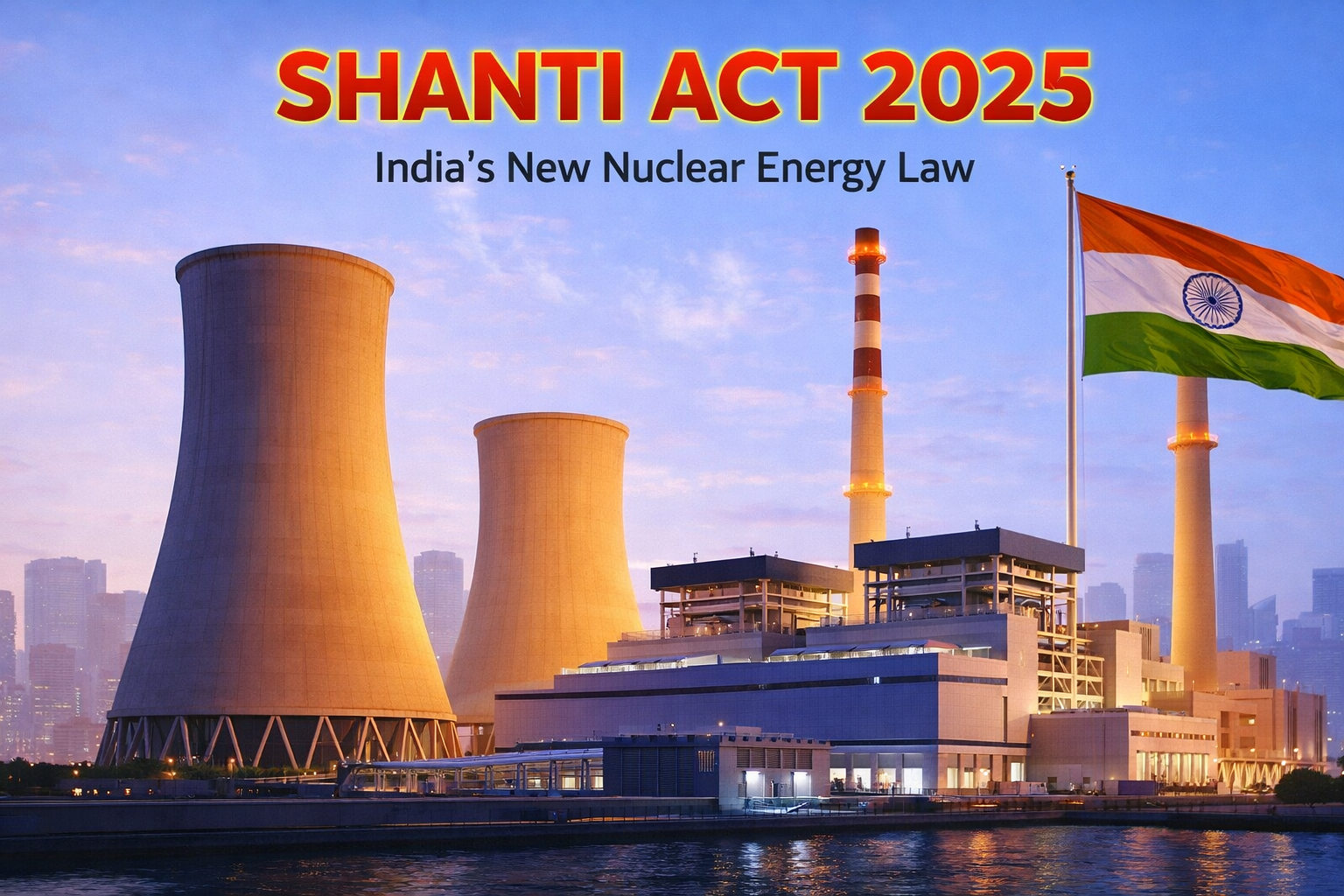
Context and Core Issue
The article critiques the proposed SHANTI Act, which seeks to amend India’s Civil Liability for Nuclear Damage (CLND) framework to encourage greater private participation in nuclear power generation. The central concern is that by indemnifying suppliers and capping liability, the Act may dilute accountability, weaken safety incentives, and expose citizens to greater risk in the event of a nuclear accident.
The broader debate concerns the tension between energy expansion and nuclear safety accountability.
Key Arguments Presented
Supplier indemnification weakens accountability
The article argues that shielding equipment suppliers from liability creates moral hazard. If manufacturers are not financially exposed to accident risk, incentives for stringent safety compliance decline.
Liability caps are insufficient for catastrophic risk
Nuclear accidents have low probability but extremely high impact. Capping compensation may leave victims inadequately compensated in worst-case scenarios.
Departure from Fukushima lessons
Drawing on global precedents, the article suggests that accidents often arise from systemic and supplier-level failures, not merely operator negligence. Limiting supplier liability ignores this reality.
Private participation may prioritise profitability
By reducing liability exposure, the Act may tilt the balance toward commercial viability over precautionary safety.
India’s nuclear energy share remains modest
Given that nuclear power contributes a relatively small portion of India’s total electricity mix, the article questions whether the risk-reward calculus justifies dilution of safeguards.
Author’s Stance
The author adopts a critical, safety-first stance, emphasising precautionary principles over expansionist energy policy. The tone suggests scepticism toward reforms perceived as industry-friendly.
Biases and Perspective
Precautionary bias
The article prioritises risk minimisation over energy diversification or climate transition arguments.
Limited climate-policy engagement
It does not deeply engage with nuclear power’s role in reducing carbon emissions and supporting energy security.
Public safety over investor confidence framing
The economic rationale for indemnification is acknowledged but not strongly defended.
Pros and Cons Highlighted
Pros of the Act (implicit or acknowledged)
- Encourages foreign and domestic investment
- Aligns Indian framework with international nuclear liability conventions
- Reduces legal uncertainty for suppliers
- Potentially accelerates nuclear capacity expansion
Cons emphasised in the article
- Moral hazard and weakened safety culture
- Limited victim compensation
- Increased burden on public exchequer in case of accidents
- Perception of regulatory capture
Policy Implications
Energy transition strategy
India must balance decarbonisation goals with safety governance. Nuclear power expansion must be accompanied by transparent, enforceable liability norms.
Regulatory independence
Strengthening the Atomic Energy Regulatory Board’s autonomy is critical to mitigate moral hazard.
Compensation architecture reform
If liability caps remain, supplementary public insurance pools and international funds may be required.
Public trust management
Nuclear projects require social legitimacy; perceived dilution of accountability could trigger resistance.
Real-World Impact
- Communities near nuclear plants may fear reduced compensation safeguards
- Private suppliers gain financial clarity and reduced risk exposure
- Government finances may bear residual accident liability
- Energy sector could see renewed momentum in nuclear capacity planning
UPSC GS Paper Alignment
GS Paper III (Economy & Environment)
- Nuclear energy and energy security
- Environmental risk management
- Infrastructure financing
GS Paper II (Governance)
- Regulatory institutions
- Public accountability mechanisms
GS Paper IV (Ethics)
- Precautionary principle
- Balancing development with safety
Essay Paper
- “Energy security versus environmental risk”
- “Precaution in public policy: necessity or obstacle?”
Balanced Conclusion and Future Perspective
The article presents a forceful argument that liability dilution in nuclear policy may create moral hazard and erode public confidence. Its caution reflects global experience with catastrophic nuclear accidents.
However, nuclear energy also occupies a strategic space in India’s long-term energy mix, particularly in the context of climate commitments and baseload stability. The path forward lies not in binary opposition but in strengthening safety architecture alongside calibrated reform.
If liability reform proceeds, it must be matched by transparent regulation, independent oversight, robust compensation funds, and community engagement. Nuclear expansion without public trust is unsustainable; safety credibility will determine whether the SHANTI Act becomes facilitative reform or a contested gamble.
