

A revision of GDP and its implications
The Hindu
Key Arguments of the Article
GDP Revision Reflects Structural Economic Changes
The new GDP series attempts to capture structural transformations in the economy over the past decade. The revision incorporates updated sectoral weights, improved data collection techniques, and new administrative datasets.
These changes aim to align economic measurement with the realities of a rapidly evolving economy.
Improved Data Sources and Methodology
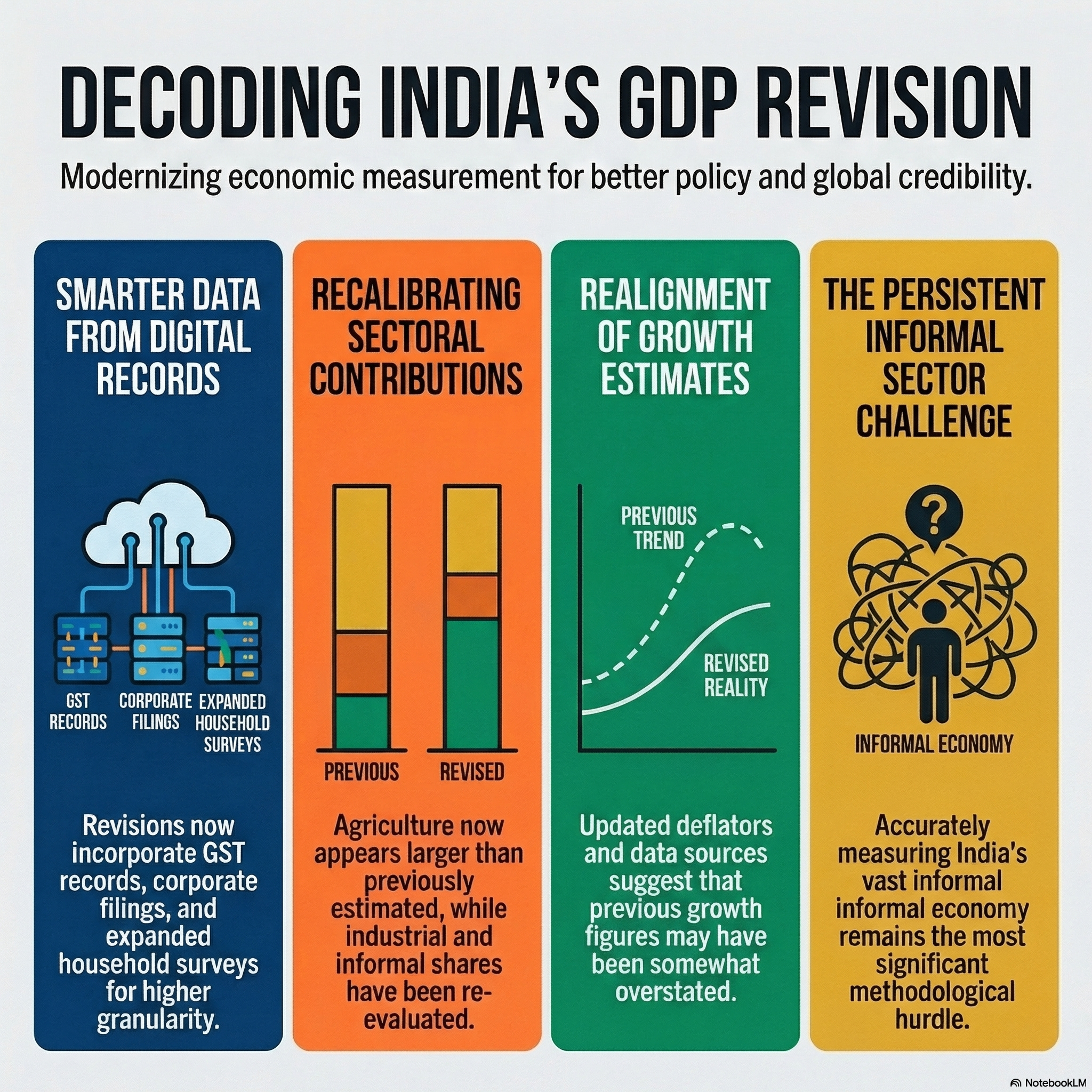
The article highlights that the revised series uses more comprehensive datasets such as GST records, corporate filings, and expanded surveys of enterprises and households.
Such improvements enhance the reliability and granularity of economic statistics.
Changes in Sectoral Contributions
One of the key outcomes of the revision is a recalibration of sectoral shares in GDP. The agricultural sector appears larger than previously estimated, while certain industrial and informal sector components have been re-evaluated.
This adjustment reflects updated measurement methods rather than sudden structural shifts.
Impact on Growth Estimates
The revised GDP series suggests that earlier growth estimates may have been somewhat overstated. Adjustments in data sources and deflators have altered growth calculations for recent years.
The article emphasises that such revisions are common in national accounting systems worldwide.
Challenges in Measuring the Informal Economy
India’s large informal sector remains difficult to measure accurately. Even with improved datasets, capturing the full scope of informal economic activity remains a methodological challenge.
The article points out that statistical revisions attempt to address this limitation but cannot completely eliminate measurement gaps.
Author’s Stance
The author adopts a cautiously analytical position. While acknowledging the improvements in statistical methodology, the article also raises concerns about inconsistencies between old and revised data series.
The tone suggests that statistical revisions should be interpreted carefully and accompanied by transparent explanations.
Possible Biases
Critical Statistical Perspective
The article focuses on methodological scrutiny, which may highlight limitations more strongly than improvements.
Data Transparency Emphasis
The author emphasises transparency and statistical credibility, potentially reflecting a broader concern about trust in official data.
Economic Interpretation Bias
The article may implicitly suggest that statistical revisions could affect policy narratives about economic performance.
Advantages of GDP Revision
Improved Statistical Accuracy
Updating the base year and methodology ensures that GDP estimates reflect current economic realities.
Better Policy Formulation
Accurate economic data enables governments to design more effective fiscal and development policies.
International Comparability
Revisions align India’s national accounts with global statistical standards.
Recognition of Structural Transformation
Changes in sectoral contributions highlight evolving patterns of production and employment.
Concerns and Limitations
Data Discontinuity
Frequent revisions create difficulties in comparing long-term economic trends.
Informal Sector Measurement
Large segments of India’s economy remain difficult to quantify.
Public Trust in Statistics
Discrepancies between different GDP series may generate confusion or scepticism.
Policy Interpretation Challenges
Statistical revisions can complicate the assessment of government performance and economic outcomes.
Policy Implications
Strengthening Statistical Institutions
Investment in data collection systems and statistical capacity is essential for improving economic measurement.
Enhancing Transparency
Clear communication about methodological changes helps maintain public confidence in official statistics.
Expanding Data Infrastructure
Greater use of digital economic records, enterprise surveys, and administrative databases can improve statistical accuracy.
Integrating Informal Sector Data
Developing innovative methods to measure informal economic activity remains a key priority.
Real-World Impact
If statistical revisions improve accuracy:
• Better economic policymaking
• Improved fiscal planning
• Enhanced credibility of economic data
If statistical uncertainty persists:
• Policy misinterpretation
• Reduced investor confidence
• Difficulty in long-term economic planning
Alignment with UPSC GS Papers
GS Paper III
Indian economy, GDP measurement, economic growth, statistical systems.
GS Paper II
Governance and institutional capacity, role of statistical institutions.
GS Paper IV
Transparency, accountability, and credibility in public institutions.
Balanced Assessment
Revisions in GDP series are a routine but important exercise in national accounting. They reflect efforts to incorporate new data sources, capture structural changes in the economy, and improve measurement accuracy.
However, such revisions must be accompanied by transparency and robust statistical communication to ensure that policymakers, researchers, and the public interpret economic data correctly.
Future Perspective
As the Indian economy becomes more complex and digitalised, economic measurement will require continuous methodological refinement. Strengthening statistical institutions, improving data quality, and developing better methods to capture the informal sector will remain crucial.
For civil services aspirants and policymakers, the debate over GDP revisions highlights the importance of reliable data in shaping economic policy and public discourse.
